
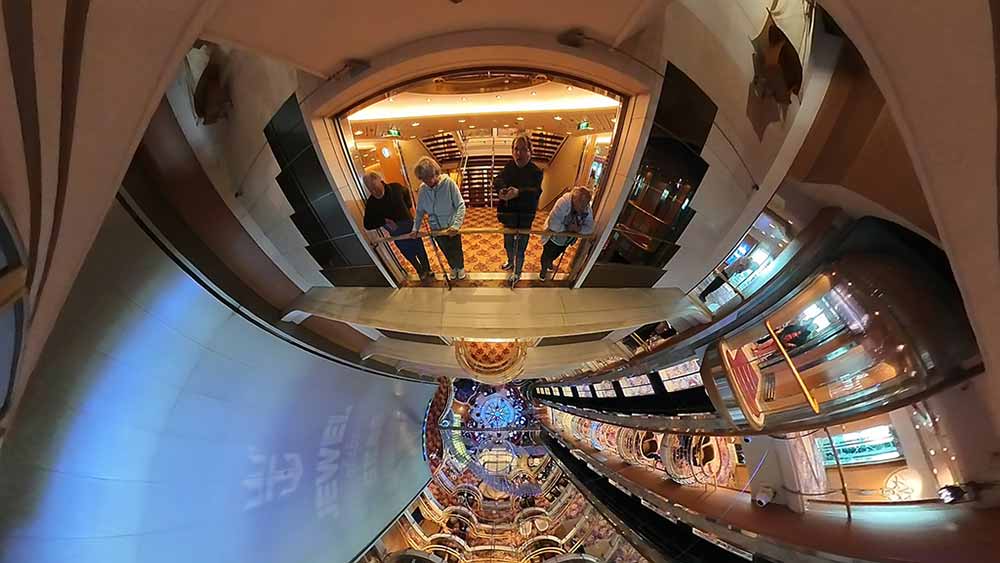
It's a long way down from the 11th deck to the fourth aboard the Jewel of the Seas. We sailed with Royal Caribbean for an incredible 12-day cruise around the British Isles, with stops in Scotland, Ireland, Wales, England, and three days in Amsterdam. If you "use your common sense," you'll read this month's extra special newsletter to see all the interesting places we visited (and learn where that mini quote came from.) Photo by Glenn.
September 28, 2023: We’ve just returned from our first trip to Europe, and what better way to celebrate the 300th edition of our family newsletter than with a look back at what could have been one of the greatest adventures of our lifetime. Make no mistake, it was an adventure, but not for all the reasons we’d hoped as we brought home more than just photographs and souvenirs.
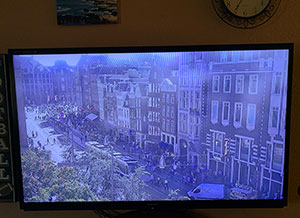
We're looking at a live cam of Damrak, a street in Amsterdam, Netherlands. It is 8:34 a.m. (our time) on Saturday morning, Aug. 12. We watch this camera often on YouTube, along with others from around the world. Never did we imagine that one day we'd be standing on this street in the middle of all the hustle and bustle of one of Europe's most majestic cities, but we are just a few hours away by plane from doing exactly that. Let our Amsterdam adventure begin! Photo by Glenn.
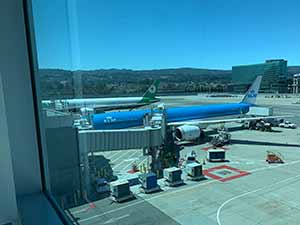
Our chariot awaits. KLM Flight 606 is getting ready to board at Gate A5 in San Francisco International Airport. Photo by Glenn.
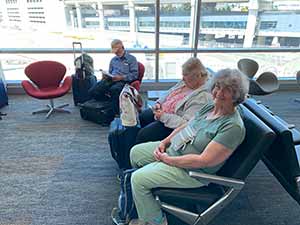
Dad, Roni and Mom wait in the upstairs lounge for our boarding call. Our flight is scheduled to leave at 1:50 p.m. Photo by Glenn.
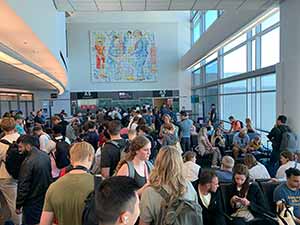
It's a zoo as passengers queue up to board. We're in Premium Economy, so we're in the second boarding group, but the gate seems so far away. Photo by Glenn.
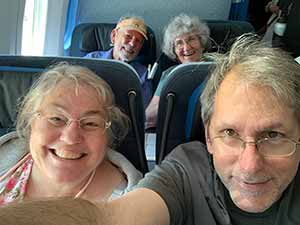
We made it! We booked our seats months ago so we could all sit in the same section. At this point the stress of planning for the trip is mostly over and we're happy to finally be underway. Photo by Glenn.
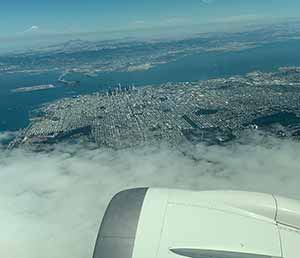
Saying goodbye to San Francisco as our Boeing 787 climbs to cruising altitude moments after departure from SFO. Photo by Glenn.
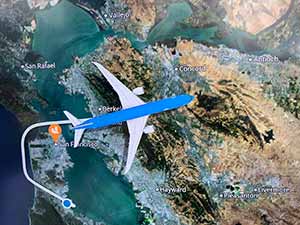
It's a big plane, but not this big. The computer flight tracker makes it look as if we're shading the entire East Bay. Look out, Antioch, we're headed your way! Photo by Glenn.
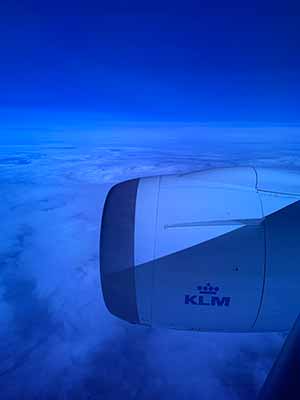
The flight crew is in control of our windows and has "pulled the shade" on our view. The windows of these planes have a gel that can be controlled to let in light or block it out with the touch of a button. It's nighttime at our destination, so maybe they figured anyone from Amsterdam would want to sleep during the flight, but for us Californians it was barely noon. Photo by Glenn.
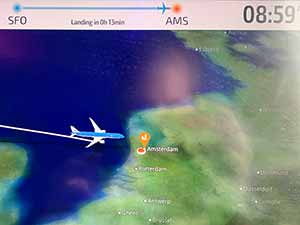
Making our descent into Amsterdam, right on time. Photo by Glenn.
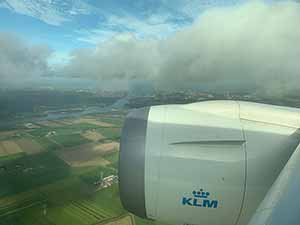
We get our first look at the Dutch countryside once the plane emerges from the clouds. It's been raining much of the month of August, but we're expecting better weather for our visit. It's about 9 a.m. Sunday morning. Photo by Glenn.
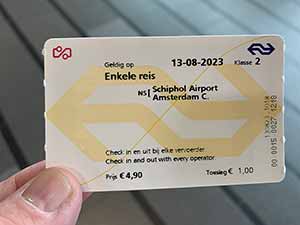
Our ticket for the train that will take us from Schiphol Airport to Amsterdam Centraal Station. The transit system here is incredibly reliable and affordable. Photo by Glenn.
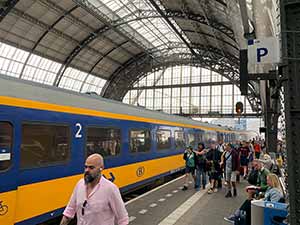
End of the line. Passengers disembark at Amsterdam Centraal Station. Photo by Glenn.
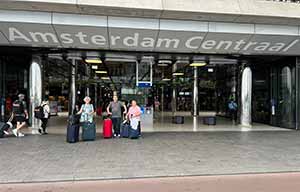
We pose for a photo with our luggage at the rear of Amsterdam Centraal Station. It is just a short walk from here to our hotel. Photo by Glenn.
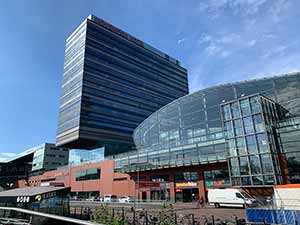
The Mövenpick Hotel is located right next to the cruise terminal. We're in the big tower on the 14th floor. Photo by Glenn.
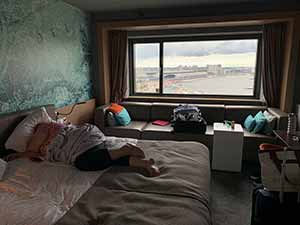
After a long travel day we looked forward to some time to sleep in the room. Outside the window is a sweeping view of the IJ and the Amsterdam waterfront. Photo by Glenn.
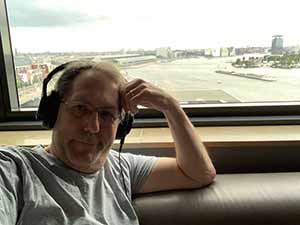
Glenn kicks back to some music on the sofa by the window. Photo by Glenn.
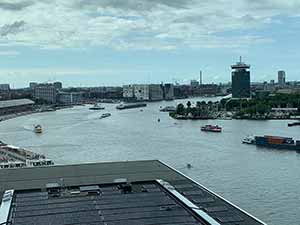
This view made staying at the Mövenpick totally worth it. It's a busy afternoon on the river with all the barge and ferry traffic. The tower at the right is A'Dam Lookout, where for a few euros you can go to the top for a better look at the city. We like our view well enough, however. Photo by Glenn.
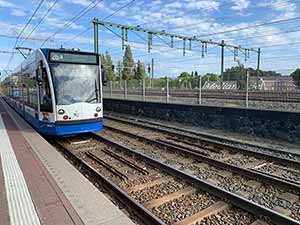
The 26 Line tram slows to a stop outside our hotel. We're going to ride it back to Amsterdam Centraal to do some sightseeing. Photo by Glenn.
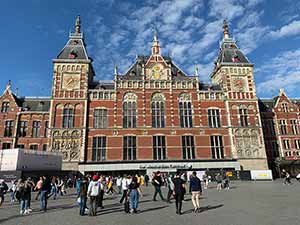
This is the front view of Amsterdam Centraal. It looks even more impressive in person. Photo by Glenn.
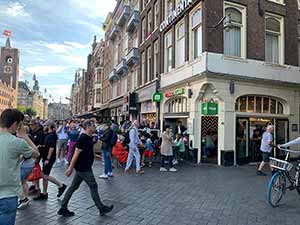
It's late Sunday afternoon and the city is alive with people. We are at the corner of Damrak and Oudebrugsteeg, about a half mile from Dam Square. Photo by Glenn.
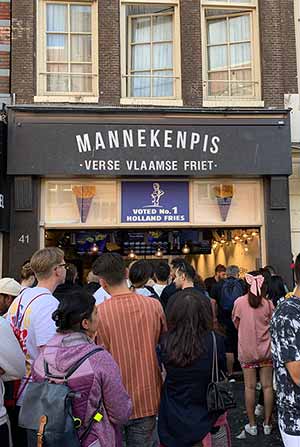
The Dutch people love their fried potatoes, and few places in Amsterdam are as popular as the Manneken Pis (named for the famous statue in neighboring Denmark.) The preferred sauce is mayonnaise, but the shop also serves its fries with ketchup as well as more than a dozen other toppings. The portions here were very generous, and although we didn't eat here because the line was massive, it looked like one serving would be enough for an entire family. Photo by Glenn.
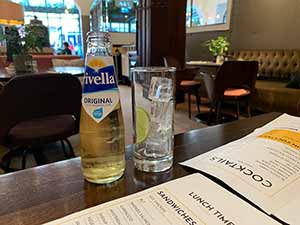
We stopped for dinner at the Brasserie De Rood Leeuw on Damrak. We ordered drinks, including this ginger ale, which were served in unrefrigerated bottles. Ice, if you could find it, was a rare treat. This was standard fare for most of the restaurants we visited. Photo by Glenn.
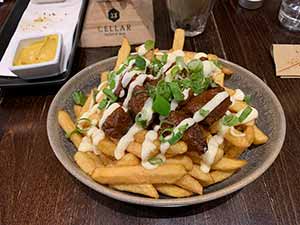
Glenn didn't have much of an appetite, so he ordered a side dish called Stoverij, which is a Flemish beef stew served over fries and topped with mayonnaise and scallions. This "small side" could have fed all four of us at the table. Photo by Glenn.
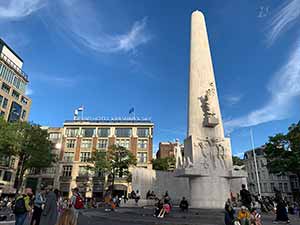
We made it to Dam Square after dinner. The recently refurbished National Monument tribute to war dead stands in the foreground, with the Anantara Grand Hotel Krasnapolsky in the distance to the left. Photo by Glenn.
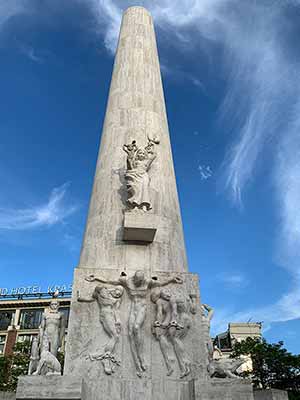
A closer look at the National Monument reveals the intricate sculptures that surround its base. A curved wall surrounding this contains an inscription that unfortunately had no English translation. Photo by Glenn.
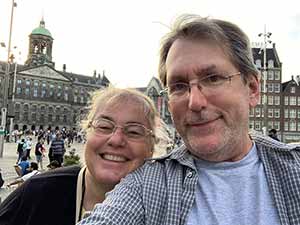
We pose together in Dam Square. Behind us to the left is the Royal Palace. Photo by Glenn.
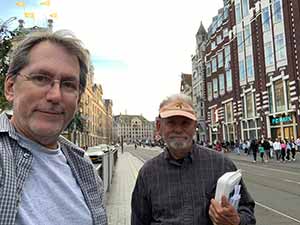
Dad and Glenn wait on Damrak to catch the tram back to Amsterdam Centraal Station. We are all very tired from our exploration. Saturday and Sunday essentially became one day, and we've been on the go for most of the past 18 hours. It's 8:15 p.m. here, but just past midnight Sunday back home and it feels like it. Photo by Glenn.
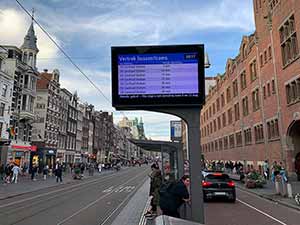
An electronic sign displays the schedule for trams arriving at this stop on Damrak. Each line runs at roughly 15-minute intervals, and there are two lines, the 14 and 24, that stop here. Both return to Centraal Station. Photo by Glenn.
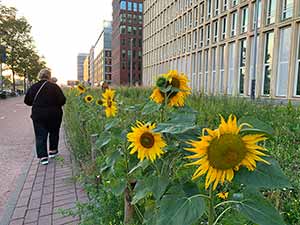
A garden of sunflowers lines the walkway leading back to our hotel. Note that Roni is walking on the brick pedestrian path, which is much narrower than the bike trail beside it, where cyclists zip along at freeway-like speeds. Amsterdam is made for bicycles, but it is not especially pedestrian friendly. Photo by Glenn.
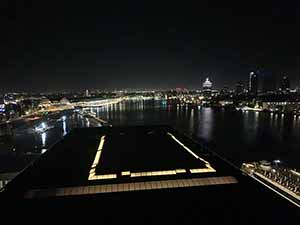
The night view of the city from our hotel room. Words can't describe what a beautiful place this is. Photo by Glenn.
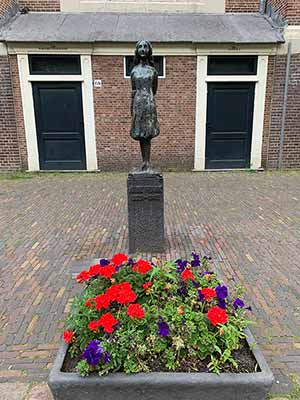
A statue of Anne Frank stands outside Westerkerk Church in the Jordaan neighborhood, several blocks west from Dam Square. We are here today for a tour of the Anne Frank House, made famous as the World War II hiding place of a young Jewish girl and her family from the Nazis. Photo by Glenn.
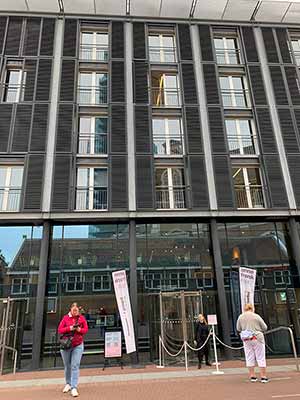
This is how the Anne Frank House looks today. The house and all its rooms have been encased by a modern museum where admission is by reservation only. We had to book our tickets on July 4 for our 9 a.m. visit on Aug. 14; they sell out within minutes of going on sale. No photos are allowed inside the museum. Photo by Glenn.
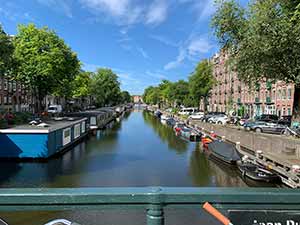
Looking down a canal that runs outside the Anne Frank House. Amsterdam is filled with canals exactly like this one, lined with liveaboards, pleasure boats, water taxis andtour boats. Photo by Glenn.
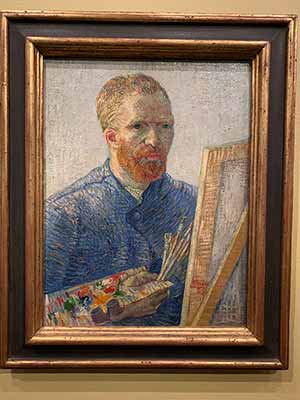
Yes, that's an original Vincent Van Gogh. One of the artist's many self-portraits resides at the Van Gogh Museum in the Museumplein park district. Photo by Glenn.
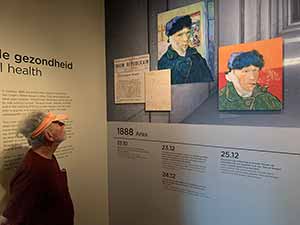
Van Gogh was plagued by mental health issues in his latter years, leading him to famously cut off his own ear. Dad reads a timeline of the artist's tormented final years that includes self-portraits of Van Gogh after losing his ear. Photo by Glenn.
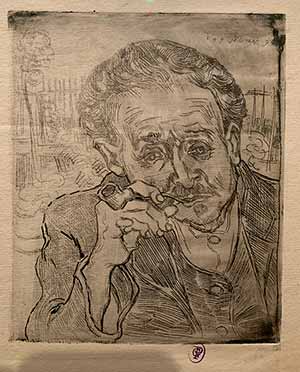
Van Gogh worked in several mediums aside from oil paints. This print of Dr. Paul Ferdinand Gachet is one in a series of etchings Van Gogh made that was part of a special exhibition at the museum that was taking place when we visited. Photo by Glenn.
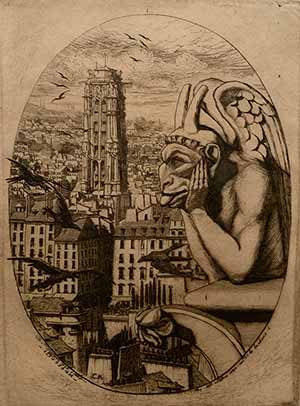
Vincent Van Gogh's etching of Notre Dame Cathedral in Paris. Photo by Glenn.
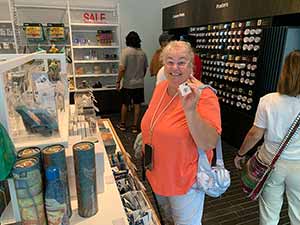
Roni shops for souvenirs at the Van Gogh Museum. She was vary excited to find this gift shop, as the one they had at the Immersive Van Gogh Experience we went to in San Francisco was woefully understocked. Photo by Glenn.
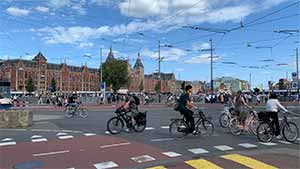
The Monday afternoon commute in Amsterdam is crazy hour for bicycles. If you visit this city and don't have to jump out of the path of a cyclist at least once, then props to you. Photo by Glenn.
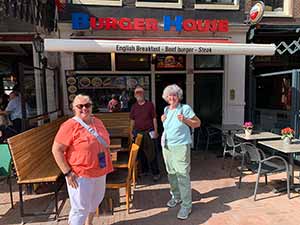
Burger House on Martelaarsgracht was where we chose to eat our late lunch after the Van Gogh Museum visit. It was an odd little hole in the wall that served American-style food and had no air conditioning on a day that needed some. Photo by Glenn.
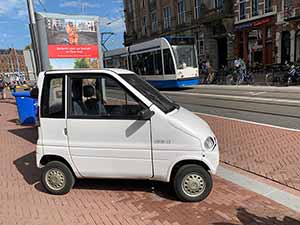
This unusual little car is a Canta LX, and you can find them all over Amsterdam. They are small enough that they can be legally driven on the bicycle paths. Photo by Glenn.
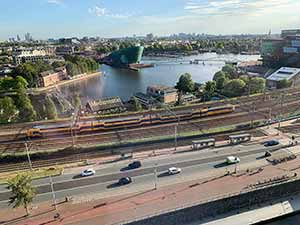
A different view of the city, looking south from our hotel. Here you can see the light traffic on Piet Heinkade, the tram station where the 26 Line runs, and a commuter train making its way along the group of tracks leading out of Amsterdam Centraal. The large wedge-like building in the middle of the frame is the NEMO Science Museum, which is shaped like a sinking boat. Photo by Glenn.
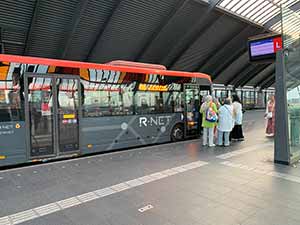
The 391 R-Net bus to Zaandam collects passengers at Amsterdam Centraal Station. We scouted it out a day early because we wanted to make sure we had the correct bus to take us to Zaanse Schans the following morning. Photo by Glenn.
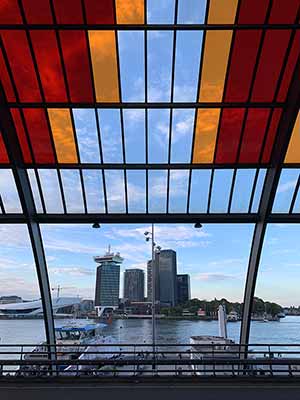
The roof over the bus terminal is fashioned from colorful stained glass panes. Across the IJ can be seen A'Dam Lookout along with apartment and hotel buildings. The passenger ferry to reach the other side runs 24/7 and is free. Photo by Glenn.
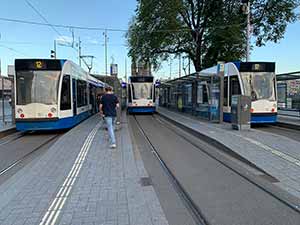
Trams wait to collect passengers outside Amsterdam Centraal Station. They run most of the day and night. Photo by Glenn.
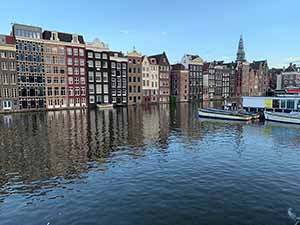
Colorful canal houses line the water's edge across from Damrak. The steeple in the distance belongs to De Oude Kerk, the oldest building in Amsterdam, which dates to the 14th century. Photo by Glenn.
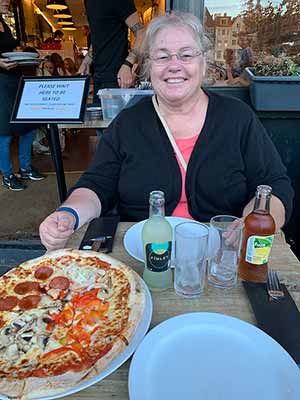
We ordered a "Four Seasons" pizza from the Pizza Pasta Bar on Damrak. The delicious pie was so named because each quadrant featured one topping. Photo by Glenn.
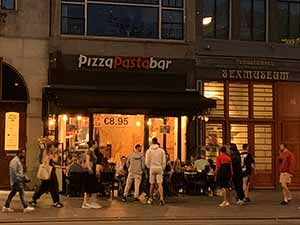
The Pizza Pasta Bar is located next door to the Sex Museum. The former was open late; the latter was closed for the evening. Photo by Glenn.
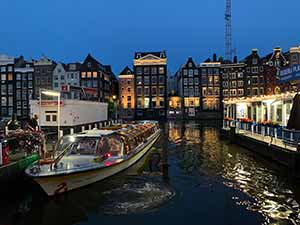
A tour boat returns to the dock across from the canal houses. At night, Amsterdam looks a bit like a Christmas village scene. Photo by Glenn.
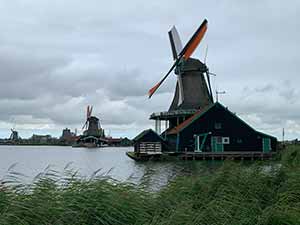
Aug. 15 finds us at Zaanse Schans, a collection of traditional Dutch windmills where visitors can tour inside and see various traditional crafts performed. The rain kept us company this day. Photo by Glenn.
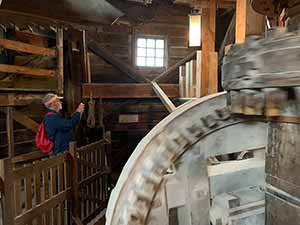
Dad photographs the gears inside De Kat, one of the windmills where paint pigment is still made to this day. Photo by Glenn.
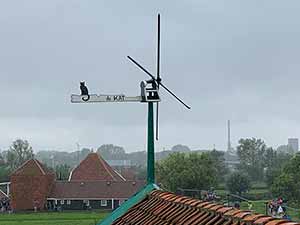
A weathervane on De Kat includes a cat perched on its tail. Photo by Glenn.
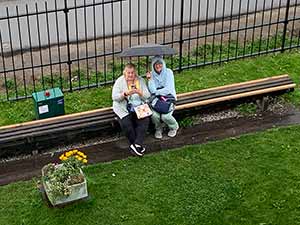
Mom shares her umbrella with Roni as they wait out the rain outside De Kat windmill at Zaanse Schans. Roni had wisely packed umbrellas for our trip, but unfortunately on this day she didn't bring them, nor did Glenn have his rain jacket. So much for our insurance policy. Photo by Glenn.
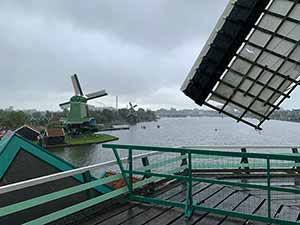
Standing on the outer deck of De Kat and facing south along the Zaan river, one can see two of the other windmills (with Dutch names too long to mention here.) Photo by Glenn.
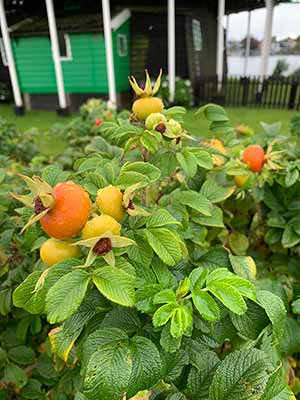
Raindrops cling to rose hips outside the De Zoeker windmill. Photo by Glenn.
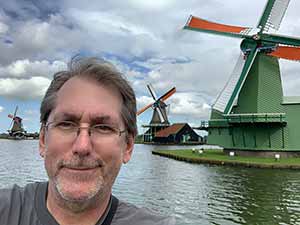
To paraphrase from Don Quixote, "What you see over there aren't giants; they're windmills." Yeah, and we're tilting at them. Photo by Glenn.
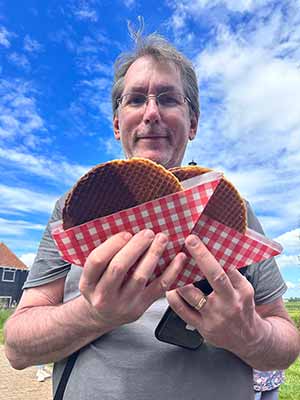
Glenn holds a pair of Stroopwafels purchased from a stand at Zaanse Schans. They are basically ice cream cone-like waffles with a caramel sauce sandwiched inside and coated with chocolate. They were very tasty — and very messy. Photo by Roni.
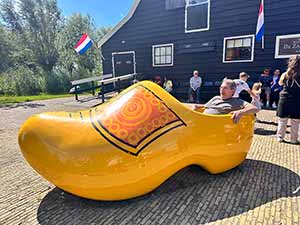
When Glenn says he's putting his foot down, he really means it! Photo by Roni.
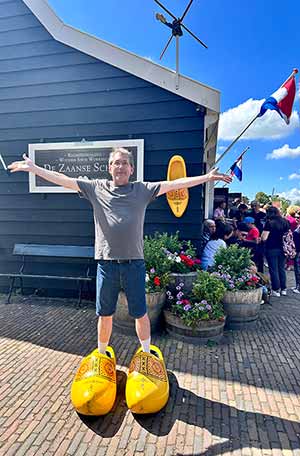
The fun we had visiting Zaanse Schans left some mighty big shoes to fill for the rest of our vacation. These appear to be about a size 30. Photo by Roni.
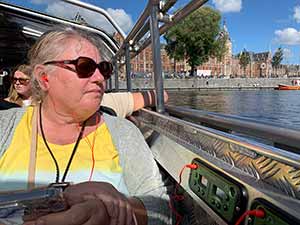
Back in Amsterdam, we are preparing to depart on an hourlong canal tour of the city. Roni has her earbuds in to hear the English translation of the audio tour. Photo by Glenn.
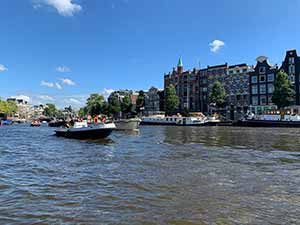
Pleasure boats, tour boats and liveaboards can all be seen along our journey through the busy canals. Photo by Glenn.
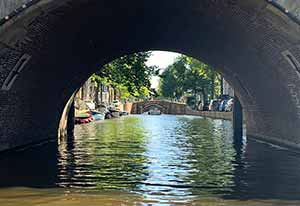
We were told that if you look through this canal tunnel you will see seven crossings up the canal. We'll have to take our guide's word for it, but there are numerous canal crossings throughout Amsterdam, which is sometimes referred to as "Venice of the North." Photo by Glenn.
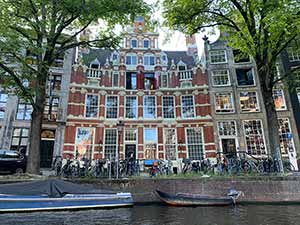
A nobleman's home sits along a canal. Dozens of bicycles are parked on the grass close to the edge. It is estimated that each year the city removes about 20,000 bikes that find their way into the canals. Photo by Glenn.
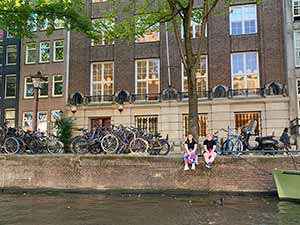
Two girls watch from the bank as our boat passes by. Photo by Glenn.
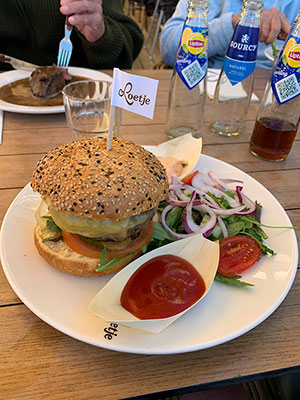
Our final night in Amsterdam brought us to Loetje for dinner. Wow, a real hamburger with real ketchup. Photo by Glenn.
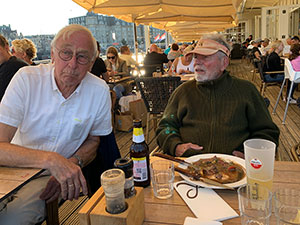
Dad has not enjoyed the lemon Amstel beer he ordered, and his rant caught the attention of a gentleman at the next table. The man lends a sympathetic ear as Dad explains the situation. Photo by Glenn.
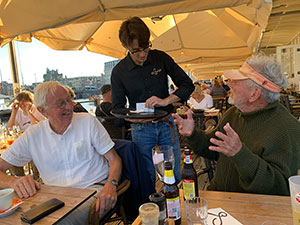
What a beautiful moment. Dad's new friend had the waiter bring over a better beer called Texels. Photo by Glenn.
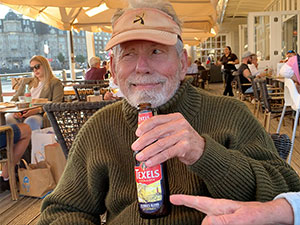
Dad's a little skeptical as he prepares to take his first sip. Photo by Glenn.
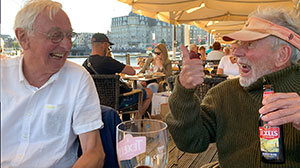
Hey, it's really good! (Thank you, kind soul, whoever you are. You made Dad's day and the top of our Amsterdam highlight reel all at once.) Photo by Glenn.
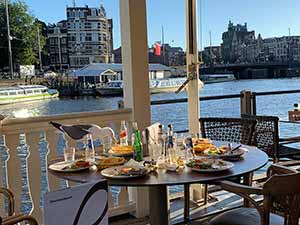
A seagull enjoys a free meal, courtesy of the Loetje waitstaff. Photo by Glenn.
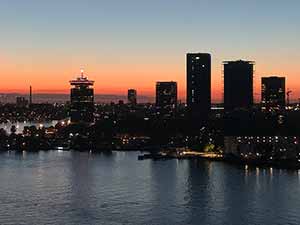
The sun sets on Amsterdam. What a beautiful city. We'll miss you. Photo by Glenn.
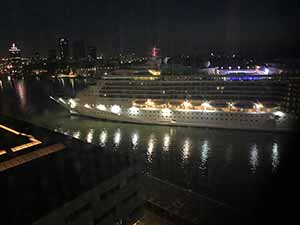
Our ship has come in. The Royal Caribbean Jewel of the Seas turns around before docking outside the Amsterdam Cruise Terminal around 5:15 in the morning. Photo by Glenn.
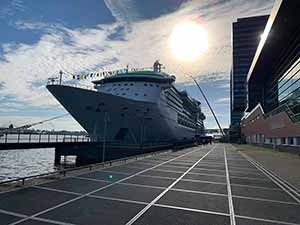
The sun rises over the Jewel of the Seas as she is made ready for our sailing in a few hours. Photo by Glenn.
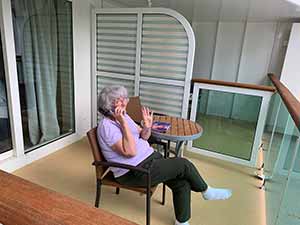
Mom chats on the phone with our niece Shannon while sitting on the balcony of her cabin as we prepare to depart from the dock. She and Dad were in room 7168 while we were next door in 7166. Photo by Glenn.
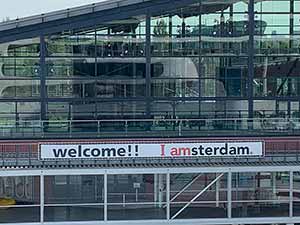
A little late to welcome us now as we're leaving, but we had a great time. See you again in 12 days. Photo by Glenn.
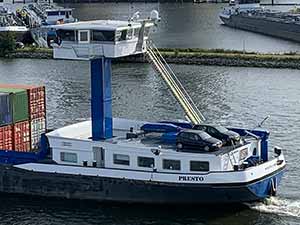
A barge along the IJ has cars parked on its roof. We thought this was unusual until we realized that all the barges do this, presumably so their crews can get around on land whenever they are in port. But how do they get up there? Photo by Glenn.
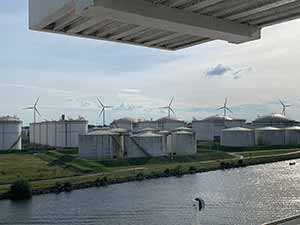
Windfarms and fuel storage tanks line the banks of the North Sea Canal as we head west to the ocean. The land between Amsterdam and the coast is essentially one long industrial park. Photo by Glenn.
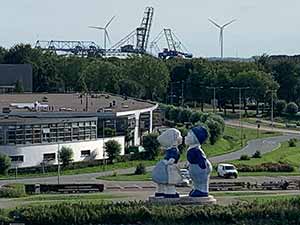
This sculpture, known as The Kissing Couple XXXL, is located near the entrance to a ferry slip about 5 miles from central Amsterdam. Erected in 2017 and standing approximately 30 feet tall, it features the familiar Delft Blue characters that can be purchased from just about every gift shop in the Netherlands. Photo by Glenn.
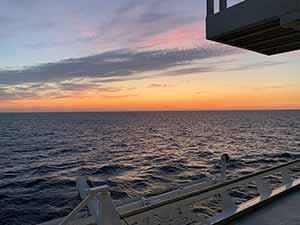
We've made it out to sea just in time for sunset, Now our cruise adventure really begins. Photo by Glenn.
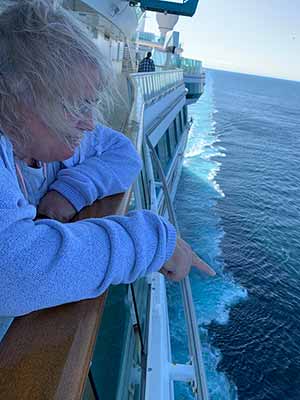
There's not much to do on our first day at sea except explore the boat and enjoy the view. Roni spots something in the waves, but it isn't a whale. Supposedly you can find them in the North Atlantic, but we never saw a single living sea creature while on the cruise ship — just lots of seagulls. Photo by Glenn.
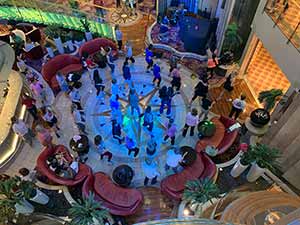
Cruisers take part in a Latin dance class in the Centrum. There were lots of activities on board, but we avoided most of them. Photo by Glenn.
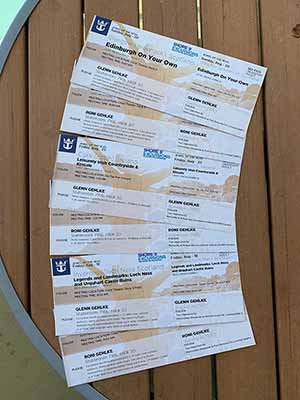
Tickets for our various shore excursions were delivered to our stateroom. Photo by Glenn.
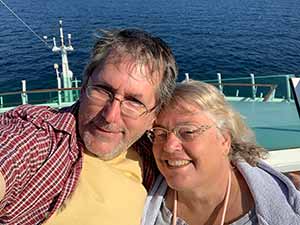
We pose for a picture near the bow of the cruise ship. It was very windy on our first day at sea, but fortunately not too cold. Photo by Glenn.
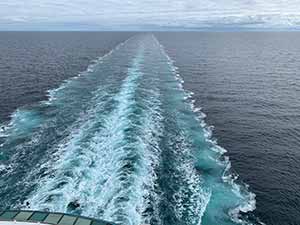
Our ship carves a turbulent path through the sea as we journey toward Scotland. Photo by Glenn.
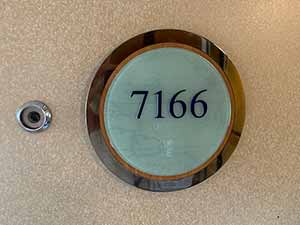
The door to our cabin. Some folks go all out to decorate their doors, but we haven't become diehard cruisers yet, apparently. Photo by Glenn.
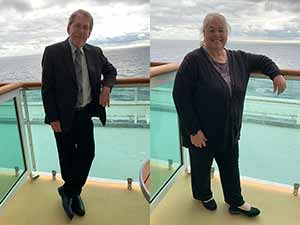
It's formal night. This is about the only time you'll get us this dressed up. We mainly wanted to look good for photos. Photos by Roni and Glenn.
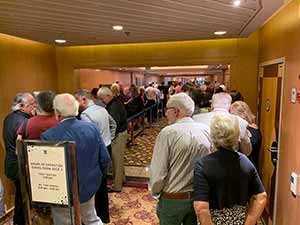
Everyone wants to eat in the main dining room on formal night. Our wait in this line for an unreserved table was at least 45 minutes. Photo by Glenn.
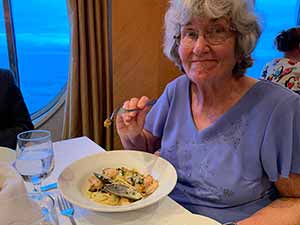
Mom enjoys her seafood pasta during our fomal night meal. Photo by Glenn.
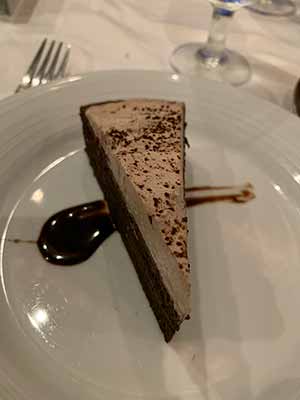
Mmmmm, cheesecake. You can never go too wrong with cheesecake... Photo by Glenn.
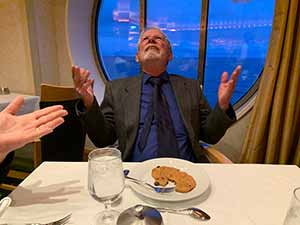
...But you can go wrong with chocolate chip cookies, as Dad discovered. They were hard, not soft, and Dad made a production of stabbing them with his fork. "Why does this keep happening to me?" he implored. Photo by Glenn.
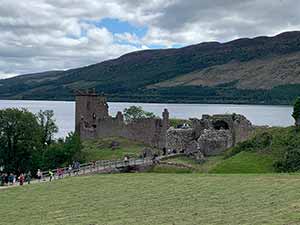
We've reached Scotland. This is Urquhart Castle — or rather what's left of it — along the shore of Loch Ness, home to the legendary mythical sea monster. Photo by Glenn.
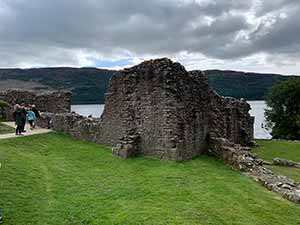
The castle was laid to waste in 1690 during one of many raids that occurred in its long history. You can still see many of the original stones, although parts of it have been hauled away over the centuries. Photo by Glenn.
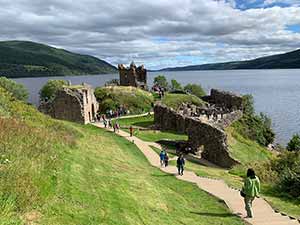
Steps lead from the upper level of Urquhart Castle to the lower buildings. The structure on the left is the gatehouse, which was destroyed by fleeing troops in 1690. The tall structure in the middle is Grant Tower, which partially collapsed during a storm in 1715. Photo by Glenn.
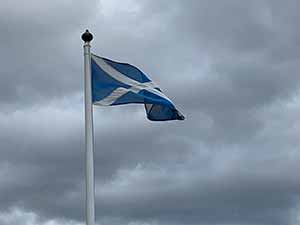
The Scottish flag waves above Urquhart Castle in a stout breeze as storm clouds threaten overhead. Photo by Glenn.
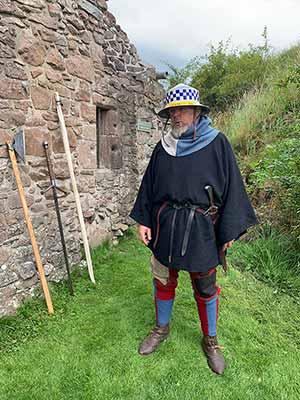
A docent is dressed as a gatehouse guard to demonstrate the clothing, customs and weapons of the Middle Ages. Photo by Glenn.
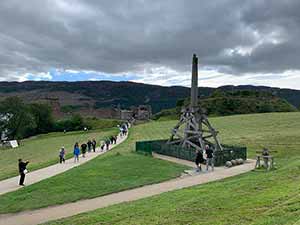
Remnants of a trebuchet are on display on the hillside leading to the entrance to the castle. This formidable beast was used to hurl boulders and other large objects in battle during medieval times. Photo by Glenn.
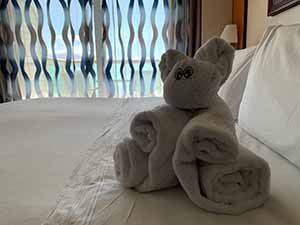
Our cabin steward Jason was new to the job and spent much of our cruise attending training classes. One of the important skills taught is how to make towel animals — and it just wouldn't be the same to have an entire cruise without at least one towel animal sitting on the bed upon returning from the day's activities. This character was Jason's first creation. Is it a mouse? We kept it by our bedside for the day. Photo by Glenn.
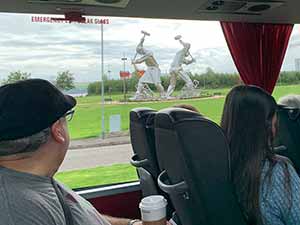
It is Sunday the 20th and we are on the bus to Edinburgh, the capital of Scotland, after landing at Greenock. just outside the port we passed this large sculpture titled "The Shipbuilders of Port Glasgow" celebrating the region's industrial might. Photo by Glenn.
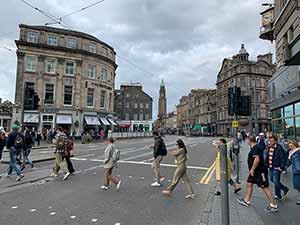
People cross Princes Street in downtown Edinburgh, most of them probably other tourists who also just got of their buses at Charlotte Square a couple of blocks away. This is where we will begin our on-your-own tour. Photo by Glenn.
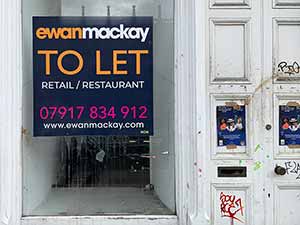
You don't lease property in the UK, you "let" it. Our eyes always tended to add the missing "I" that would have spelled something else, and every time we encountered one of these signs it reminded us that there were no public restrooms nearby when we needed one. Photo by Glenn.
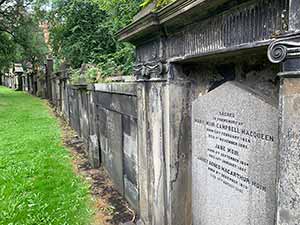
Headstones are embedded in the walls surrounding the Parish Church of St. Cuthbert. Photo by Glenn.
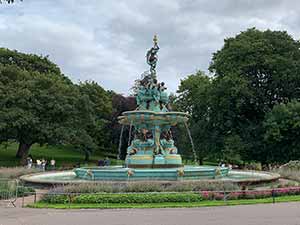
This is Ross Fountain, a 19th century cast iron fountain that serves as a centerpiece in the gardens at the foot of Edinburgh Castle. Photo by Glenn.
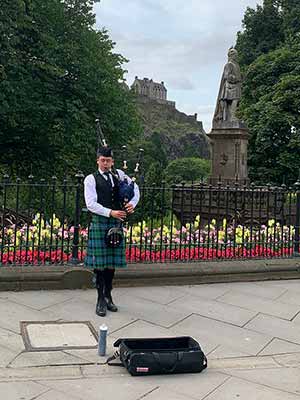
You can see Edinburgh Castle high on its hill in the distance while a bagpiper plays for the tourists at the corner of Princes Street and The Mound near the Allan Ramsay Monument. Ramsay was a celebratedpoet, playwright and collector of Scottish folk songs who lived from 1686 to 1758. Photo by Glenn.
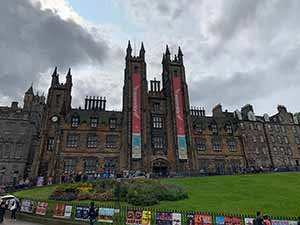
The Assembly Hall at New College, University of Edinburgh, is close to the Royal Mile. On the fence in the foreground are dozens of posters advertising live theatre shows. There is a very active LGBTQ scene in this city, which has the reputation as one of the most LGBTQ-friendly places in the world. Photo by Glenn.
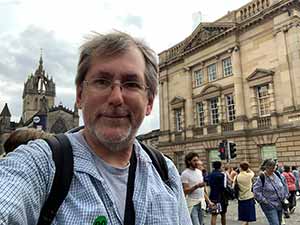
Standing at the intersection of Bank Street and Lawnmarket on the Royal Mile. St. Giles' Cathedral rises behind Glenn's right shoulder. Photo by Glenn.
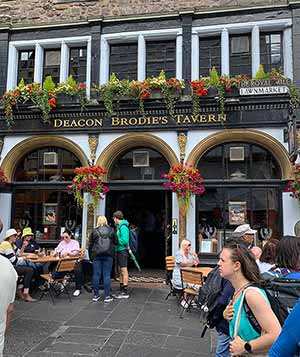
We ate lunch at Deacon Brodie's Tavern, an authentic British/Scottish pub with a solid reputation as a great place to dine. Photo by Glenn.
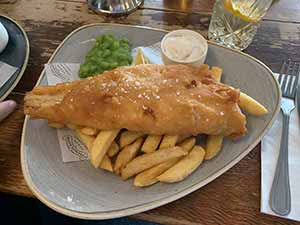
The food at Deacon Brodie's Tavern was delicious and the portions generous. This was Glenn's fish and chips, served with "mushy peas." Photo by Glenn.
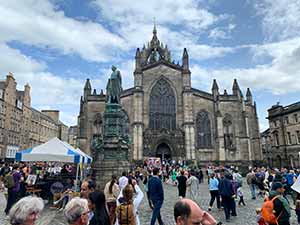
There was a huge street festival going on during our visit to the Royal Mile. We looked around for a bit in the square near St. Giles' Cathedral. Photo by Glenn.
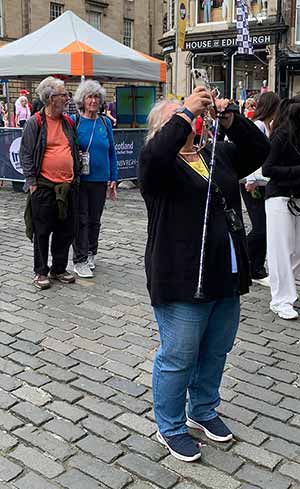
Roni takes pictures of the cathedral while Dad lends Mom a bit of moral support; this big street fair wasn't her cup of tea. Photo by Glenn.
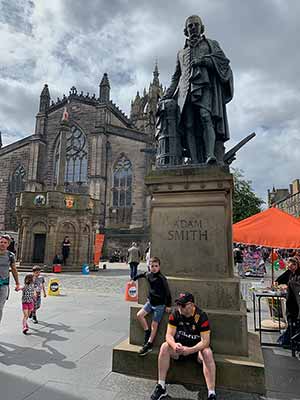
A statue of Adam Smith (1723-1790), economist and philosopher, stands in the square on the back side of St. Giles' Cathedral. Not only has his portrait graced the front of modern Scottish and UK banknotes, but the plinth of his monument makes a very convenient resting place for tired tourists. Photo by Glenn.
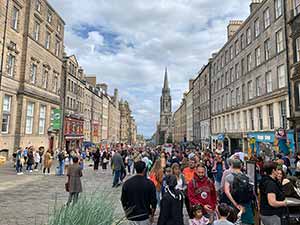
Looking west along the Royal Mile as we continue our walk down High Street. Photo by Glenn.
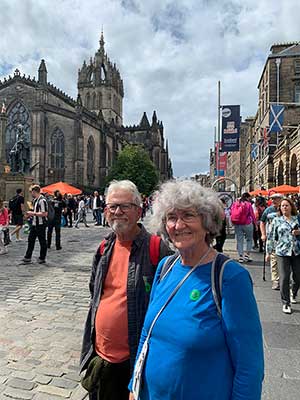
Mom manages a smile. Photo by Glenn.
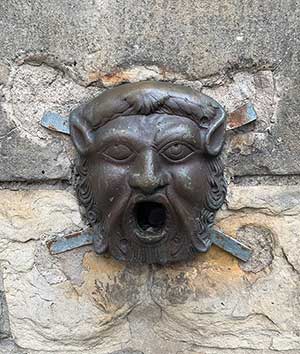
This frightening fellow is a (we think) a gargoyle on the Netherbow Wellhead, the oldest surviving cistern in the city of Edinburgh, tracing its origins to 1675. It is located on High Street along the sidewalk in front of the John Knox House and once provided water for the residents of the old central city. Photo by Glenn.
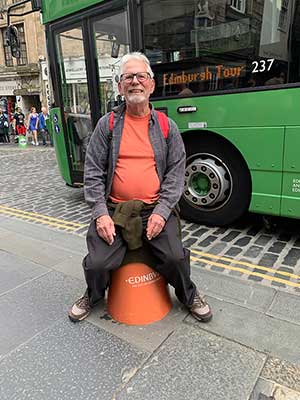
Dad finds a convenient stool along High Street on the Royal Mile. The orange of the pylon is almost a perfect match for his shirt. Photo by Glenn.
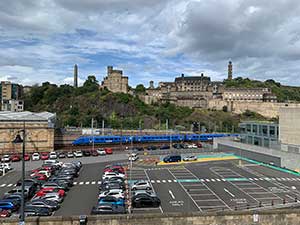
The Edinburgh Waverly train station is a massive structure in the heart of the city. We could have ridden the train here from Greenock and saved a lot of money over the tour bus, but then we would have had the challenge of figuring out the train schedules. Photo by Glenn.
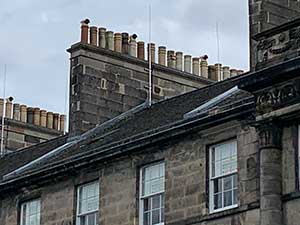
Rows of stovepipes line the rooftops of apartment structures along Charlotte Square. Chim-chiminey, chim-chiminey, chim-chim-cher-ee, a chimney sweep's lucky, as lucky can be.... Photo by Glenn.
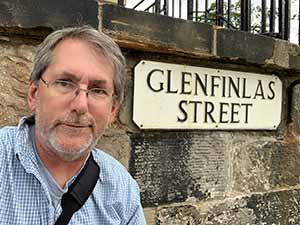
From one Glenn to another. Killing some time while waiting for the bus to collect us at Charlotte Square. Photo by Glenn.
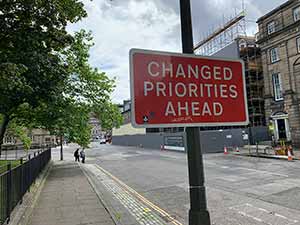
This sign is meant to inform motorists about altered traffic patterns around a road construction site, but perhaps it might also work as a motivational tool for behavioral psychologists, who knows? Photo by Glenn.
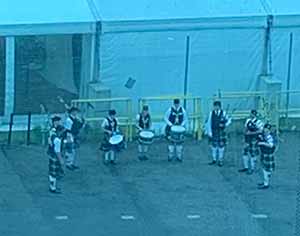
The bagpipe band performs a farewell serenade as our ship prepares to depart Greenock. We've enjoyed our couple of days visiting Scotland. Photo by Glenn.
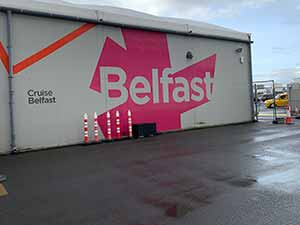
It is a rainy morning in Belfast, Ireland. With luck we'll have clear skies for most of our visit. Photo by Glenn.
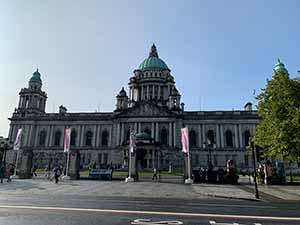
Belfast City Hall is a splendid building in the center of town surrounded by gardens and memorials. The public can go inside where there is a museum, cafe and more. We'll return here after our hop-on, hop-off tour of the city. Photo by Glenn.
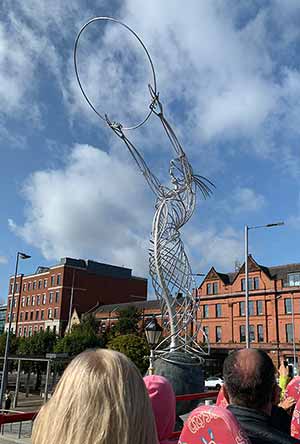
This 64-foot-tall metal sculpture is called "Beacon of Hope." It is the second largest public art installation in Belfast, and sometimes referred to by locals as "the thing with the ring." Photo by Glenn.
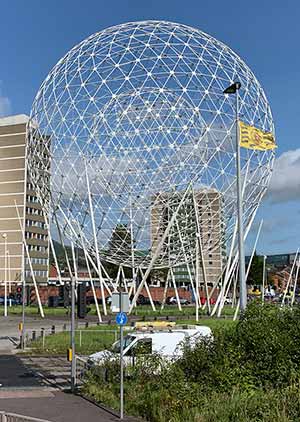
This would be the largest public art display in Belfast, titled "Rise." Located on the Broadway Roundabout at one of the main gateways to the city, the artwork features a pair of white steel globes symbolizing the rising sun and hope for a better future. Photo by Glenn.
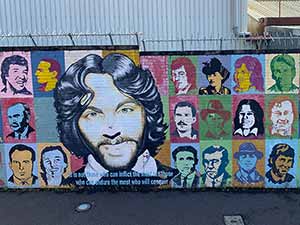
Decades of division are portrayed in the "peace wall" murals that can be found throughout Belfast, with artwork memorializing victims of "The Troubles," Catholics and Protestants alike. Photo by Glenn.
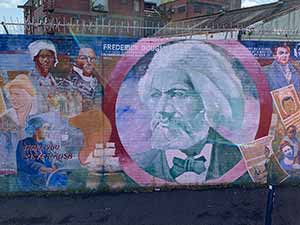
Other murals pay tribute to historical figures and events. Here we see a mural dedicated to Frederick Douglass, who rose from slavery to become a ministe, abolitionist and U.S. Minister Resident to Haiti. Photo by Glenn.
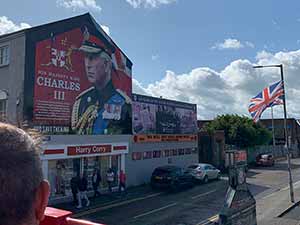
King Charles III is honored with his own mural on the wall of a Harry Corry Interiors store at the corner of Shankill Road and Argyle Street — now known as King's Corner. Photo by Glenn.
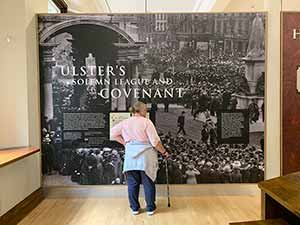
Roni checks out one of the history exhibits inside Belfast City Hall. The museum here was quite impressive. Photo by Glenn.
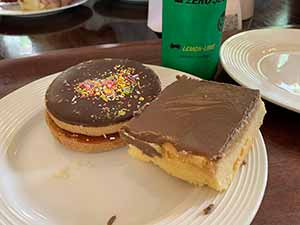
We ordered these bakery treats from The Bobbin coffee shop inside City Hall. Photo by Glenn.
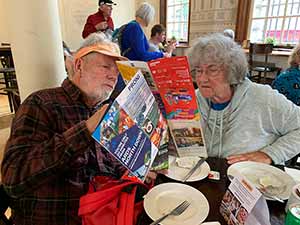
Dad and Momstudy the hop-on bus map in the cafe to see if there was anywhere we wanted to return to for a longer visit. Photo by Glenn.
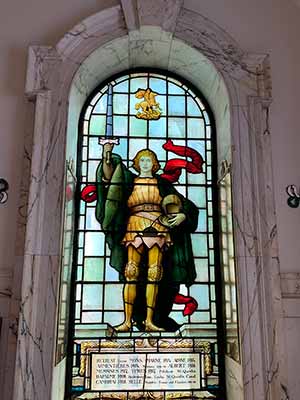
Belfast City Hall is filled with beautiful stained glass windows dedicated to historical events. This one is the World War I North Irish Horse window, dedicated in 1925 to those who lost their lives during the Great War serving in the North Irish Horse regiment. Photo by Glenn.
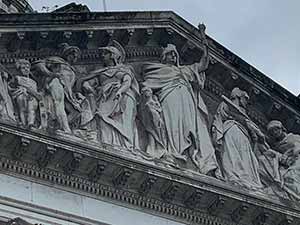
Classical sculptures stand above the portico outside the front of Belfast City Hall. Photo by Glenn.
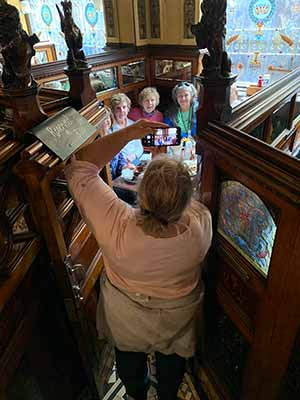
We're inside the Crown Bar, one of Northern Ireland's oldest and best known pubs. These people offered us their booth if Roni would take their photo. Photo by Glenn.
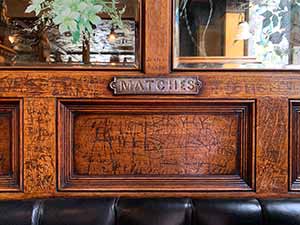
Booths in the Crown Bar date back to the Victorian era and were built by Italian craftsmen to provideprivacy for women and members of society who wanted a drink without being observed. Photo by Glenn.
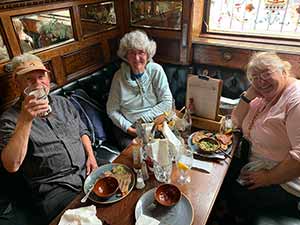
Our booth inside the Crown Bar. It was an interesting place to dine. Photo by Glenn.
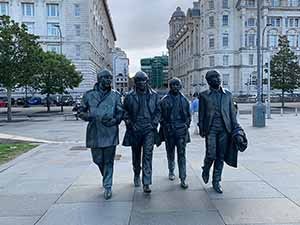
From Belfast we turn to Liverpool, England, home of the Fab Four. A bronze tribute to The Beatles stands along the waterfront and is usually mobbed with tourists. Getting a photo of it with no one else around was extraordinarily difficult. Photo by Glenn.
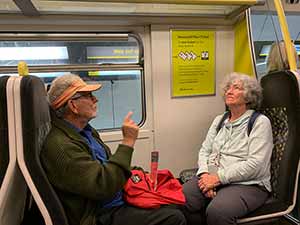
We had to take a commuter train from James Street Station in Liverpool to reach Speake Hall about a half hour south of the city where we planned to pick up a small tour of the Beatles' childhood homes. Dad was a lot more confident of this adventure than Mom. Photo by Glenn.
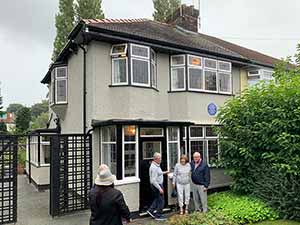
This was John Lennon's childhood home at 251 Menlove Ave., known as Mendips, wherehe lived between 1945 and 1963. It is now owned by the National Trust Photo by Glenn.
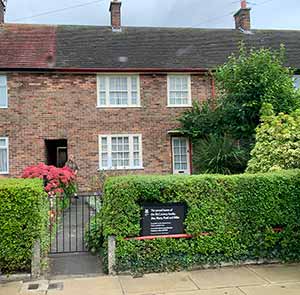
Paul McCartney lived in this terraced house at 20 Forthlin Road from around 1955 until he was in his late teens. His parents continued to live there until Paul bought his father a fancier place to live in 1965. Photo by Glenn.
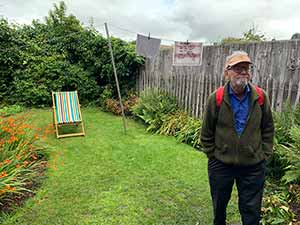
Dad stands on the back lawn of the McCartney home. Visitors are allowed to sit in the lawn chair, but it wasn't encouraged on this rainy day. Photo by Glenn.
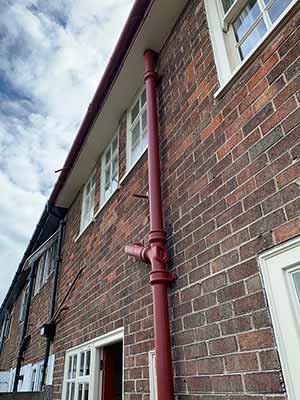
A drainpipe leads up the back wall to what used to be Paul's room, and often served as a ladder to and from the house for the young musician. Photo by Glenn.
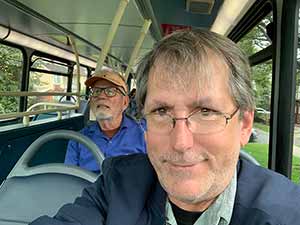
We ride a double-decker public bus from Liverpool South Parkway Station back to the heart of the city. Photo by Glenn.
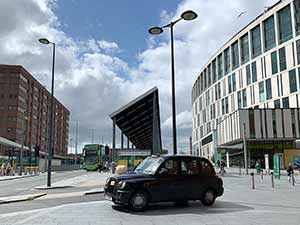
Our bus has reached the end of the line at the Liverpool ONE shopping plaza. A traditional British cab waits for passengers near the bus plaza. Photo by Glenn.
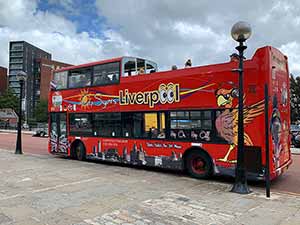
A Liverpool City Sights tour bus idles near Royal Albert Dock. We've got tickets. Photo by Glenn.
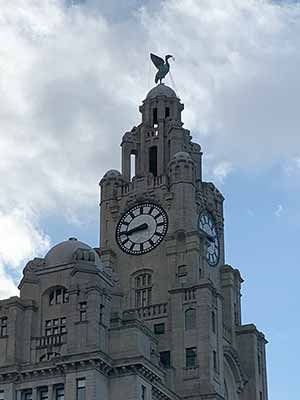
The Royal Liver Building is one of Liverpool's most iconic landmarks and features a pair of Liver Birds atop its tallest towers. Legend has it that if the birds were to fly away that the city would cease to exist. Maybe that's why they've tied them down with steel cables? Photo by Glenn.
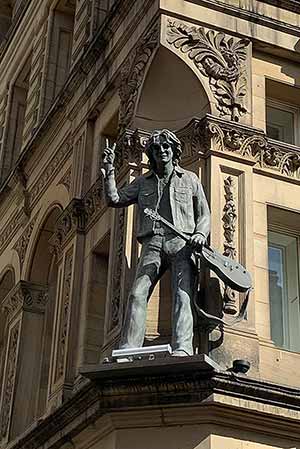
A sculture of John Lennon stands along an upper balcony of the Hard Days Night Hotel on North John Street in Liverpool. The other three Beatles are also represented on the building. Photo by Glenn.
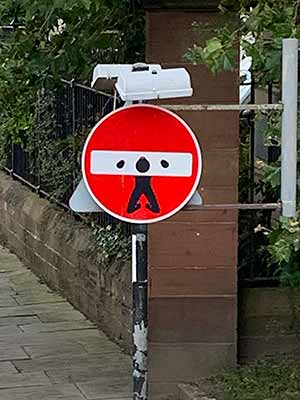
The Brits have a great sense of humor. Someone has transformed a Do Not Enter sign into a pillory. Photo by Glenn.
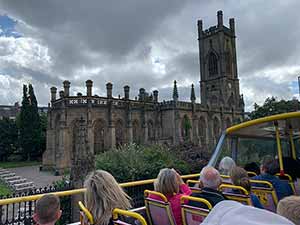
St. Luke's Church on Berry Street is literally a shell of its former self. Bombed during a German raid in World War II, the ruins still stands in the heart of Liverpool as both a war memorial and event space. Photo by Glenn.
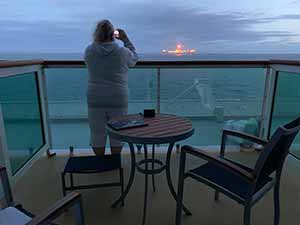
Roni photographs the flaming stack of a petroleum drilling platform somewhere in the Irish Sea as our cruise ship makes its way to Holyhead, Wales. Photo by Glenn.
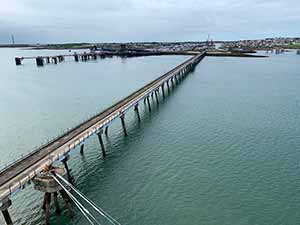
If anyone ever tells you to take a long walk off a short pier, better hope it's this one in Holyhead, Wales. Fortunately we've got a shuttle bus to take us ashore. Photo by Glenn.
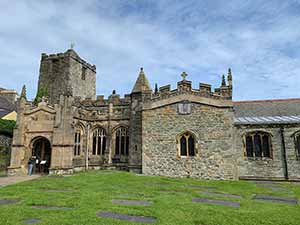
St. Cybi's Church in Holyhead was constructed around 540 A.D. Photo by Glenn.
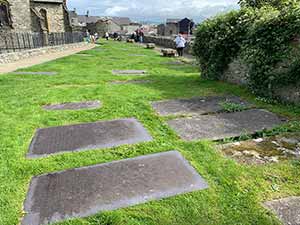
Gravestones are embedded in the grounds surrounding St. Cybi's Church. Photo by Glenn.
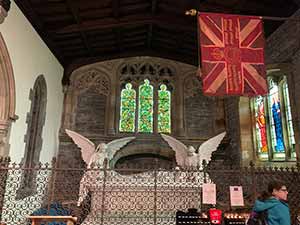
A peek inside St. Cybi's Church reveals beautiful statues, carvings, stained glass and woodwork. The place has an air of history. Photo by Glenn.
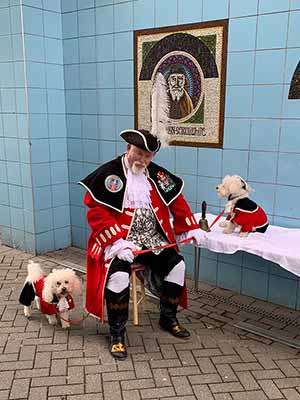
A gentleman in period attire was waiting to welcome tourists to downtown Holyhead. Town crier? Ambassador? Dog catcher? We didn't hear what his official title was. Photo by Glenn.
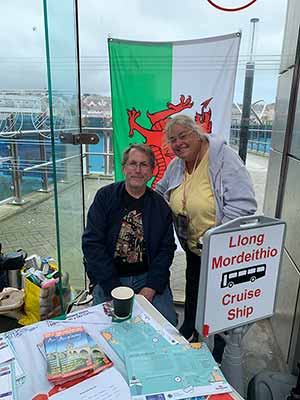
We pose for a photo with the Welsh flag at the tourist information table inside the Holyhead train station.
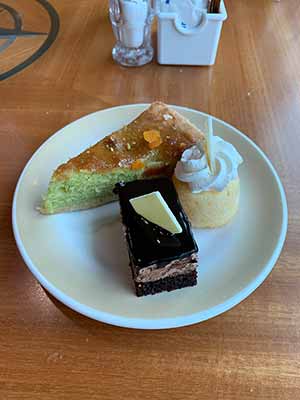
Why have one dessert when you can enjoy three? The buffet on the ship offered a daily array of tempting treats, but sadly we found that many of them weren't worth the calories. Photo by Glenn.
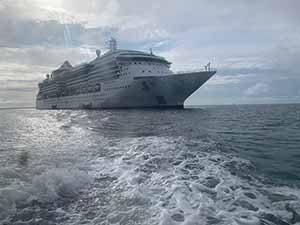
Dunmore East, Ireland, was the only port we went to that required a tender to shore. Here's how our cruise ship looked through the rear window of the tender boat. Photo by Glenn.
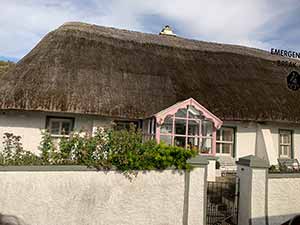
A thatched roof appears on one of the buildings we passed on our drive up to Waterford. You won't find these in America. Photo by Glenn.
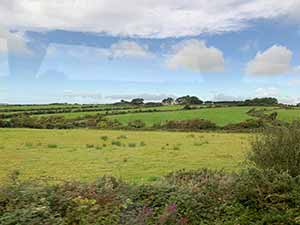
Passing the green scenery of the Irish countryside on the road to Waterford. Photo by Glenn.
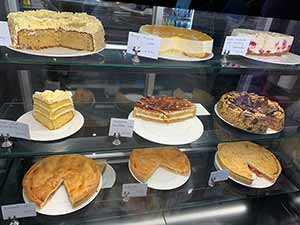
Forget the cruise ship. This bakery at the Waterford Crystal visitor center offered some truly mouthwatering baked goods. Photo by Glenn.
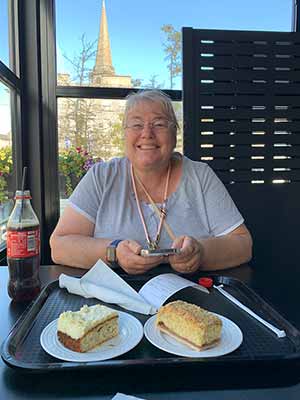
We prepare to enjoy some bakery treats while waiting for our tour to begin at the Waterford Crystal visitor center. Photo by Glenn.
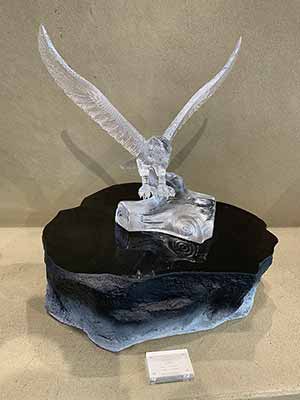
This Waterford Crystal sculpture is available for purchase in the factory shop. It retails for 21,450 euros, but they'll sell it to you at the tax-free price of 17,439.02, or about $18,600 in U.S. currency. Photo by Glenn.
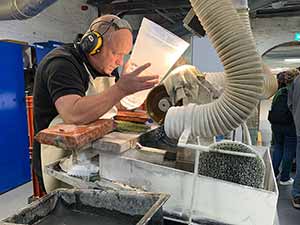
A craftsman concentrates on his workpiece as he makes a precision cut for a vase at the Waterford Crystal factory. Workers apprentice for five years to learn their craft. Photo by Glenn.
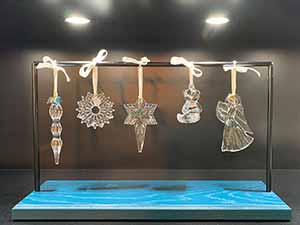
Here are some of the more affordable pieces for sale at the Waterford Crystal visitor center. We bought the angel ornament on the right for about $75. Photo by Glenn.
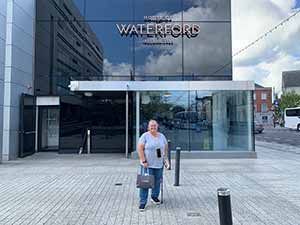
Roni stands with her purchase outside the House of Waterford visitor center. Photo by Glenn.
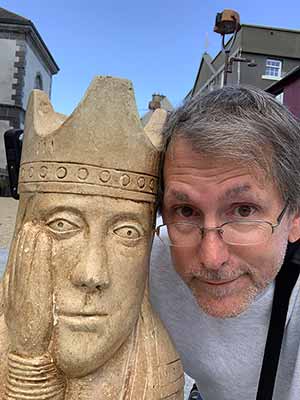
Glenn has found a new friend. This is a replica of the queen from the famous Lewis chess pieces that were created sometime in the 12th century. This was part of a giant chess board located outside the Waterford Treasures Irish Wake Museum in the Viking Triangle district. Photo by Glenn.
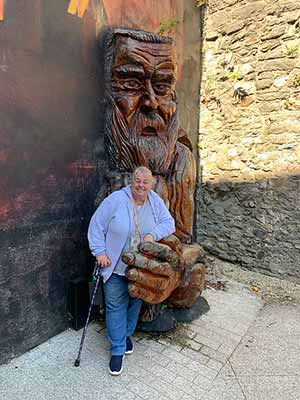
Roni appears to be held captive outside the King of the Vikings exhibit in Viking Triangel. Photo by Glenn.
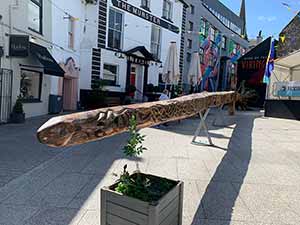
The Dragon Slayer Sword is carved from a large tree and installed, roots and all, in the plaza behind the ruins of Blackfriars Abbey. Photo by Glenn.
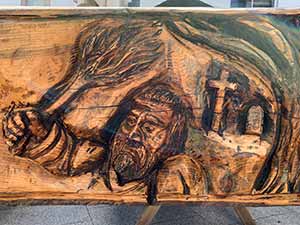
A detail shot of the Dragon Slayer Sword shows one of the scenes carved into its blade. The images tell the story of the vikings in early Waterford. Photo by Glenn.
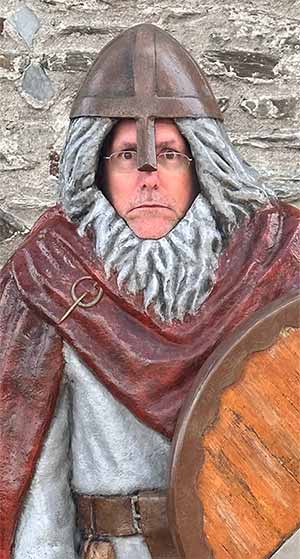
Glenn would have made a formidable viking. Photo by Roni.
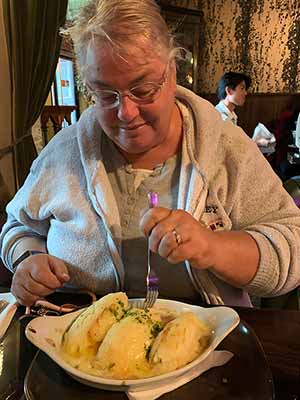
Roni enjoys some traditional Irish food at The Reg restaurant in the Viking Triangle. That's enough for about three meals. Photo by Glenn.
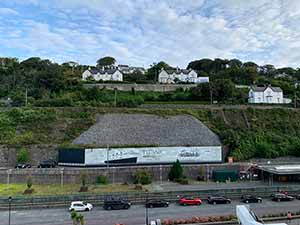
Cobh, Ireland, embraces its connection with Titanic lore. A huge mural across from the port honors the 100th anniversary of the luxury liner's sinking in 1912. Photo by Glenn.
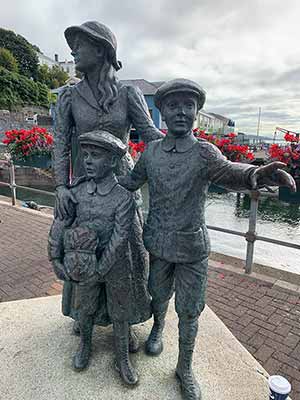
A young Annie Moore stands with her two brothers in a statue depicting her arrival at Ellis Island in New York City. Moore, a native of Ireland's Cork County, was the first person to pass through immigrant inspection at Ellis Island in 1892. Photo by Glenn.
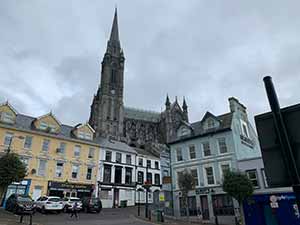
At 300 feet tall, the Cathedral Church of St. Colman towers above Cobh and is the tallest church in Ireland. Photo by Glenn.
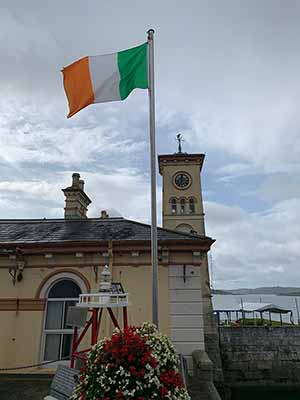
The Irish flag waves outside Cobh's Old Town Hall, which ironically now serves as a Chinese restaurant. Photo by Glenn.
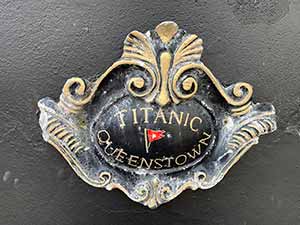
An emblem is attached to a stairway outside the Titanic Experience in Cobh. Just as there is no escaping the Beatles in Liverpool, Cobh is awash in Titanic memorabilia and memorials. The city at the time of the 1912 tragedy was known as Queenstown. Photo by Glenn.
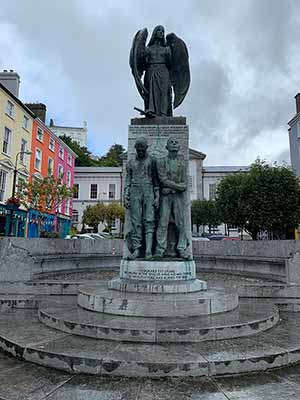
The Titanic was not the only maritime catastrophe to touch thelives of Cobh's residents. The sinking of the RMS Lusitania by a German submarine during World War I is remembered with this statue in Casement Square. Photo by Glenn.
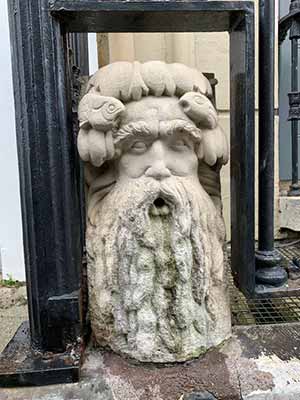
A whimsical gargoyle does its work at the end of a drainpipe outside a commercial building on Westbourne Place in downtown Cobh. Photo by Glenn.
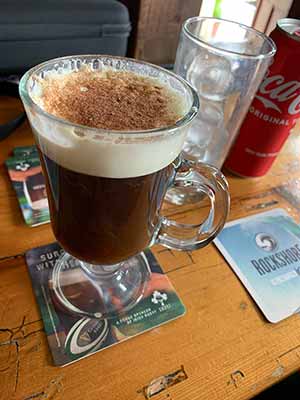
Enjoying an Irish coffee at Kelly's Bar. Photo by Glenn.
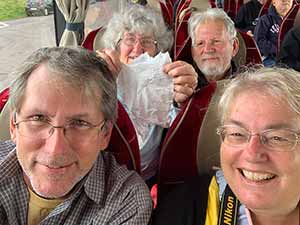
We're on the tour bus headed to Kinsale. Mom, who had a case of the sniffles, didn't have a tissue with her, so Dad offered to let her use one of the notebook pages he uses as a journal. His notes are a bit soggier now. Photo by Glenn.
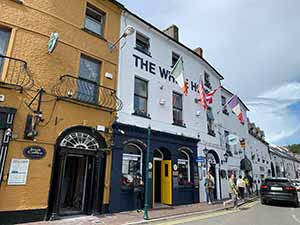
We stopped in at this bar in Kinsale, where Dad ordered a stout beer and enjoyed it while the rest of us relaxed in the booth. We think the name of the place was Kitty Ó Sé's. Photo by Glenn.
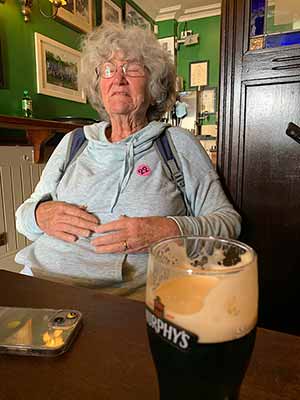
Mom got a sio of Dad's beer. Needless to say, she was not impressed. Photo by Glenn.
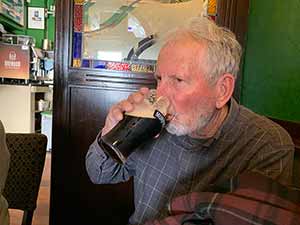
Dad imbibes... Photo by Glenn.
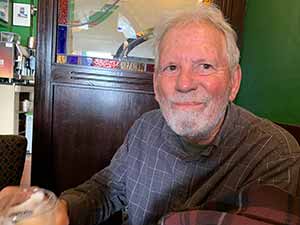
...We think he likes it. Photo by Glenn.
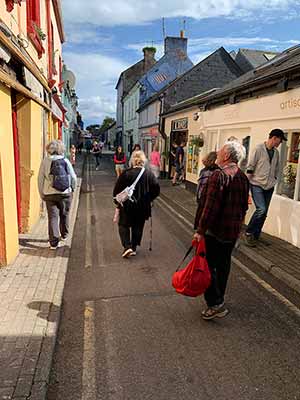
We walk up the narrow Market Quay, past bars and craft shops, as we make our way back to the tour bus. Photo by Glenn.
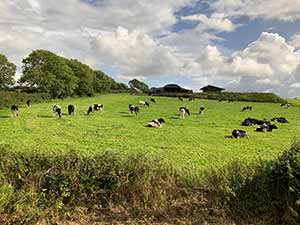
Our return to the cruise ship from Kinsale was marked by an extensive detour that took us along scenic backroads. A herd of cows graze in a field somewhere along the road. Photo by Glenn.
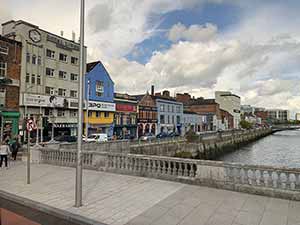
This is Cork, a city of some 222,000 people a few miles northwest of Cobh. It wasn't part of our itinerary, but the detour took us there long enough to realize we were glad not to have had to visit there. Photo by Glenn.
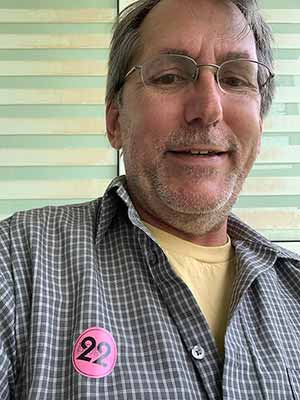
"I am not a number, I am a free man!" At least now that the Kinsale tour is done. Photo by Glenn.
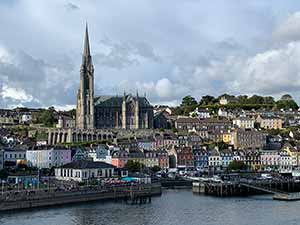
We are leaving Cobh. One last look at St. Colman's Cathedral and those cute little row houses as we head out to sea for a couple of days on our way to Dover. Photo by Glenn.
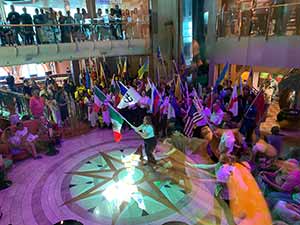
The crew of the cruise ship celebrate their internationaldiversity in a festive pageant of flags and music in the ship's Centrum. We were at the customer service desk when they started, and our service rep lamented that he wasn't out there to represent his country with a flag as he was the only one from France. Photo by Glenn.
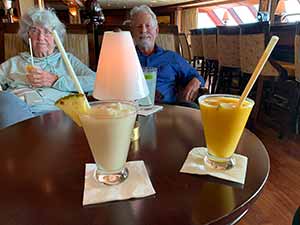
It's our last day at sea, so we enjoy some adult beverages in the Safari Lounge. Photo by Glenn.
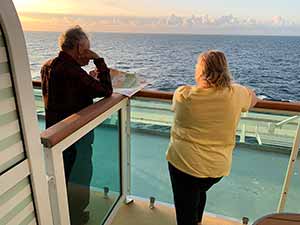
Dad and Roni visit on the balcony outside our staterooms as the sun sets on our last day at sea. Photo by Glenn.
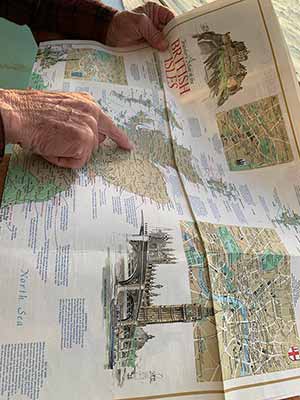
Dad has the same National Geographic map of the British Isles that once belonged to his mother, Glenn's late Grandma Sorenson. You can find a few of her notes in the margins. Photo by Glenn.
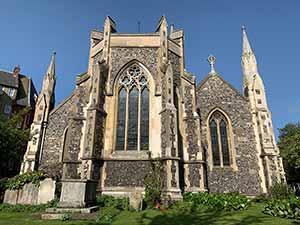
We are outside St. Mary's Church in Dover, England. The historic building is more than 900 years old. Photo by Glenn.
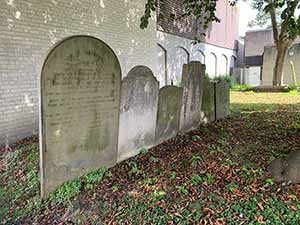
Headstones stand in a row behind St. Mary's Church in Dover. Photo by Glenn.
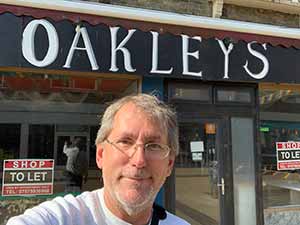
It's almost like being at home. An Oakleyite poses for a photo outside Oakleys in downtown Dover. The shop may be vacant, but at least it has toilets... or whatever those signs say. Photo by Glenn.
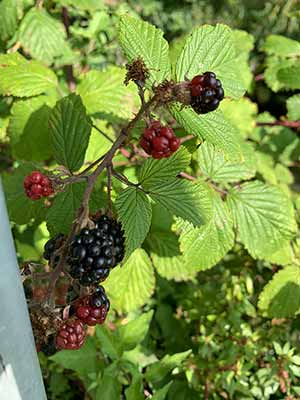
Blackberries grow wild along the fence line on the River Dour, which flows through the center of Dover's downtown. Photo by Glenn.
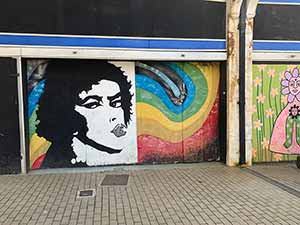
He's just a sweet transvestite from Transexual, Transylvania... and he's somehow found a home on the wall of a vacant storefront in downtown Dover. That would be Dr. Frank-N-Furter of Rocky Horror Picture Show fame, for the uninitiated. Photo by Glenn.
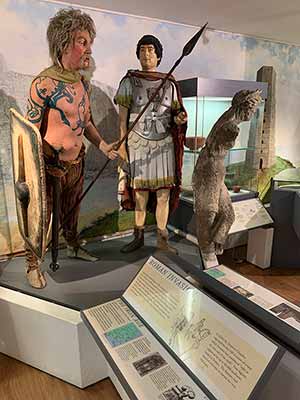
The ancient Romans weren't a bunch of stiffs, even if they appear that way in this exhibit from theBronze Age Boat Gallery inside the Dover Museum. The gallery has an impressive collection of artifacts dating to the Roman invasion of Dover centuries ago. Photo by Glenn.
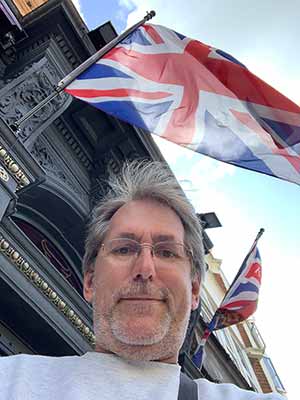
Glenn poses below the Union Jack outside the Rhino & Bull's restaurant. The Union Jack is a combined representation of the flags of Scotland, England and Northern Ireland — the UK's largest member nations. Don't ask the Welsh people what they think about their omission from the royal banner. Photo by Glenn.
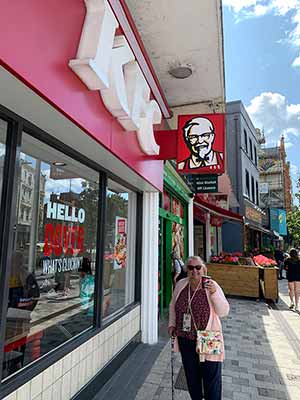
We did not travel 5,000 miles to eat American fast food in England... but we did stop in at this KFC in search of a soda. Photo by Glenn.
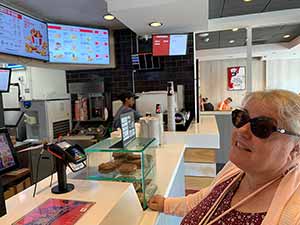
Roni has found her Pepsi in a paper cup, thanks to KFC. The Colonel smiles down with a hint of corporate pride. Photo by Glenn.
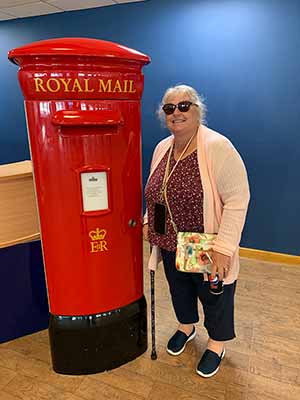
An official Royal Mail postal box glistens inside the Dover cruise terminal. We didn't have any letters to send, alas. Photo by Glenn.
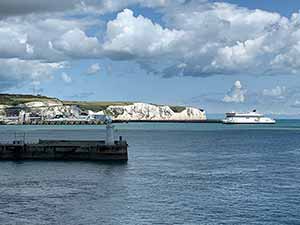
The White Cliffs of Dover aren't so impressive from this far out in the water. One of the many ferries that call on this port was heading out the same time our ship was. Photo by Glenn.
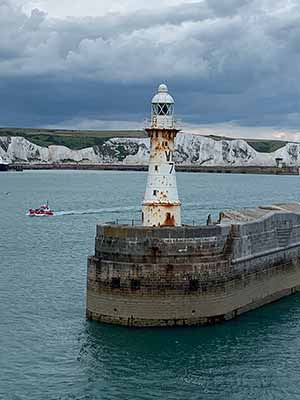
A rusted lighthouse at the end of the breakwater attests to the harsh conditions Dover experiences. There's a storm chasing us as we head into the English Channel. Photo by Glenn.
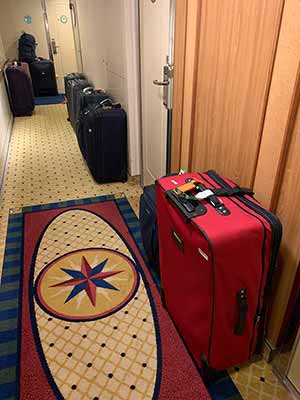
Our bags are packed and sitting in the hall with everyone else's so the ship crew can collect them overnight. Back to Amsterdam by morning. Photo by Glenn.
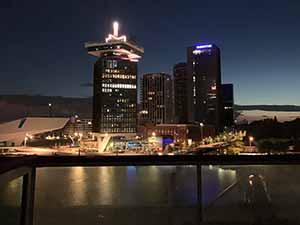
Look familiar? A'Dam Lookout is still lit up as dawn begins to break over Amsterdam and we arrive in port. Photo by Glenn.
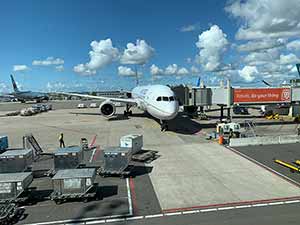
United Airlines Flight 969 bound for SFO prepares for boarding at Gate G7 in Amsterdam Schiphol Airport. Photo by Glenn.
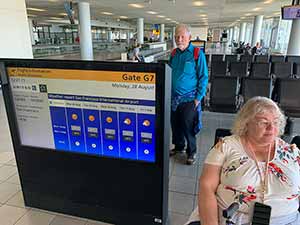
Dad checks the weather at our destination while Roni waits in the lounge for our boarding call. Photo by Glenn.
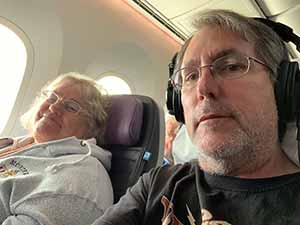
It's another long flight. Gotta have headphones and some entertainment for the next 10 hours. Photo by Glenn.
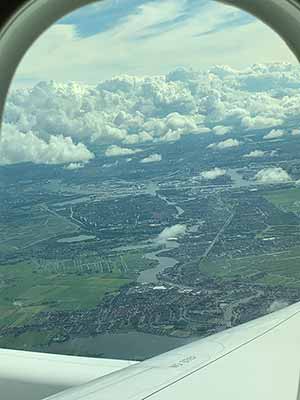
Saying goodbye to Amsterdam. Thanks for having us. Hope we'll meet again one day. Photo by Glenn.
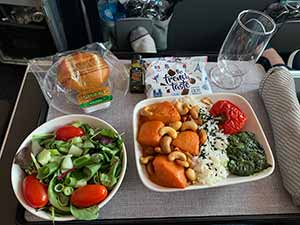
Tikka masala, salad, veggies and a bread roll for dinner with brownie bites for dessert. United really knows how to feed you on the long flights. Photo by Glenn.
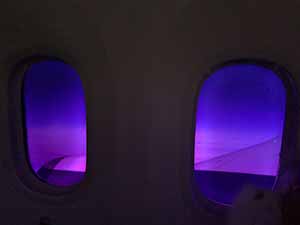
Time to dim the shades again. Pfffft. Photo by Glenn.
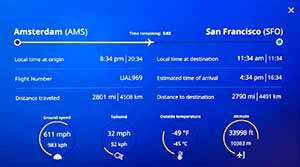
We're right around halfway into our flight. We're cruising at 611 mph at 34,000 feet with an outside air temperature of 49 degrees below zero. United gave us blankets when we boarded. Good thing we're inside the cabin. Photo by Glenn.
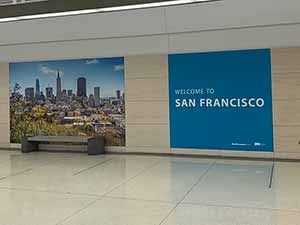
Welcome home. Photo by Glenn.
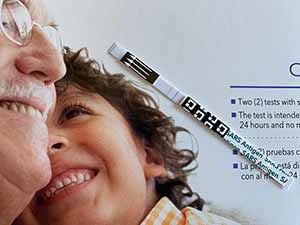
Guess who came home with COVID? No, it's not these happy people. Photo by Glenn.
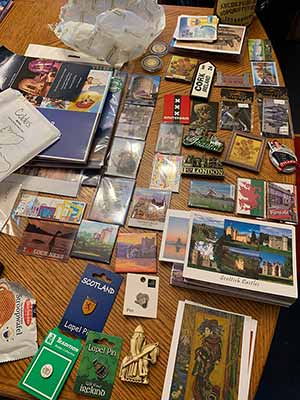
Our postcards and magnets fill the dining room table. We'll need to buy a bigger refrigerator. Photo by Glenn.
This vacation was nearly two years in the making — a Christmas gift from Glenn’s folks in 2021, a free cruise to a destination to be determined that was delayed by life events during a topsy-turvy 2022. We’d been thinking about Hawaii or Alaska until Glenn’s mom tossed out the idea of sailing around the British Isles, and so it was that we eventually found ourselves booked aboard Royal Caribbean’s “Jewel of the Seas” to tour five countries in 12 days.
Our journey began early the morning of Saturday, Aug. 12. We awoke before 6 a.m. to say goodbye to Ben as he headed off to work, then went about final luggage checks so we could be out the door by 8:30 for the drive to Hayward to meet Glenn’s parents. We’d all decided to ride together to take advantage of Mom’s decision to pay for long-term parking at SFO. Even with their roomy RAV4, all our luggage just narrowly fit in the rear cargo deck, and it took more than a few attempts before the electronic door would close securely.
Mom wanted to make sure we arrived at the airport three hours ahead of our flight aboard KLM Royal Dutch Airlines so we could handle any hassles with airport security screenings and passport checks, but all went smoothly and we had more than an hour to kick back in the lounge at the boarding gate, grab something to eat and anticipate what was scheduled to be a 10-hour flight to Amsterdam in The Netherlands.
We’d decided on the cruise leaving out of Amsterdam as opposed to London because Mom had long wanted to see Holland and it was one of the few itineraries that included a stop in Liverpool, England, where The Beatles originated and that Dad dearly wanted to see. London might have been a bit cheaper for flights, but the travel duration difference was negligible and Amsterdam had the advantage of the cruise port being right outside of the hotel where we’d chosen to stay.
* * * * *
W
E'D GOTTEN A late start with the travel booking process back in February, and seats were filling up fast for the flight we needed. Mom and Roni had decided we should splurge for the premium economy seats to hopefully give us some additional comfort on an unusually long flight, and the decision to do that gave us a better seat selection at booking. We were able to procure four seats in adjacent rows by the right wing. Our plan was for Glenn to take the window seat on the outbound flight and let Roni have it for the trip back to home.
Our tickets allowed us each to have a pair of checked bags and a couple of carry-ons. We didn’t have anywhere near that much luggage, so we checked our largest bag and decided to bring aboard a couple of smaller suitcases that could fit comfortably in the overhead bin. We were in the second boarding group after business class, followed by the three groups of passengers traveling in basic economy. Because the airlines want to get boarded as quickly as possible, there isn’t much time to get situated in your seat once you find it.
We boarded on the left aisle of the cabin instead of where we should have been, on the right side. What that meant was we had to cut across through the middle seats to get to the right aisle, and by the time we got there they were starting to board the groups after us, meaning we were holding up traffic while Glenn fiddled with trying to get our bags into the overhead storage compartment. The first one went in fine, but the second one didn’t quite fit without some rearranging. To expedite things, Glenn told Roni to take the window seat so he could quickly slide in next to her as soon as the bag situation was resolved. The hope was to swap seats before the flight departed, but after adjusting pillows, blankets, headsets and floorspace to our liking it would have been too much trouble to undo everything, so we decided to stay put.
In the end, Roni had a spectacular view of the Bay Area when our plane took off while Glenn, trapped on the aisle, only caught a glimpse of the scenery. It wasn’t until we were somewhere over North Dakota that we finally decided to make that seat swap, and it was no more than a couple of minutes later that the flight crew decided to dim all the cabin windows for the duration of the trip — a pretty neat trick made possible with the current generation of Boeing 787s. With nothing left to see outside and Wi-Fi available for a premium, there was little to do but watch the in-flight entertainment console or attempt to sleep.
* * * * *
E
VEN WITH THE minimal upgrade in comfort that premium economy offers, 10 hours is a long time to be stuck in an airplane seat. Roni can attest to this after suffering several painful leg cramps mid-flight, and Glenn did his best to save his back from the steel braces in the seat by wedging his blanket behind him. Sleep, despite the dimmed cabin windows, was mostly a bleary-eyed dream, although Dad seemed to get some shut eye somehow. We were all quite glad when our descent into Amsterdam began shortly before 9 a.m. local time on Sunday morning — that’s midnight as far as our jet-lagged California bodies were concerned, and we’d been in the air since roughly 2 p.m.
Now the windows were undimmed, but all there was to see was an ocean of clouds — typical weather at all times of the year for Amsterdam. Once we lowered through them we caught our first glimpse of the lush green fields and waterways that lie between the coast and the Schiphol Airport, our final destination. We touched down smoothly and commenced what must have been a 10-minute taxi back to the terminal — our first international flight successfully completed.
* * * * *
C
OLLECTING OUR BAGS from the luggage carousel and getting through customs proved to be easy, but now we were largely on our own to figure out how to get to our hotel near Amsterdam Centraal Station. The Netherlands (like much of Europe) is English-friendly with translations provided on public signage, but it is easy to forget that Dutch is the official language and is predominantly what is spoken, so it was a bit of a shock to us not to hear more English on the public address system or from other travelers as we navigated our way through the local transit system for the first time.
The airport is located right below the platforms for the train and bus terminal, and trains run about every 10 minutes. We figured out how to purchase tickets from a kiosk for the train that goes into the central station and soon were riding with our luggage in one of the second-class coaches that took about 15 minutes to ferry us to our destination.
We got off at Amsterdam Centraal Station and made our way to the rear exit overlooking the river with all its ferry traffic and hundreds of people riding bicycles along a dedicated bike path. It was wonderful, much like a coming to America moment for immigrants arriving at Ellis Island, but in reverse.
Our hotel, the Mövenpick, was about a 2-mile walk from the train station. That wouldn’t have been too bad under normal circumstances, but we had to do it after more than 15 hours of travel, on little sleep, with luggage in tow. We were all exhausted and running on adrenaline, and it wasn’t even noon yet in Amsterdam. It felt like we’d combined two days into one, essentially losing our Saturday afternoon and evening in the process.
We’d booked separate rooms. Our folks’ room was ready, but ours wasn’t yet. The clerk offered to put us up in a different room so we’d have a place to crash for a while. They booked us into room 1412, which provided us with a westward view of the city that included the train station, A’Dam Lookout observation tower, and a long section of the IJ waterway that forms the heart of the city’s waterfront. We could have enjoyed that view all day, except that we were both out for a couple of hours once our heads hit the pillows.
* * * * *
S
LEEP IS GENERALLY underrated, but we would only be in Amsterdam for three days before our cruise and wanted to make every moment count. As tired as we all were, we decided to head into town late that afternoon to explore the sights and find some dinner.
Amsterdam has a sophisticated public transportation system that includes a network of trams that are easy and affordable to use, running roughly every 10-15 minutes. There was a station for the 26 line immediately across the street from our hotel. Fares are handled electronically. The idea is to swipe your ATM card when you board and swipe it again when you exit at your destination. As simple as this should have been, in practice we found it more challenging and managed to skip out on payment the first few times. A bunch of American fare evaders! But fortunately no one was waiting to handcuff us when we disembarked outside Amsterdam Centraal.
The station is the hub for everything in this city of nearly 900,000 people — most of whom must have been there that Sunday afternoon! It was bewildering to step out into the mix of humanity, nothing like we had experienced in most American cities. Few cars, but trams, cyclists, buses, scooters and pedestrians everywhere. Canals filled with tour boats. Trains coming and going in the 133-year-old station that somewhat resembled a building you might find at Disneyland. And as we made our way up Damrak street toward Dam Square, we were swallowed up in a crowd that spoke dozens of languages and represented nationalities from all over the world.
It was all too much for Mom, who was exhausted from our travels and overwhelmed by the crowd. We all decided it was time to find dinner, and we landed at the Brasserie De Roode Leeuw. Often when traveling we find our eyes are bigger than our appetites when it comes to dinner, so Glenn thought he was playing it safe to order a side dish called stoverij. The waitress questioned whether that would be enough of a meal, given that it was just a “small side” of fries and beef stew. Well, Glenn probably would have needed an extra stomach to consume a main course, as this “small side” was enough to feed at least three people. It consisted of thick french fries smothered in stew and mayonnaise. What, no ketchup? Nope. It was, to put it bluntly, gross.
Our appetites sated after dinner, we continued our stroll into Dam Square where we visited the National Monument honoring those who died in World War II. There is a live webcam we often watch on YouTube of this location, so it was interesting to finally be standing there in person. We would have liked to spend longer as the square is quite large, but it had been a long day and we wanted to head back to the hotel to get a good night’s sleep for Monday’s tourism itinerary. We caught the tram back to the Mövenpick and fell asleep well before midnight.
* * * * *
M
ONDAY WAS DAY 2 — or was it Day 3? We were no longer sure. We’d successfully booked tickets to the Anne Frank House weeks ago and had to be at the museum in time for our 9 a.m. entry. The site is where a teenaged Anne and her family hid from the Nazis for nearly three years during World War II before they were eventually discovered and met their fate in concentration camps. The museum is one of the most popular attractions in Amsterdam, and timed tickets are released in limited quantities six weeks in advance; those who think they can walk up to the counter the day they want to visit are in for a huge disappointment, and it was a good thing we’d learned this well in advance. Glenn had to be online July 4 at the stroke of 1 a.m. to purchase our four tickets that were sold out within hours.
The hotel had a decent buffet breakfast that we had to buy separately from our stay. We hadn’t purchased it at the time we booked, but we probably should have as we ate there all three mornings we were in Amsterdam. The four of us met up in the lobby at 8 a.m. after our meal and caught the 26 tram to the central station to connect with the 17 line that would take us out to Westermarkt, about a block from the museum. Even knowing where we wanted to go, getting off at the right station proved to be a bit nerve wracking because all the street names are in Dutch.
The tram stops right outside the Westerkerk Church, which dates to the 1600s and is currently undergoing restoration. There is a small sculpture of Anne Frank outside. The museum is a half-block around the corner from the church and bears little resemblance today to the canal house that existed in the 1940s, although its interior has been preserved so that it largely resembles what it looked like when Anne and her family were hidden there. The exterior has been enveloped in a modern looking steel and glass facade, with some interpretive displays and a gift shop on the bottom floors and a one-way path leading to the secret annex above.
Visitors get a radio receiver for an audio program presented in one of several different languages. Each room of the house contains a transmitter that can be swiped with the receiver to start the next portion of the audio tour. There are plaques posted alongside the exhibits written in Dutch and translated in English, but it is a bit of a challenge to read the signs while also trying to concentrate on the audio. No photos are allowed inside, purportedly to keep the line moving, but likely because the museum wants to preserve the integrity of its exhibits.
We found the experience moving, learning about the history of those war years and standing in the same places where Anne lived and wrote about what it was like to be in hiding. You get to walk through the secret entrance to the annex that was hidden by a bookcase, climb the narrow ladder to the attic, see the room Anne and her sister shared where the magazine clippings she glued to the walls still exist. Original pages of her famous diary are displayed along with other artifacts. Perhaps most chilling is the quotation from Anne’s writings that she hoped one day to be a famous writer. She found that fame, but not in the way she would have wanted.
* * * * *
F
ROM THE ANNE Frank House it was on to the Vincent Van Gogh Museum, a roughly 30-minute walk along the canal-lined streets. At least, that was Glenn’s original plan. After our experience walking to Dam Square the previous day, it was clear that we should take advantage of the trams and save our energy for walking around the exhibits once we arrived.
So we returned to the 17 line to take us to our next destination. Unfortunately the tram didn’t provide a direct connection to the museum district, and we would need to transfer to the 7 line a few blocks away. But remember what we said about all the street names being in Dutch? Now we were in unfamiliar territory, zipping through the Jordaan neighborhood where nothing looked familiar when we referenced the transit map. Fearing we had missed or might miss our connection, Glenn had everyone get off at an unplanned stop so we could get our bearings. It seemed like a reasonable plan, except that we never did locate the 7 line and spent the next half hour wandering aimlessly in search of the museums.
Mom and Roni used their cellular GPS while Dad pulled aside random pedestrians to ask for directions. Glenn scoured his transit map in search of a familiar street name. It took our combined efforts and a lot more walking before we finally reached the Van Gogh with less than two minutes to spare before our 11:30 timed entry. Roni had been in a panic that we wouldn’t make it in time to an exhibit she’d been planning for months to see.
Unlike the Anne Frank House, there were no restrictions on photography here and a much larger crowd. Consequently it was challenging to get close up to the many paintings on display and spend the sort of time to reflect that such an exhibit really calls for. It was interesting to see the original Sunflowers painting and some of Van Gogh’s self portraits as well as etchings he had done. But we didn’t get as much out of the experience as we otherwise might have because of the crowds.
We thought we’d figured out the tram system for the ride back to Amsterdam Centraal, but this time we succeeded in boarding a tram that took us in the wrong direction, and we wound up riding with the commuters out to the suburbs, getting off near a lake before we were able to catch the reverse route back to where we needed to be.
While our folks were content to go back to the hotel to rest up from the day’s adventure, we recovered a bit sooner and decided to venture downtown one more time as it got close to evening. If we’d found Amsterdam to be a beautiful city by day, it was downright gorgeous at night with all its storefronts and canal houses lit up, the rainbow collection of lights reflecting off the water where the tour boats continued to run.
It was a short walk from the central station to where we decided to get dinner along Damrak, a hole-in-the-wall restaurant called the Pizza Pasta Bar. We’d lucked out on the weather so far, arriving in town following endless days of rain, and this night was pleasant enough to sit outside at the sidewalk tables and enjoy a “four seasons pizza,” so named because its four toppings each had their own quadrant on the pie. We had cheesecake and Dutch apple pie for dessert, more because they were inexpensive and we were enjoying the ambience than because we really needed the calories.
We sat in that restaurant for a long time, barely noticed by the wait staff. It wasn’t that the service was poor, just that — as we were coming to realize — they do things differently in Europe. There is no rush to get diners in and out, no constant check-ins to see if everything is to your liking, and surely no urgency to show you the dessert menu. Drinks, including water, are almost always served in bottles. Tips are rarely expected. It was… refreshing.
We poked our heads into some of the gift shops but bought very little, assuming there would be another opportunity to pick up souvenirs. In hindsight, we should have done our buying while we had the chance. We were just amazed so many places remained open after 10 p.m. We talked about going back to Dam Square but decided against it because it was getting late and we had more touring to do the next day. So it was back to the tram, back to the hotel, and off to bed.
* * * * *
T
UESDAY THE 15TH marked our last full day in Amsterdam and it felt as though we’d barely scratched the surface of its many charms. One of those wasn’t located in the city at all, but rather about a half hour to the northwest at Zaanse Schans, a popular tourist destination where visitors can see the blades of iconic Dutch windmills turning along the Zaan riverfront.
We’d scouted out the bus to Zaandam the night before while we were at the central station, so at least we knew where to catch it. What we didn’t know was how to go about purchasing tickets, and after a couple of unsuccessful attempts using the kiosks at the train station, we had to seek out a live person at a nearby travel agency to acquire tickets directly.
Zaanse Schans is actually a connected village of several museums housed inside traditional windmills and workshops that date back hundreds of years. Visitors can purchase admission to each museum separately for a few euros or get in free to all of them by purchasing a day pass. The museums cover different activities, including one that makes paint pigments, a saw mill, a coopery, biscuit factory, weaving and more.
We’d been spoiled by the weather up to now and left our rain gear back at the hotel. Roni had purchased a pair of umbrellas that we jokingly referred to as our insurance policy because the skies were clear whenever we had them with us. But on this day we’d let our guard down and now Mother Nature made us pay by whipping up an isolated shower as we strolled the winding path between windmills. Mom shared her umbrella with Roni as they waited out the downpour on a bench, while Glenn and Dad ducked into the De Kat paint mill. It was worth the 5 euros to see the operating machinery and buy a few minutes out of the elements.
The rain was short-lived, thankfully, and it didn’t interfere with the rest of our roughly four-hour visit. In fact, we grew tired well before exhausting all the attractions the place had to offer. Even though we were visiting on a Tuesday, Zaanse Schans was packed with tourists that made it difficult to enjoy walking along the narrow path between the workshops; we only got about halfway before deciding to start back. But that left us with enough time to check out the Delft Blue shop Mom really wanted to see and purchase a few souvenirs of our visit.
Preparing for our visit to the Netherlands, we’d made a mental list of some of the food items we really wanted to try if we were lucky enough to find them. We’d gotten our first taste of bitterballen, a sort of breaded and fried meatball, on our first night at the Brasserie De Roode Leeuw. Now we found a popular sweet, stroopwafels — literally meaning syrup waffles — at one of the snack shops at Zaanse. They consist of a pair of thin, round waffles about the thickness of an ice cream cone sandwiching a sticky layer of caramel and dipped in chocolate or other substances. Ours came wrapped in a sheet of folded paper to make them easy to hold without getting sticky stuff all over your hands. At least in theory.
The stroopwafels came fresh off the griddle and were warm and amazing. We were all happily enjoying them, oblivious to the fact that the chocolate was melting from the heat and had begun leaking out the bottom of the paper, running down our hands and onto shirts and shoes. Yikes! The damage was mostly minimal, the stains another “souvenir” of our visit.
We stopped at the visitor center near the bus stop so we could get some cold drinks, but mainly because a purchase in the cafe included a free barcode for use of the restrooms, which otherwise were 1 euro. It was a sophisticated admission system, too, equipped with electronic debit card readers so users could swipe an ATM card rather than fuss with finding cash. (As an aside, Europe is largely a cashless society these days since the pandemic. We didn’t bring a single euro or pound with us on the trip, and other than a couple of street vendors who only took cash we never ran into a business that wouldn’t accept cards or Apple Pay, which we try to use whenever possible.)
* * * * *
W
E'D ENJOYED OUR visit to Zaanse Schans, but we had to be back at Amsterdam Centraal by 4:30 p.m. because we’d booked a canal cruise on one of the many open-air tour boats that board at the docks just outside the station. Canals are ubiquitous in Amsterdam, and they stretch out like interconnected threads of a spider web from the central waterfront, fanning out for miles around the city.
We’d hoped to get an open-top boat that would allow for unobstructed views of the buildings we passed, but our boat was semi-enclosed by an aluminum canopy that made photography difficult, and even though Glenn brought along his Insta 360 to record the trip, the footage was unspectacular.
The tour took about an hour and sent us under stone and brick viaducts just below street level. A multilingual audio program provided most of the commentary while our tour guide supplemented by pointing out the highlights on shore.
There is little separating the streets from the canals, and one of the things we learned is that there are a surprising number of bicycles that fall in. The city retrieves about 20,000 bikes each year from the water, some of which are refurbished and resold while others are simply scrapped.
Once back at the docks, we were all hungry for a real dinner after spending all day touring. We probably would have opted for one of the downtown restaurants, but our folks were feeling less adventurous and Mom led us to the closest dining option, a chain establishment on the water across from central station called Loetje. It was a little busy, but they sat us at an outdoor table near the far end of the deck where we at least had a view of the canal boats.
In true European restaurant fashion, service was poky. We had plenty of time to peruse the menu after ordering our bottled drinks. Dad wanted an authentic local beer and ordered the Amstel Radler Citroen, which would have been a fine choice for someone who likes lemon beer — Dad didn’t, a point that became abundantly clear as he launched into a rant about the product that became more comical the longer it went.
His monologue wasn’t lost on the older couple dining at the table next to ours, and try as they might to pretend to mind their own business, they were clearly amused. We eventually struck up a conversation with them, in which we learned they were on their way home to Utrecht and that Amstel is not the preferred beer of locals in the know. “If you leave Amsterdam saying you liked the beer, something is wrong,” the gentleman informed Dad.
And what would he recommend? Something called Texels, a brand the restaurant apparently was having a difficult time finding. Well, at least for us American tourists. Most people would have expressed their sympathies for a poor beer choice and left it at that, but this kindly man actually spoke with the waiter and not only got a bottle of Texels delivered to Dad, but also got the restaurant to take the Amstel off his bill.
It was a memorable moment and quickly became one of the highlights of our time in Amsterdam. It was also a great way to end our visit there, as the next day we would literally be shipping out for 12 days around the United Kingdom. We hopped on the 26 tram back to the hotel, taking one last look at Amsterdam Centraal as our train rounded the corner of the station.
* * * * *
W
EDNESDAY THE 16TH was departure day, and although we didn’t have to board the cruise ship until the afternoon, no one but Glenn was up for one last trip into town to eat breakfast or look for souvenirs. So instead we got up early and grabbed breakfast from the hotel buffet before strolling around the dock to check out the ship as the last of the passengers from the previous trip disembarked and crews worked to service the vessel. The cruise companies run a tight schedule, with just a few hours from the time a ship ports to when it leaves the dock.
Because we had purchased “The Key” program with our cruise tickets, we had priority boarding privileges that included a free lunch in the main dining room. The cruise terminal was right next door to the hotel, making it convenient to wheel our luggage to the drop-off point and then board.
Booking our rooms had been a major ordeal. Mom felt it was important to have adjoining rooms, but she originally selected standard staterooms that lack balconies — something we’d all come to appreciate during our Panama cruise four years ago. After some discussion and multiple calls to Royal Caribbean’s customer service department, we were able to book a pair of adjoining balcony rooms on the port side of the ship toward the aft — we were in 7166, our folks in 7168.
We had been assured the rooms did not have obstructed views — such as ladders or lifeboats or bulkheads in the way. Beyond that, we’d had no idea what to expect. It turned out that the rooms were much smaller than we’d enjoyed on the Panama cruise. There was a double bed, a sofa, and a desk that contained a dresser drawer set and cooler with a TV mounted nearby. There indeed was a balcony, but it was set back several feet from the side of the ship, so we wouldn’t be able to look directly below and instead had some metal equipment nearby. Unobstructed? It was a matter of semantics. Our folks were closer to the aft than we were, and there was a large wall behind us. We had decent views in front of us and to the right, but the left hand view was mostly obscured.
Most disappointing of all, however, was when we learned that evening that our rooms were located directly above one of the lounges where stage performances take place every night. The sound system was literally right below our room, and not only could we hear the bass notes, but we could feel them penetrating the floor. And here we had naively believed we were getting a two-week break from our noisy neighbors back home — now we were guaranteed to be treated to six hours of bass beats every night for the duration of the cruise!
Some would have complained (and did) about the noise, but we preferred to make our waves through the ocean rather than with the cruise staff, so we accepted our plight while making a mental note to never again book a room above an entertainment venue.
This being our third cruise, a lot of the magic was lost. We explored the ship enough to find where the restaurants were located and spent a little time sitting near the pool area, but we had no interest in dancing to house bands in the Centrum or rock wall climbing or pickleball courts on the sports deck. The casino hours were infrequent, based on international laws of the cities where we ported, and the movie selections were uninspiring. We don’t drink, so there was little need to hang out at bars. Mostly we wanted places where we could escape the activity and hang out in silence. It made us all the more thankful for the balconies and the ability to open the sliding door and enjoy the sound of the waves and the fresh ocean air.
The Jewel of the Seas departed from the Amsterdam cruise terminal around 5:15 p.m. and sailed west from the IJ past towns, industrial terminals and wind farms until it reached the coast sometime around 8 p.m. Along the way we passed through one lock that brought us up to sea level in a process that was nowhere near as entertaining as the locks of the Panama Canal.
* * * * *
T
THURSDAY WE WERE at sea, which was a refreshing change of pace after several days of being on the go and visiting tourist attractions; there would be plenty more of that to come. It was also formal night, which meant passengers were encouraged to dress in their finery to enjoy an evening of dining and entertainment just as if we were at a luxury resort on land.
But of course we weren’t on land, and there is plenty to be said for packing as light as possible for an international trip. It just felt silly to be bringing an entire suitcase dedicated to suits, slacks, dresses and dress shoes when we don’t even wear those items for work at home, let alone on a boat while on vacation.
But we also knew this might be the only time we’d get dressed up for a formal portrait, and since our last one was nearly four years old, we decided to pack enough fancy clothes to handle the couple of formal nights we knew were scheduled on this trip.
Our folks had decided they wanted to go for “anytime dining” in the main dining room, which doesn’t require a reservation. What we didn’t know was that the dining room gets more traffic than usual on formal nights, so when we arrived at 7 p.m. to get our table there was already an enormous line. We had to wait almost an hour to be seated. Once inside, service in the restaurant proceeded at a snail’s pace, even considering that three-course service is designed to take at least an hour and they warn you about it in advance. But because of the extra traffic our meal took nearly two hours from start to finish, not even including the wait time.
It was getting pretty late by the time we got out of there, but the photographer was still on hand to take our pictures. We lined up for a half-dozen stiff, rushed poses and called it a night. Fortunately we later found one print that we sort of liked and spent the $25 it cost to take it home. It was a good thing, because none of us would be in the mood for the second formal night in a week or so.
* * * * *
F
RIDAY THE 18TH found us at our first port of call, a quaint seaside community called Invergordon in Scotland. Quaint, but not much to recommend in the way of tourist attractions. As we discovered with most of the places we visited on this cruise, major attractions are located a few miles inland and require a tour group or some other form of transportation to reach. Here was no different, with the major draw being Inverness Castle about half an hour away by bus.
The problem with Inverness Castle was that the tour was somewhat expensive, and because we’d booked our cruise a few months later than we probably would have preferred, the Inverness tour was already sold out before we’d even known about it. That left option two, which was a tour of Urquhart Castle, or at least what was left of it — a vast stone ruins along the bank on Loch Ness, famous as the home of a purported sea monster that many have claimed to have seen but whose existence has yet to be verified
We assembled in the ship’s theater where we were divvied up into groups for the bus ride to Urquhart. The trip took around an hour as we wound our way through the Scottish countryside and listened to our tour guide — who ironically was a native of Germany — provide information about the history and customs of the area. We’d selected seats on the right side of the bus, and it seemed as if all the attractions were out the left hand windows.
When we arrived at the parking lot to Urquhart Castle, we were told to return to the bus in about 45 minutes! That wasn’t much time to visit the museum and gift shop, watch a short introductory video and then walk down to the castle ruins that are situated at the end of an almost quarter-mile pathway. All of that while pushing our way through a sizable crowd.
The castle traces its origins to the 12th century A.D., where it played a significant role in the wars for Scottish independence. It was often the site of significant battles, raids and other events through the centuries, but it didn’t take on its ruinous appearance until 1690, when it was seized from a small band of garrisoned soldiers who blew it up as they fled in defeat. In the ensuing years the damaged castle was stripped of its contents and many of its stones were carted away as materials for other construction. The castle was entrusted to state care in 1913, a visitor center was approved in 1998, and nowadays the castle is the third most visited in Scotland, drawing more than 550,000 visitors annually.
Every one of those tourists must have been at Urquhart the day we visited. They clogged the narrow pathway as families walked in large groups and people stopped to take selfies. Glenn had brought the Insta 360 along, and now he was thankful to have the 6-foot telescoping selfie stick so he could raise the camera above the crowd and get unobstructed views of the ruins with Loch Ness in the background. It made him a bit of a spectacle as he walked through the ruins with the camera in the air, but so what.
It was a whirlwind tour. There had been scant time for photos, let alone to read any of the interpretive signs along the crowded pathways, before we had to scurry back uphill to the gift shop where we picked up a couple of souvenirs before returning to the tour bus.
* * * * *
W
E DIDN'T HAVE enough time to spend at Urquhart Castle, but apparently there was still plenty of time for an unscheduled stop at a roadside gift shop along the road back to Invergordon, where we were told they had some good Scotch whiskey and restrooms, among other things. They also had a pasture where we could see real live highland cattle with their long horns and shaggy coats. The cows were somewhat standoffish, unfortunately, so the only photos of them we got were of their backsides.
The trip to see the castle and cattle took about four hours, and the tour bus had us back to the ship around noon. Even after a brief nap there was still an opportunity to stroll down to the dock and walk into town before the ship was scheduled to depart. Roni was a reluctant explorer after the long bus ride, but she came along to check out the lone gift shop located at the end of the pier near the marina where crews with the oil companies serviced their boats and equipment.
We walked just far enough to cross the B817 two-lane road and gaze up King Street toward the ancient steeple of the Invergordon Parish Church in the distance. It could have been an interesting place to walk and explore if not for the late hour and our fatigue after our earlier tour.
We finished the afternoon with a stop at the on-board Starbucks for coffee and tea drinks that we took back to the room and enjoyed on our balcony while watching the ship pull away from the dock and head back out to sea.
We were in for another sea day before our next stop at Greenock, Scotland, and it was probably a good idea to rest up because it would be the last break we’d get for several days as the ship began hopping back and forth between Wales, England and Ireland as we made our way through the North Sea toward the Hebrides and then south toward the English Channel.
* * * * *
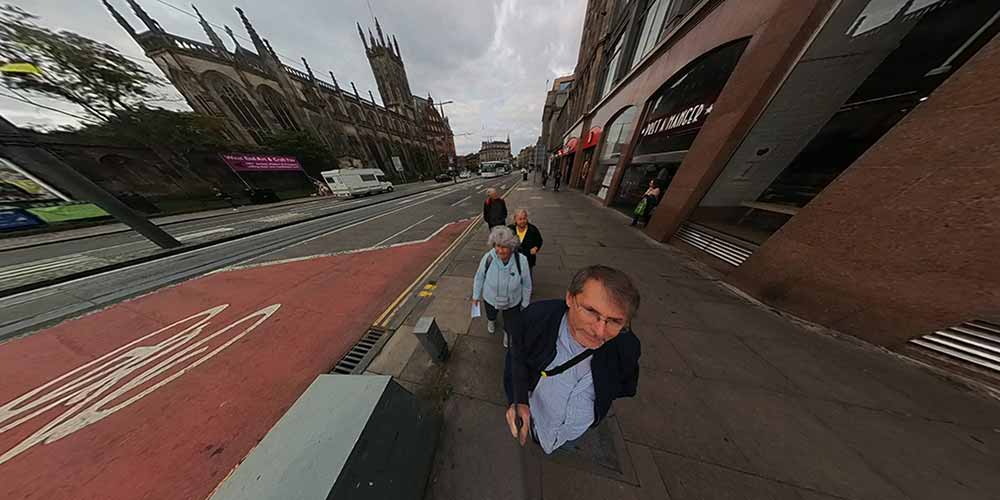
We're walking the mean streets of Edinburgh, Scotland, on the fourth day of the cruise. Photo by Glenn.
S
COTLAND HOLDS SIGNIFICANCE in our family because some of our ancestors came from there. The Henry clan, on Glenn’s mother’s side of the family, can trace its roots directly. Not to mention that Glenn and his brother Sean own land there, even if it is no more than a couple of square feet. So Mom was quite excited at the prospect of finally getting to see the country first hand. That excitement was short-lived once she discovered that the tour to Edinburgh, the capital city, was already sold out when we booked our cruise and we would have to settle for a day in Glasgow, which may have been interesting, but probably in the same vein as if we’d been hoping to visit San Francisco and instead had to go to San Jose — both big, important cities, but one totally lacking in the charms that attract tourists.
Edinburgh has the Royal Mile, a long street through the downtown with pubs and shops and interesting architecture with cultural significance that has evolved over the centuries. Glasgow has… well, a huge industrial port and some murals that have been painted on the sides of buildings. In America we would call it “nondescript.” Big but not beautiful. And this was the Scotland we were destined to see until… more tour slots to Edinburgh opened up at the last minute! It was true, there were enough seats on the bus for all of us, we just had to decide what time we wanted to go. So we hurriedly booked the tour independently, Mom on her computer and Roni on ours. Despite our best intentions, we wound up on different buses departing at slightly different times, but at least we’d all be going to Edinburgh instead of Glasgow.
As a rule, the more time you spend on a bus to get to your destination, the less time you’ll have to see it when you arrive. The ride between our port and Edinburgh was a good 90 minutes each way, but fortunately we’d been given nearly five hours to roam around the city once we arrived, which should have been more than enough time to hit the highlights.
The tour buses dropped us off on Charlotte Square next to the National Records building, from where we were free to head off on our own. During the ride over, our tour guide had been pushing the idea that we should take the hop-on, hop-off buses as the easiest way to see the sights, but we had already decided against it because it cost additional money and it didn’t seem like we’d have enough time to do much besides sitting on the bus all day. So we walked instead.
We availed ourselves of the facilities at a McDonald’s restaurant on Princes Street, which just happened to be across from the entrance to the Parish Church of St. Cuthbert and the Princes Street Gardens. The church was constructed in the 1800s and is surrounded on all sides by burial vaults and headstones embedded in the garden walls. When you emerge from the tree-shaded grounds you get a spectacular view of Edinburgh Castle perched high on a hill overlooking the city.
The gardens are close to a mile long and include the enormous Ross Fountain, a concert bandstand, park benches, statues and even a private residence. We walked the entire length of it until a stairway took us back up to street level where a bagpiper performed for tips at the corner of Princes Street and The Mound. Appropriately named for its upward slope, we walked up The Mound toward the stately New College at University of Edinburgh and then followed the crowd until we reached Lawnmarket Street where the Royal Mile begins.
It was a Sunday afternoon and we’d arrived in the middle of one of the city’s numerous street fairs that take place throughout August. It was something called the Fringe Festival and featured dozens of street performers who were attracting quite the audience as we stood at the intersection trying to decide where to go next. Mom, who was anxious to get out of the crowd, thought it was the right time for lunch, so we took her lead and walked into the first restaurant we came to, an old-timey pub at the corner of Lawnmarket called Deacon Brodie’s Tavern where folks were engrossed in the Women’s World Cup Soccer tournament.
The place was busy, but we were quickly seated in the upstairs dining area with its dark polished wood tables and tartan carpet. All of the menu items looked tempting. Glenn had always wanted to have fish and chips in a traditional British-style pub, and now he indulged with a platter that could have fed three people. And yes, they served it with ketchup rather than mayonnaise!
We’d enjoyed our lunch, but when it came time to head back to the streets to continue our exploration, it was more than Mom could handle. The crowds, the heat, the three-ring circus of performances… it all brought back bad memories of our time in Cartagena, Colombia, four years ago. She felt unsafe and was eager to head back to the bus stop. But we’d only just gotten there. As Dad put it, we’d only seen the Royal Half-Mile, and probably not even that much.
So once again, there was limited opportunity to browse the gift shops, nor did we linger to watch the performers as they entertained the crowd. We snapped our photos and quickly made our way back around the block until we reached the train station along Market Street. We’d perhaps walked more than three miles by then and fatigue was starting to become a factor. Mom noticed the cab drivers waiting nearby and decided it made more sense to spend the 10 pounds for a ride back to Charlotte Square than wear ourselves out more by continuing to walk.
The cab ride was convenient, but it got us back so early that we had an hour to kill before our buses returned to collect us. Dad, Mom and Roni waited on the steps of the National Records building while Glenn explored the street encircling Charlotte Square and the private garden containing the statue of Queen Victoria’s consort, Prince Albert. We apparently were there on the wrong day, because the gardens are open during the Edinburgh International Book Festival held over the last three weeks of August. We saw no books and the garden gates remained locked.
On the way back to port, our tour guide remarked at how we’d made good time on the M8 and dodged the traffic that you can sometimes encounter — right before we ran into traffic. We’d also dodged the rain that now managed to find us as it so often does in the British Isles. The locals like to call it “liquid sunshine.” But still we managed to get back to the cruise ship in plenty of time to hear the bagpipe band on shore performing as we cast off for the next port of call.
* * * * *
A
UG. 21 WE woke up in Belfast, Ireland. Well, at least we were in the port with a gangplank down from the ship to dry land. That is, the land would have been dry had it not been raining. We’d been very lucky on this trip so far to have mostly avoided inclement weather, but judging from the water running down in rivers along the windows in the buffet while we ate our breakfast, this time we might not be so lucky.
Originally we weren’t planning to go into Belfast as there were no tours that looked interesting and it sounded like just another big city. But late in the game we learned about the hop-on, hop-off buses that make seeing the city easy, and so we booked four tickets to do just that. We’d learned that it was probably best to ride the entire route first to see if anything looked interesting enough to stop at, then make a point of getting off at just those stops. The buses run about half an hour apart, so at a minimum you’d need that much time for each stop you’d care to visit.
It was a great plan, except for one detail: how to get to the pickup spot? While the cruise ship offered shuttle service to the downtown, what they didn’t tell us up front was that it would cost 10 each for a ticket. Ten what, you ask? Ten of whatever you had — pounds, euros or dollars. Cash, of course. We paid in dollars, which actually was the best deal because of the currency exchange rates. Euros were trading for 1.09 to the dollar, while pounds were a whopping 1.27. For once, our inflationary economy back home had been a benefit rather than a liability.
We’d contemplated walking to the first hop-on bus stop and might have attempted it in better weather, but realistically the port was isolated from everything and it would have been at least three miles on foot; we’d already walked a lot on this vacation and knew the results of doing too much of it, especially for the older members of our party. So we sucked it up and bought the shuttle tickets. The bus dropped us off at Belfast City Centre, literally just outside the city hall.
Sometimes the best tourist experiences turn out to be the ones that are least planned, and such turned out to be the case with Belfast. We’d arrived at 9 a.m., a full hour before the first tour bus would depart. That gave us time to go inside the tourist information center where there were some gift items and lots of brochures about places to go or stay in the city. If we’d been there for more than a few hours, this would have been very useful.
When it was time to pick up the double-decker tour bus, even though we got in line early we were still near the back of the group and wound up getting lousy seats inside. The weather had improved, and of course people wanted to sit upstairs for the best views. Fortunately we didn’t have to wait long to upgrade our seats, as the first stop was at the Titanic Belfast museum, perhaps the city’s most popular destination.
Every city in the UK seems to have some connection to the ill-fated luxury liner that sank in 1912 after hitting an iceberg on its maiden voyage. For Belfast, it was where the 46,000-ton ship was manufactured and launched on May 31, 1911. More than a simple memorial to the 1,500 souls who perished in the sinking, the museum celebrates Belfast’s heritage as a great industrial city and its place in one of the most captivating maritime stories in history.
Of course the museum was the place everyone wanted to be, and so when many got off the tour bus to check it out, we opportunistically inherited their upstairs seats. It was a great place to set up the Insta 360 to record the rest of the tour around the city, which took a little more than an hour and brought us to such places as the Botanic Gardens, the Bobby Sands Mural, the Garden of Remembrance, and the Peace Wall where visitors can sign their names.
Belfast has a long history of political and religious strife, most famously marked by The Troubles and civil war between the Protestants and Catholics that lasted from the 1960s until 1998. The conflicts resulted in the erection of “peace lines” — walls throughout the city to separate loyalists and republicans that exist to this day, even though they were all supposed to have been dismantled by 2023. As our guide explained to us, it is quite uncommon to find modern buildings with sleek glass edifices in Northern Ireland because those structures would have fared poorly during a time when bombings were commonplace.
The bombs may be a thing of the past, but the tensions clearly remain. Belfast is one of six counties in Ireland that associate with the UK and are governed by the British Parliament. They use the pound as currency, fly the British flag from government buildings, and generally affiliate with the monarchy. Not so for the rest of the country, where they are part of the European Union and clearly bitter about the fact that the northerners remain separate.
With politics so prevalent in everyday life for Northern Ireland, it is little surprise that political issues and figures are featured so prominently in the murals that line the walls of buildings along Shankill Road. Here we saw images of Nelson Mandela alongside tributes to fallen members of the Irish National Liberation Army, abolitionist Frederick Douglass, and a sign promoting International Peace Day with a painting of John Lennon’s “Imagine” candlelight memorial. Not far away, another wall was adorned with larger-than-life images of Queen Elizabeth II and King Charles III.
* * * * *
T
HE TOUR BUS eventually brought us back to Belfast City Centre, and we were surprised to discover that City Hall not only was open to the public, but that it included a full museum, gift shop, cafe and restrooms. Ahhhh, restrooms — bonus points! But also props for the Bobbin Coffee Shop cafe as we were all hungry and thirsty after the tour bus ride. The place was run by a group offering work experience to the developmentally disabled and they had a tempting array of bakery goods available as well as sandwiches. We opted for the snacks and bottled drinks that we ate at one of the tables inside the cafe.
Afterward, we went into a few of the museum exhibit rooms to learn a bit of the history of Belfast. It was more as a thing to do after our snack, because we really had no itinerary for the day and had already taken the city tour. Was there a place we’d seen that we wanted to revisit? It turned out that there was — the Botanic Garden, which oddly we had somehow missed on our first pass in the tour bus. So we found the nearest hop-on stop a couple of blocks away from City Hall and went there to wait for the bus… and wait, and wait, and wait. There was so much traffic and it seemed not to be moving anywhere. Even if we could get on a bus, it certainly wasn’t going to reach us anytime soon. Then came the bigger realization that it didn’t matter whether or not the bus came at all, because the Botanic Garden was closed on Mondays! Dangit.
The Titanic museum and the Peace Wall murals both looked interesting, but no one was up for the time it would take to tour the museum, and the hop-on bus being unidirectional meant we’d have to allow another 90 minutes at least just to make the round trip, excluding any time we spent at the site. Naw, better to stick close to the downtown so we could catch the shuttle back to the ship whenever we were ready.
Dad knew exactly what he wanted to do. You can’t go to Ireland without grabbing a mug of beer, and we were mere feet from one of the oldest pubs in the city — the Crown Bar. We aren’t huge drinkers, but the bar also had a decent food menu and everyone was ready for a good meal. The place reeks of history when you first walk inside. Seating is inside enclosed wood booths that were constructed in the 1880s by Italian craftsmen to provide private spaces where “ladies and high society” could grab a drink “without being overlooked” — which is to say, women weren’t supposed to drink or smoke but could do so there without others seeing them.
The bar was busy and seating appeared to be at a premium, but as luck would have it there was a group of American tourists from Fremont in the Bay Area just getting ready to leave. One of them told Roni they would let us have their booth if she would take their picture together, so she did and the table was ours. We might have been a little too eager to move in because we’d only just sat down amid the clutter of empty bottles and dirty dishes when the barkeep came up with rag in hand, scowl upon his face, and asked us to wait outside while he cleaned up the table. “Use your common sense,” he said as he reset the table for us. That line stuck with us for the remainder of the cruise, and we still pull it out often for comic effect whenever we encounter idiocy in the world.
Ordering food at the Crown Bar is a little unusual. They give you a menu and you figure out what you want, then go up to the bar to order it. It was more of a challenge because they didn’t have everything in stock, so it meant multiple trips between the booth and the bar to update individual orders, but eventually we had our food and were happily eating and drinking away. Roni had Coke while Mom and Glenn had unusual lemonades on tap. Dad of course ordered a beer that he consumed slowly and lovingly.
After the meal, we “used our common sense” and decided we had spent enough time in Belfast to say we’d really been there and seen it; more than could be said for a few of the places we visited on this cruise. We made a quick stop at a Tesco drug store so Roni could pick up some tissues and antacids — more on this to come — and then returned to the shuttle bus back to the port. It had been an unexpectedly enjoyable day.
* * * * *
A
NOTHER DAY, ANOTHER port of call. Up until now we’d mostly relied on tours sanctioned by the cruise ship, which is to say that we’d booked our transportation and destinations through Royal Caribbean. That was about to change as we arrived in Liverpool, England, birthplace of The Beatles and rock music’s British Invasion.
This was Dad’s stop. Not only was this the reason for everything else we’d done on this vacation, but he had planned how it would all go down in Liverpool. No fan of organized group tours, he went “off script” to book his own semi-private tour of the Beatles’ childhood homes through the National Trust, which is the UK’s version of America’s National Park Service. The tickets were a bit pricey for nonmembers at 32 pounds, but that was still a mint cheaper than what the cruise company was asking for its Beatles tour, and likely much less crowded. We’d see.
We’d had no preconceived notions of what our day in Liverpool would look like, and we’d left all the planning up to Dad. As Glenn said, seeing Dad’s reaction to getting to tour the homes of his musical idols would be entertainment in itself, and so we designated ourselves as passengers along for the ride — wherever that ride would take us.
What we hadn’t planned for was illness. It was like deja vu of our last cruise in Panama when Roni awoke feeling more under the weather than the clouds that had followed us throughout the trip. Those tissues and antacids she’d purchased the previous day in Belfast were in anticipation of worse things to come, and as Tuesday morning dawned and she was coughing and feeling generally crappy, she made the unwanted decision to skip the shore tour.
As for the rest of us hardy travelers, it was a quick breakfast upstairs in the buffet and then down to the gangway for the beginning of the day’s adventure. Traveling with Dad can get interesting at times; he likes to go off on tangents when he sees something unexpected that grabs his attention. One moment he’ll be with us and talking, and the next we are searching the crowd wondering which direction he went. This was occasionally the source of anxious moments for Mom, especially being in a foreign country and unsure of the surroundings.
But put Dad on a mission of his own making and he’s like a bloodhound on the trail. This was the man who now led us into Liverpool, with a plan and a schedule to keep. We had a deadline to reach Speke Hall from where the tour was scheduled to depart at 10:15 a.m. To get there would require multiple train rides out to the Liverpool suburbs, a taxi connection, and maybe a wing and a prayer.
Dad set the pace as we exited the Liverpool Cruise Terminal and walked south along the waterfront toward the stately monument of a horse-mounted Edward VII and the considerably smaller yet vastly more popular statue of the Fab Four in a carefree jaunt through the city. We had barely a second to grab a photo of the attraction before it was mobbed by yet another group of tourists eager to take selfies and family portraits. We did not pose with it ourselves.
Dad was eager to get us to the train station, even as he was unsure how to find it. The simplest way would have been to flag down a cab, which is exactly what he tried to do with unexpected results. The cabbie we approached actually turned down the ride, saying the station was so close that it wouldn’t be worth it. Translation: it wouldn’t be worth it to the cab driver, who was at the head of a queue of other cabs and likely waiting for a more lucrative fare destination. He didn’t want to have to give up his spot in line for a short hop around the block after waiting for who knew how long.
So we continued on foot, Dad corralling passersby like a man on the street interviewer to ask for directions to the James Street Station where we could catch the train toward Hunts Cross. Somehow we found it, and somehow we were able to explain to the station agent where we needed to go well enough that we ended up with tickets. She directed us to a lift that took us down a couple of levels to the boarding platform inside a long underground tube. The train arrived in about 10 minutes.
The train we were on runs in a one-way loop, so we had to go about three-quarters of the way along it to reach Liverpool Central Station, where we connected with the train that took us to Liverpool South Parkway, almost the end of the line not far from the John Lennon Airport. It had been a harrowing adventure as we sweated making connections and getting off at the right stations, all the while watching the clock as it ticked closer to 10 a.m. But when we got off the train at Liverpool South Parkway, Dad felt that he’d conquered the world. All that was left was to catch a cab for the last leg of our journey to Speke Hall.
There’s a button on the wall in the station that connects directly with Village Taxis. You tell the dispatcher you need a cab and they tell you to wait outside in the loading zone near the parking lot. Dad booked our cab and celebrated our successful journey. Well, maybe the celebration was premature as the cab was nowhere to be seen. 10:05… 10:10… Now we were starting to get desperate. Maybe we should look for an Uber?
Just then, the cab rolled up and the driver called out his window, “Are you Norm?” We quickly piled in. Fortunately the driver was no stranger to the Beatles tour we were about to take or how to find Speke Hall, having likely made the trip hundreds of times. He got us there quickly and we arrived at the pickup spot just as the tour shuttle was preparing to leave, the bus operator tapping his clipboard to check off his missing passengers.
“There are four of you?” he asked, noting our missing member. “Just the three of us, unfortunately,” Glenn said. “My wife is ill.”
We took our seats with the dozen other passengers and were on our way.
* * * * *
T
HE BEATLES' CHILDHOOD Homes tour offers a different take on the legendary band. Rather than wandering through a museum of exhibits and rock and roll memorabilia — something one can do elsewhere in Liverpool — this tour takes you to the places where John Lennon and Paul McCartney grew up and met one another, before they formed their band The Quarrymen, which preceded The Beatles. The tour guides offer insight into the events and places that helped shape the musicians’ early and most successful song.
The first stop was at Lennon’s house on Menlove Avenue, barely a stone’s throw from Strawberry Field and Penny Lane, which both were immortalized in the songwriter’s music. The house and surrounding gardens have been preserved much as they looked in the 1940s and ’50s. As much as we’d love to show you pictures, unfortunately they weren’t allowed inside. The house was small enough that even our little tour group barely fit inside.
Here we got to walk through each of the rooms of the two-story duplex and learn about the young boy who dreamed of playing music before his chance encounter with Paul McCartney made the dream reality. Unlike Paul, John received little encouragement to pursue his passion, and was told he would never make a living playing music. The world knows well how that ended.
We saw the enclosed front porch where the teens liked to practice their songs because the acoustics were better; tourists were encouraged to go out and hum a few notes to experience it for themselves. We learned how the kitchen at the rear of the house also served as the main entry. Shortly after The Beatles found success, fans would camp out in the driveway and the family would have to make sure to lock the kitchen door or people would come inside to steal pots and pans and other items.
While our group completed the 45-minute tour of the Lennon home, our tour bus had returned to Speke Hall to collect another group. Once they were dropped off to start their tour, we were collected to proceed on to the next stop: Paul McCartney’s childhood home at 20 Forthlin Road.
Unlike Lennon’s house that is identified with an official blue UK heritage plaque, there is no such marker at the McCartney home, the reason being that the subject recognized by the plaque must have been deceased for at least 20 years, and we all know Sir Paul is still very much with us! There are, however, other signs designating the entrance to the historic row house.
Again, no photos were permitted inside the house except for through the windows to look at the yards. This was because Paul’s younger brother Mike, who became an accomplished photographer, shot many candid photos of the singer and their family that guests were invited to attempt to replicate by shooting from the same angles. Not so easy with an iPhone and difficult lighting.
The house is tiny by modern standards. The furnishings are largely original, right down to the peeling linoleum floors. Wallpaper has been replicated as close to the original as possible. The living room piano where Paul once practiced is also not original, but we were told that its replica now on display had in fact been touched by the great performer during a visit back to his childhood home, and members of our group were encouraged to play it as well; one girl did.
We even got to hear a special recorded message from Paul that essentially said he’d grown up there before fame found him, and then he moved away and never looked back. Well then.
* * * * *
T
HE TOURS WERE interesting and our guides informative. We were given free run of both houses to look at the artifacts and “imagine” what it must have been like for a couple of average kids from Liverpool growing up to find fame and fortune. We also got some very slick souvenir booklets to take home.
Although we were all encouraged to stop by Strawberry Field on our own after the tour, we didn’t attempt it. We still had to figure out how to get back to the waterfront. Our shuttle driver was very kind and offered to take us directly to the train station, which saved us from having to pay for another cab ride.
We’d planned to take the train again until we discovered it would be a half-hour wait and there were public buses that could get us where we wanted to go in about the same time for just a couple of pounds per person. We sat on the top floor of a double-decker bus with a great forward view of the narrow city streets as we zipped along on the “wrong side” of the road through the downtown. We passed Penny Lane, although no one remembered actually seeing it.
The bus dropped us off at the end of the line at the Liverpool One transit station, just across the street from Royal Albert Dock, a converted maritime warehouse complex that today features upscale shops and restaurants. We stopped in for lunch at Revolución de Cuba Liverpool. Service there, like every other restaurant we’d visited, was anything but snappy, and we barely had time to finish our meals before it was time to race over to the nearby Gower Street to catch the Liverpool City Sights tour bus.
As part of our day’s excursions, Dad had bought tickets aboard yet another bus, this one to view Liverpool’s non-Beatles attractions such as the Royal Liver Building with its iconic metal “Liver Birds” perched on top, the 400-foot-tall St. John’s Beacon tower, and the hollowed-out remains of St. Luke’s Church which was bombed in German raids during World War II. Oh sure, there were still plenty of Beatles references during this tour; as our tour guide said, “If you don’t like the Beatles then you probably shouldn’t come to Liverpool.”
We wrapped up our tour back where we started, at Royal Albert Dock. We had a few minutes to hunt for Beatles merch at the Fab4 Store before heading back to the cruise ship, another successful adventure for the memory books.
* * * * *
T
HAT NIGHT OUR ship sailed from Liverpool to Holyhead, Wales — a journey that would have taken no more than an hour 50 minutes on land, but which in the world of cruise ships was made to last all night. We awoke to find the ship moored at the end of what might have been the UK’s longest pier stretching close to a mile back to land. At least we wouldn’t have to walk it, thanks to the free shuttle buses provided to ferry the cruisers ashore.
Roni was still not feeling great, but was well enough to be determined that she didn’t want to spend our short time in port confined to our cabin. We hadn’t booked a shore excursion here, although one was offered, but frankly there seemed little reason to visit Holyhead at all other than to allow us to say we’d been in another country. (At the risk of exposing our ignorance, Glenn was unaware that Wales was its own country, thinking of it rather as another suburb of England.)
The “liquid sunshine” had returned, but by now we were becoming used to these temperamental weather patterns that would threaten rain in the morning before burning off to clearing skies and warmer temperatures in the afternoon. It made choosing what to wear more challenging; layering is great until you realize that you have too many layers and have to carry them around with you. Heavy jackets were rarely needed during our trip, but neither was it shorts and T-shirt weather in some of the places we went, including Holyhead. We stuck with the sweaters and jackets on this day.
The shuttle bus dropped up outside the red brick train station, which looked forlorn and abandoned despite being an active commuter hub. We walked through it to reach the Celtic Gateway Bridge pedestrian walkway that took us over the tracks and harbor waters to reach the “commercial” district on the opposite side. There we were let out onto Market Street, which looked like a neighborhood lost in time.
Here the shops lining the cobblestone streets sported hand-lettered signs and weathered storefronts that harkened back to the 1940s. The pandemic appears not to have treated the area well, with many vacancies amid the active businesses. We were excited to find a restaurant called the Holly Molly Cafe that served drinks to go as we were both thirsty, but were quickly disappointed to learn that they couldn’t do milkshakes despite advertising they had them.
We wandered along Market Street, noting the bland collection of shops and equally bored tourists who passed them, most coming off the ship like us and looking for some entertainment to pass the time. There were a few barbers and pharmacies, a couple of places to eat, something that appeared to be a pawn shop, a hotel, and a tattoo parlor. A person played guitar for tips outside the Holyhead Market Cross statue, while across the street sat a large parade float with a dragon sculpture to represent the national flag. No gift shops. Roni noted that Holyhead was a town that was unfortunate enough to have tourists and not know what to do with them. How true!
Beyond the Market Cross sculpture was an open gate to the grounds of St. Cybi’s Church, a medieval church that was established in Holyhead in 540 A.D. Sacked by Vikings in the 10th century and ruined again during an invasion by Henry VII in 1405, the present-day church was built sometime between the 13th and 16th centuries and has undergone numerous renovations since, most recently to reverse decades of erosion from harsh coastal conditions of the sandstone carvings on its exterior.
A service was concluding inside on the day we visited, although a sign near the main door let tourists know it was OK to come in, just be quiet. The interior of the church is even more spectacular than the outside — one can literally smell the history seeping from its stone walls and wood floors. Glenn has always been fascinated by gargoyles and grotesques, and here there were dozens of figures adorning the tops of columns, looking down over the pews. Glenn used the Insta 360 on its fully extended selfie stick to get the camera as close as he could to the intricate carvings.
In the grass surrounding the church are the ancient graves of people buried there. Epitaphs are mostly written in another language, which we surmised was Welsh when a woman asked if we knew what language the inscriptions were.
Our expectations for Holyhead had been low, which is perhaps why we felt we’d seen plenty after touring St. Cybi’s. And since Roni still wasn’t feeling well, and by now neither was Glenn, we didn’t want to spend too much time ashore. Yes, it was sadly true that we were experiencing our second straight cruise with an illness. Despite constant admonitions from the crewmembers about washing hands and using sanitizer around restaurants and other trafficked locations aboard the ship, we’d managed to contract yet another case of the creeping crud. Roni felt sick at Liverpool, Glenn felt sick at Wales, and when we returned to the ship and had a chance to share notes with our folks about our respective adventures on shore, we learned that Mom also was starting to come down with something. It just didn’t seem fair!
* * * * *
W
HAT MADE BEING sick even less enjoyable was that we were now into the busiest part of our cruise, with ports of call planned every day but one before we returned to Amsterdam. Thursday, Aug. 24, found us back in Ireland, at Dunmore East. It was the only port where a tender was necessary to travel from the ship to shore, and like many of the small ports we visited, there was little to do there unless one enjoys walking along the harbor and looking out at the ocean.
We hadn’t booked an excursion here initially, but when we learned they had opened up space for shuttles to Waterford, Roni was eager to go. Waterford is home to the world famous Waterford Crystal company that manufactures fine glassware. There is a factory tour at the visitor center. Getting there would only cost $40 per person via the shuttle.
Mom probably would have really enjoyed Waterford, but she was feeling rotten from whatever it was that had infected us, and so she elected to stay behind. Dad stayed aboard to keep her company.
The tender boat dropped us off at the harbor and then the shuttle bus whisked us off to Waterford, about a half hour drive east through the Irish countryside. This was an on-your-own excursion, so the shuttle dropped us off near the Viking Triangle district, directly across the street from the House of Waterford Crystal Visitor Center. We were able to do whatever we liked until the last shuttle departed for Dunmore East later that afternoon.
Of course we had to start with the Waterford Crystal attraction. The place is a combination workshop, museum and gift shop where you can see the craftsmen (and they were all men that we saw) making the incredible glasswares that can also be purchased. Tours were 17 euros for adults and departed on a timed schedule about every 10 minutes. We were able to get in with the 11:10 a.m. group, leaving us enough time to check out the nearby bakery for some treats beforehand. It was only as we were paying for our food that it occurred to us we were being charged in euros rather than pounds. Wasn’t all of the UK on the pound? Curious.
* * * * *
T
HE TOUR BEGAN with a brief history of the Waterford Crystal company — its rise and fall and eventual rise again from bankruptcy during the Great Recession of 2009. It was purchased by Fiskars in 2015, and while the company maintains the tourist facility in Waterford, most of its cut glass today is produced in other countries.
After the introduction, we were led back into the workshops to see each of the production stages, beginning with the glassblowing station where molten glass is given its basic shape using metal or wooden molds, depending on if it is a standard piece or a specialty item. Scrap pieces are cut away and tossed back into bins for recycling. Nothing is wasted.
Once the rough glassware is shaped, it moves onto the next stage where a worker uses a marker and jig to precisely draw lines where the piece will be cut. From there, the piece might be cut by hand or placed on a computer controlled lathe to produce a desired effect. The precision cuts are performed with diamond-tipped saws and grinding wheels that polish rough edges while creating dazzling designs.
It takes the workers five years of apprenticing to hone their skills, and some have been on the job for so long that they have an innate sense of how to execute each cut. When asked how he knew how deep he could safely cut into a glass goblet, one worker told us that it was partly by feel and also knowing who had blown the glass, how thick it would likely be. In a business where even one mistake can ruin an entire piece, we asked the worker how often that happens. His response was somewhere less than 10 percent.
In the final stage of the production process, an engraver adds details to complete each piece. This might be something as simple as creating a watermark or as complex as detailing an entire scene such as Vincent Van Gogh’s “Starry Night” painting. Bald eagles, royal crests and even astronauts on the lunar surface roll off the production line and can be purchased for thousands of dollars right there in the factory store.
Naturally we loved watching the craftsmen at their work and wanted to take it all home, but our limited budget said the 18,000-euro bald eagle wasn’t an option. Which reminded Glenn of his earlier curiosity about the local currency. He asked our tour guide to explain it: “Why are you on the euro here? I thought all of the UK was on the pound since Brexit.”
The pain in his eyes was unmistakable. “Because we aren’t the UK,” he said.
“Oh, but when we were in Belfast they were on the pound.”
And then he explained how only six of Ireland’s 32 counties (Northern Ireland) are on the pound while the majority of the country is part of the European Union. Waterford was not the oddball; Belfast is. “And that is The Troubles,” he said sadly, before quickly turning and walking away.
* * * * *
A
LTHOUGH MANY OF the objects for sale at Waterford Crystal were on the expensive side, they had thoughtfully provided a few ornaments that were more at our price point. We wound up purchasing an angel with a harp for around $75 that will go on our tree this Christmas — easily the most expensive ornament we’ve ever owned. It’s beautiful and weighty, and we were scared to death to put it in our luggage for the plane ride home out of fear it might be damaged, despite its solid packaging.
After that, we went across the street to Viking Triangle where most of the tourist attractions can be found. Waterford smartly established the district in 2011 as a place of arts, culture, entertainment and dining. In America we would call it upscale. They probably consider it that in Ireland, too, but it didn’t feel that way to us.
Our first stop was at the Medieval Museum inside a place called Waterford Treasures. Anyone who has ever played Dungeons and Dragons would be in seventh heaven in the gift shop, which in addition to objects of Old World charm carried a number of unique gifts reflecting the local flavor of Ireland. Glenn picked out a few postcards along with some refrigerator magnets featuring replica pieces from the famous Lewis chess set.
Amid the narrow alleyways lined with shops and wall murals we came across the Irish Museum of Time, one of four museums in the Viking Triangle in addition to Bishop's Palace, the Medieval Museum and the Irish Silver Museum that can be accessed for one 20-euro ticket. Had we known earlier, we might have bought it and saved a bundle while seeing more attractions. Alas. We decided not to make time for the time museum, despite the low admission price of 5 euros.
We were right near the ruins of Blackfriars Abbey, a medieval structure that traces its history to the 13th century and is presently under restoration. Around the corner we found the Viking Dragon Slayer Sword, a massive 75-foot-long work of art carved from a fallen tree, which has been installed, roots and all, in the middle of Baileys New Street. Along its trunk are carved scenes of the Vikings’ history in Waterford. A timeline explaining the imagery is posted on on of the nearby buildings, but it is mostly written in Gaelic so we didn’t get all the details.
We were ready for lunch by now, so dined at a restaurant called The Reg where they served a tasty seafood chowder, which Glenn tried, and the East Dunmore Fisherman’s Pie, which Roni ordered. Our visit to Waterford concluded with a stop at the lone souvenir shop we found, and after we’d added to our burgeoning collection of travel trinkets we decided it was time to hop the shuttle bus back to the ship. We were glad we’d decided to spring for the shuttle tickets, as this turned out to be one of our favorite shore excursions of the cruise.
Back aboard the Jewel of the Seas, our folks’ cabin next door to ours resembled a hospital ward. Mom and Dad — who by now was also starting to feel under the weather — had spent the day nursing their respective colds. Mom, who had packed a COVID-19 test kit with her, had decided to use it and came back with a negative result. So while we were in our cabin coughing our heads off while trying to sleep, she reassured us that at least it wasn’t COVID.
But what was it? It was enough to leave everyone feeling like crud, but not debilitating enough to prevent us from getting out and about, as we had done that day in Waterford, or from heading up to the buffet on the 11th floor for breakfast, lunch or dinner, although there was one afternoon when all we wanted was a huge dish of soft serve ice cream to soothe our raw throats while we lounged on the balcony or in the comfort of our bed.
* * * * *
T
HE FOLLOWING MORNING found us in Cobh, Ireland. We kept wanting to call it “Cobb,” but it’s actually pronounced “Cove,” as in a small sheltered bay. It really is, sitting as it does at the end of a coastal inlet in County Cork near the southeastern part of the island.
The thing to do at this port was visit the Blarney Castle, which everyone knows because of the famous Blarney Stone that one can kiss to supposedly bring good luck. There were at least two reasons why we didn’t do this: first, the tour was expensive; second, it wasn’t close to the port, which would have meant a long bus ride only to have a couple of hours to visit the castle once we got there, and everything we’d read and seen about the place warned us that the wait could be more than an hour just to see the Blarney Stone. Having already played that game at the Urquhart Castle ruins in Scotland and feeling disappointed we’d had so little time to actually see the ruins, we thought better of it.
There was another reason we decided against the Blarney Castle that on its face seemed silly but shouldn’t have been in these unusual times, which was the idea of kissing a rock that thousands of others had also done recently. Think COVID. It’s not that they don’t take precautions to sanitize the site, but you’re seriously going to go all that way to wait in a packed line for more than an hour to then have to contort your body to lie on your back and put your lips on a dirty old rock with the potential to contract a disease in the process? No thank you.
So we all decided on a different tour, this one to Kinsale, a picturesque coastal town about an hour south of Cobh where they have shops and pubs and some of the best cuisine in the world, or something like that Roni read in one of the tour descriptions. It sounded like fun, except that we were in the day’s second tour group and would have to wait until afternoon for our bus to depart.
That gave us most of the morning to… well, do nothing. Unless we wanted to walk into Cobh just to check it out. Which sounded more fun than hanging out on the ship where there was little to do on a port day.
Cobh’s claim to fame is that it was the last port of call for the Titanic. Known then as Queenstown, the doomed passenger liner docked there on April 11, 1912, less than four days before going to the bottom of the ocean and taking several of the locals down with her. Like all communities with a connection to the Titanic, Cobh has turned tragedy into a celebration of history with placards, murals, monuments and museums dedicated to the luxury liner.
It starts with the massive mural on an embankment across from the cruise dock marking the 100th anniversary of the sinking in 2012. Elsewhere in town you’ll find the Titanic Experience museum with its exhibits dedicated to the ship. The Rob Roy is known as the spot where families said goodbye to their loved ones before sending them off on ocean voyages (including the Titanic) possibly never to return. And of course there is the Cobh Heritage Centre, located at the end of the cruise dock, where you are greeted with a wood cutout of the London newsboy hawking his papers with the headline: “TITANIC DISASTER GREAT LOSS OF LIFE.”
It was outside the heritage center where we also found the statue of Annie Moore, who earned a place in history by becoming the first immigrant to pass through Ellis Island in New York in 1892. History has it that she received a $10 gold piece from the government upon arrival, which based on today’s spot price for gold would be worth around $932. That wouldn’t even buy you a week in a cheap apartment in Manhattan!
* * * * *
W
E DIDN'T EXPECT Cobh to impress us, but somehow it did. Perhaps it was because it was pleasantly uncrowded when we went exploring around 9 a.m. on a drizzly Friday morning, but more likely it was because the place was just quaint. The buildings look like something out of a Christmas village display with their basic color palette of reds, yellows, blues and browns. And right in the middle of it all are two splendid old world churches with their gothic-inspired architecture.
The Cathedral Church of St. Colman, more commonly known as Cobh Cathedral, towers over everything with its 300-foot-tall steeple, making it not only the tallest structure in Cobh, but the tallest church in all of Ireland. Although it looks far older, it was constructed only between 1868 and 1919 — not a record for slowest construction project, but certainly one that wouldn’t have made the bookkeepers happy as they watched construction costs spiral over more than five decades.
We walked out along West Beach past John F. Kennedy Park, as far as the Old Town Hall that now serves as a Chinese restaurant. Along the way were numerous plaques and memorial tributes to various maritime disasters in the town’s history. We saw the sculpture honoring the victims of the Lusitania sinking at the hands of a German torpedo during the first world war, and you can also find one of the ship’s original propellers on display in the downtown.
All of this nautical history made us thirsty, so we stopped in at Kelly’s Bar for an Irish coffee. That is, Glenn wanted the coffee while Roni preferred a canned Coke. She reminded him that Irish coffee is not Irish at all, but rather the creation of a bar in San Francisco. There may be some truth to that, but more likely the recipe evolved many years before in Europe as people experimented with mixing various forms of alcohol with their coffee. Wherever it’s from, the drink served at Kelly’s was both tasty and potent, so it was good we didn’t have to drive anywhere.
* * * * *
T
HE TRIP TO Kinsale made us appreciate the time we’d spent that morning in Cobh all the more. It was roughly 90 minutes round trip from the cruise dock, but remember what we said earlier about the longer the drive the less time you have at your destination once you arrive. That would prove to be the case here.
If it had to be a long drive, it was a scenic one nevertheless — perhaps some of the prettiest countryside we’d traversed on any of our tours. Everything was so green, and there were acres of farmland and hedgerows populated by cows and goats. We got a bit of rain on the drive (which would probably explain all the greenery) and for the first time on our vacation also heard thunder.
Our tour bus stopped at Charles Fort, one of several fortresses built to guard the mouth of Kinsale Harbor. This place could have been worth a visit in its own right, given its size and prominence, but we only had a few minutes to basically stretch our legs and snap a few pictures before we were back aboard the bus for what was, at best, another five minutes to our destination of Kinsale.
The promise of this being some great culinary capital seemed mostly just hype. Kinsale apparently held a reputation many years ago as a great place for foodies, yet all we saw were a couple of small restaurants and a few bars. We stopped in at one of the latter — a place called the White House along Market Street. Dad really wanted to try some of the region’s spirits, but there was no food service there, and upon going inside and finding a seat, we knew it was likely all the sightseeing we would have time to do in the town.
True enough, we were only able to check out a couple of small gift shops before having to head back to the bus. Making matters worse, Dad somehow managed to lose his postcards between the place where he bought them and the bar, so he decided to make a mad dash back to the store he bought them from as our bus was loading up for the trip back to the ship. He made it back in time, thankfully.
For whatever reason — road closures or construction work — we had to take an alternate route back from the one we’d followed to Kinsale. This took us along several backroads and through the city of Cork, population 222,000, which hadn’t originally been part of the itinerary. This was a great opportunity for some additional sightseeing, but it made us appreciate having toured the smaller towns rather than yet another big city.
We originally were scheduled to get back to the cruise dock by 5 p.m., in plenty of time before the ship’s planned departure time of 6 p.m. But the detour delayed us significantly, adding nearly half an hour to our return trip. We weren’t too worried, because the main advantage of taking a sanctioned shore excursion is that the boat will wait for you if things happen to go wrong. But Mom was getting a bit nervous, as she tends to get when plans go awry and she’s forced out of her comfort zone.
Our tour guide was good at improvising, and he pointed out the sights as we rolled through Cork and then the byways that led us back to port. He entertained us by telling jokes:
An Irishman was playing golf when he ran across a leprechaun who promised to make him the world’s greatest golfer on the condition that he’d never have sex again. The golfer thinks about this and agrees. Some months later the two encounter one another again. The leprechaun asks the man how his golf game is going, and the man tells him never better; he’s been winning tournaments, hitting holes in one, etc. Then the leprechaun asks him how his sex life has been in the last month. Nothing. How about the past six months? Not at all. The past year? Completely abstinent. The leprechaun is impressed, knowing what a difficult thing this had to have been for the golfer to give up sex. The golfer replies, not at all, that he was a priest and had taken a vow of abstinence a long time ago.
OK, so we’re terrible joke tellers, but our tour guide had us in stitches until we reached the dock, just as the shore crews were finishing up their maintenance duties and starting to reel in the walkways. We were back in our cabins just in time to watch the boat pull away from the dock while a band on shore gave us a musical sendoff and people stopped to wave at us. What is it about a cruise ship that people feel compelled to wave at you? Glenn caught sight of a couple of teen girls frantically trying to get any of the passengers to acknowledge them, and when Glenn waved back you’d think they’d just made a celebrity sighting, they were so beside themselves.
* * * * *
A
BOARD THE SHIP again, it was time for our last remaining at-sea day. We spent Saturday the 26th of August making our way through the Celtic Sea and into the English Channel. Here we noticed a dramatic increase in ship traffic, which should have been no surprise as we were near the major port of Southampton, England, and the gateway to France, Germany, Norway, Sweden and various other major countries needing to get goods in and out of the Atlantic Ocean shipping corridors.
We were starting to feel better from our illnesses, although Mom and Dad were still a couple of days behind us in their recovery process. At least we felt well enough to venture about the ship again. We had to retrieve our passports that morning from the customs folks in the main dining room; everyone was required to surrender them on the second day of the cruise because of something about Irish immigration, probably because they are part of the EU while the rest of our ports of call were in the UK. We had felt naked without them, considering you can’t travel anywhere without them and the last thing any of us wanted was to be stranded in Europe, no matter how beautiful it was.
We’d decided not to participate in the second formal night, mostly because it’s a drag having to play dress-up while you’re on a leisure trip, but also because we already had gotten the photos we wanted out of the first formal night and we still weren’t feeling our best. We finally got to check out our portraits in the photo gallery and purchased one we liked for $25, then had to figure out how to pack it in our suitcase without squishing it for the plane trip home.
Much of our sea day was spent rearranging the suitcases, a task we hadn’t been looking forward to because of all the souvenir items we’d accumulated during our travels. Roni had planned ahead and purchased a foldable travel bag to give us the extra room we needed. Since we only checked our largest suitcase on the outbound flight, we still had an allowance for one more checked bag in addition to two carry-ons per person — more than enough room. Yet somehow we got it all to fit in the same space we’d started with. We made sure to put all the souvenirs in Glenn’s carry-on suitcase, just to make sure they wouldn’t get crushed by the baggage handlers at the airport.
The cruise company makes it relatively simple to get everything off the ship and to the airport. You just tell them what time you want to catch the bus (for a fee) and they print out tags for all your luggage, which you leave in the hallway near your cabin by 10 p.m. the night before disembarking. That way you don’t have to lug your bags while trying to navigate the narrow gangways at the cruise terminal.
One of the things you’re supposed to do on the cruise is drink, or at least that’s what the cruise company hopes you will do. They sell you pre-paid drink packages for about $60 per day, which would be the equivalent of maybe four fancy alcoholic beverages. Since it was the next to last day of the cruise and we’d had yet to sip a drop of anything more than water or iced tea from the buffet, we definitely wanted to have at least one drink in the lounge. So late that afternoon the four of us went down to Deck 6 and enjoyed margaritas and pina coladas while listening to one of the house bands play reggae music on the stage that was located beneath our stateroom floors — the source of the nightly bass serenade.
* * * * *
S
UNDAY, AUG. 27, our ship docked early that morning at Dover, England. Of all the places we’d researched in the months leading up to the cruise, Dover always seemed the least interesting. It’s far away from anything people might want to see, and we weren’t in port long enough to make catching a train or bus a worthwhile option. London is about an hour 40 minutes away, while the ferry to Calais, France, could easily take that long or longer. A tour of Dover Castle in the heart of the city runs around $25 per person, while a visit to Canterbury Cathedral is about $141. We did sort of like the idea of a walk along the White Cliffs, where there is a trail with access down to the beaches for a better look, but it didn’t look like there was a convenient way to reach the trailhead and we also knew that people in our group probably wouldn’t have the stamina for a mountainous walk. So ultimately we decided to stick with the shuttle buses to get us from the cruise dock to downtown.
And you really had to go into town if you wanted to see anything. Dover is essentially a giant ferry terminal, such that you can barely see the White Cliffs beyond all the port apparatus. Ferry boats from Calais and Dunkerque in France are constantly coming and going, not to mention that another cruise ship was docked nearby which meant that thousands of other travelers potentially would be joining us in town.
With our folks staying behind, we purchased our shuttle bus tickets and took our seats on the top deck, thinking we’d just ride around for a while. But when we discovered that the bus was going all the way up to Dover Castle on a one-way loop, we decided we didn’t want to go that far and instead tried to hop off at the first stop on Downs Way across from St. Mary’s Church. It was a struggle getting through the packed bus to the front exit door, and once we were off we thought that was probably a dumb decision as we’d likely never find room on the next shuttle since everyone but us wanted to go to the castle instead of downtown. So we made do with the situation.
St. Mary’s, like most of the churches we’d seen on this trip, has a long and storied history. It was constructed on the site of a Roman building sometime between 1066 and 1086, after Saxon Dover was destroyed by Norman invaders. It has survived numerous wars and regime changes of the British monarchy to remain a vital place of worship to this day, and true to that point there was a Sunday service in progress the morning of our visit. We didn’t go inside, but we did get to look about the gardens outside where centuries-old gravestones and memorials weather with the passing years.
The church was definitely the highlight here, as walking around to its front on Cannon Street put us into a dilapidated commercial district that had seen better days. We walked to Biggin Street, where thrift shops, Turkish barbers, video game parlors and boarded up storefronts seemed to prevail along the cobblestone street. We walked as far as the Dover War Memorial before we got bored with the scenery and turned up a pathway that led us to the Citizens Advice Bureau in a park near the Dover Bowling Club.
The River Dour cuts through town here, and there is another paved path along it where people were walking and cycling, so we decided if the locals used it then it probably went somewhere worth going to. The river was pretty, as far as rivers go. Ducks swam in the shallows near its banks, and there were berry bushes growing along the fence line. Glenn used the selfie stick with the Insta 360 to get closer to the water.
The path eventually brought us back to Biggin Street. We stopped for refreshments at a Costa Coffee shop, which is basically the UK’s version of Starbucks, then made our way back toward the bus stop thinking we were about ready to move on. Who should we run into there but our folks, who were just getting off the shuttle. We didn’t think they were coming into town, but Dad needed to because he was on a mission to find a mailbox where he could send out his postcards. We had earlier found a variety store that contains a postal annex, and although it hadn’t been open when we walked past it the first time, it was later now and should have been open for business. Our folks headed off the direction we’d just been.
Meanwhile, we were standing in Market Square near a couple of small gift shops and the Dover Museum and Bronze Age Boat Gallery, all of which we checked out. At the museum they had a good collection of souvenir items; Roni really wanted a T-shirt from England and had yet to find one, but the ones they had on display were all the wrong size. Glenn, however, picked up one that fit just fine — a gray tee with “DOVER, ENGLAND” spelled out in block letters across the front.
A little more walking took us to an access tunnel that led under a street to the waterfront, but Roni decided her bad knee had been through enough and voted we head back to the cruise ship. We stopped in at a KFC, where she was able to buy a Pepsi — the first we’d been able to find on the whole trip.
It wasn’t the most exciting shore adventure we had on our vacation, but we could have done much worse. Later we learned from my folks that the postal annex we’d found wasn’t in fact accepting mail that day. But the true irony was that there was a mailbox right inside the cruise terminal and Dad wouldn’t have needed to go into town at all had any of us discovered it.
* * * * *
F
IFTEEN DAYS AND thousands of miles traveled, and just like that it was time to go home to America. Sunday night we placed our bags in the hallway by the door and went off to bed hoping to get a bit of sleep before our early wake-up call to prepare for departure.
But sleep rarely comes easily when we travel, and so it was that Glenn was awake at 4 in the morning watching the lights and buildings slip past as our ship made its way up the river toward Amsterdam. The Jewel of the Seas put in to the cruise port outside the Mövenpick Hotel just before 6 a.m. as the sun began to rise over the IJ.
Because we had purchased “The Key” pass with our cruise tickets we were entitled to a free breakfast in the main dining room prior to departure. Which was nice because we didn’t have to wait in line with everyone else to disembark. We’d already been assigned a group number for those going to the airport by shuttle bus, and our luggage was already downstairs waiting for us, so we ate our breakfast until it was time to go.
When it came time to leave, we trundled our couple of remaining carry-on bags down the gangway, into the cruise terminal, and headed over to where the luggage was laid out in rows by group number so we could retrieve our larger bags to take to the waiting shuttle bus. It took a few minutes to find ours because they had somehow wound up in the wrong row, causing us a bit of panic when we wondered if they had been picked up by someone else. Fortunately all was well, and we found our seats on the bus for the ride back to Schiphol Airport. Because our carry-on bag with all the souvenirs was too big to fit in an overhead bin on the bus and Glenn didn’t trust to place it in the cargo hold, he carried it on his lap for the 10 miles to the airport.
At Schiphol, the bus dropped us off near the international terminal and we made our way to the United Airlines baggage counter to check our biggest bags in. Our plane, Flight 969, was scheduled to depart at 2:50 p.m. and we had more than three hours to kill in the terminal until then.
Roni’s knee had been bothering her a lot on this trip, and she had wisely remembered to bring her folding metal cane with her. We don’t believe in receiving special treatment most of the time, but that $5 cane was worth its weight in aluminum as airport workers who saw Roni walking with it moved aside barricades and directed her to express lanes typically reserved for the elderly and disabled. We breezed through the security screening and what would have been a 40-minute wait in the passport check line thanks to the cane. Glenn, who is arguably very able-bodied, got to tag along with Roni as her spouse and assistant. Mom and Dad also got the benefit of special access based on age alone, although it didn’t prove as helpful in the security line when Dad got flagged for accidentally packing a pair of scissors in his carry-on bag.
We have to say that Amsterdam’s version of the TSA is much easier to navigate than its American counterpart. In the U.S. they make you unpack your luggage before it goes through the metal detector and place all your coins, keys and cell phones in a separate tray, take off your shoes, remove your belt, and so on. In Amsterdam, all you had to do was place your pocket items inside your carry-on bag, then put your jacket or sweater in the bottom of a bin and place your bag on top of it. That was it. They send the entire bin through the metal detector while the passenger steps through a full body scanner that takes about five seconds, and you’re on your way.
The international terminal had several shops and restaurants. We got our last fix of souvenir items and bought some bottled drinks to stay hydrated until our plane boarded right on time. Our seats were right behind the bulkhead in premium economy, which was nice because of the extra legroom. Although this was a Boeing 787 like our KLM flight, the seats were much more comfortable this time around. And like our KLM flight, the cabin crew blacked out the windows so there was little to see once we were airborne, all the way until it was nearly time to touch down in the Bay Area at 4:50 p.m. A 10-hour flight that, because of its east-to-west trajectory, took barely two hours on the clock.
* * * * *
I
T HAS BEENfour weeks since our return home from this incredible trip, and while we have mostly recovered from the jet lag, some effects lingered with us longer than we expected — fatigue, mainly.
Mom never truly felt better after her bout with illness aboard the cruise ship, and although she had convinced herself that whatever it was wasn’t COVID, her daughter Jennifer suggested that she should take the antigen test again. This time the result came back positive. Fearing we could all have contracted COVID, she contacted us right away to have us test ourselves so we would keep our distance from Ben lest he get sick too.
Glenn had a spare test in the bathroom cabinet. He took it now and watched as the double blue and red lines revealed themselves to indicate a positive result. We were out of more tests, but we assumed Roni had it as well since she was the first of us to develop symptoms while on the ship, and if you hear her tell the story it is likely she caught the virus while we were in Amsterdam, probably packed onto one of the trams or shuffling along Damrak with a sea of other tourists.
At this point it really didn’t matter, as we’d been sick for roughly 10 days and were about at the stage where we would no longer be contagious. That didn’t mean we felt good knowing we’d been sick all that time without quarantining ourselves or masking up. We could only imagine how many people we’d come into contact with and unwittingly passed along the disease to.
But we also had to consider what might have happened had we gone to the on-board doctor and been diagnosed midway through the cruise. We surely would have been forced to remain in the cabin, at a minimum, and likely would have missed our shore excursions. So our apologies to the rest of the world for helping to spread the virus. Now we are hyper aware of every little ache, pain or cough we have.
Among the first things we did while unpacking was to gather all our souvenir items together on the dining room table. It was an impressive pile with more than two dozen magnets, an 8-inch stack of postcards, several calendars, pins, T-shirts, and Christmas ornaments including the Waterford Crystal angel. We aren’t sure what we’ll do with all of them — sometimes it’s the thrill of the hunt rather than the capture of the prey — but each item helps tell the story of our first visit to Europe and the UK.
Would we go again? Most definitely! There was so much of Amsterdam to see that we never got a chance to, and maybe next time we’d do it on the back of a bicycle. The towns in and around the British Isles were lovely, but they weren’t London with its great monuments and famous attractions. We might prefer to explore by rail rather than by cruise ship. And without a doubt we’d plan on better health — no more getting sick on vacation!
For now we’ve returned to watching our favorite live cams on YouTube. Maybe one of them holds our next travel destination. But it will likely be a long time before our next adventure of this scale because we have to replenish our travel budget. Greece, Iceland, Australia, Rome… be they ever so beautiful, there’s still nowhere like home.
It really is a small world after all. Photo by Glenn.

