
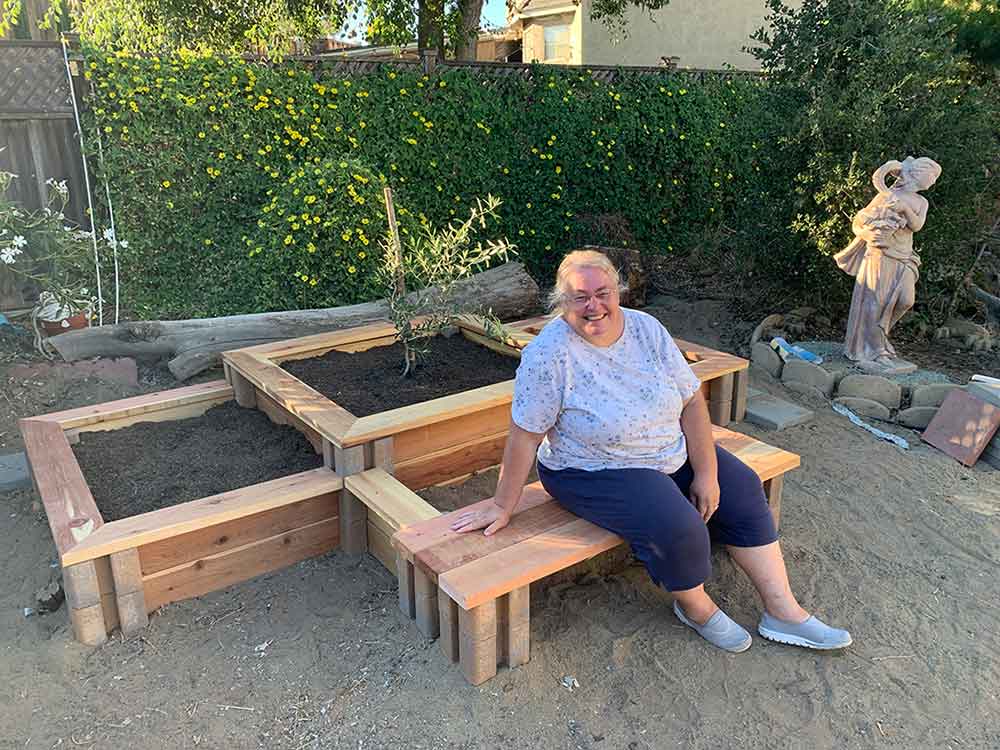
When Roni vows to tackle a project, you can bet that it will be completed in the utmost of timely fashions. Such was the case with this redwood planter box, which a month ago wan't even a concept on paper. But she was determined to rid the side yard of weeds with a project Glenn would find easiest to build, and so this was the result. The bench was a late addition, but so far we're loving it. Photo by Glenn.
June 29, 2022: The screen doors are here! The screen doors are here! And if that isn’t cause for a celebration then you surely haven’t been waiting on them for the past eight months as we have. Difficult as it is to believe, it was October when the contractors from Home Depot showed up with our new vinyl doors and windows and a promise that the screen doors — for which we had already paid — would be around in, oh, about six weeks. At the time, we were just starting to realize that supply chain bottlenecks were a real thing and that goods we once took for granted could take weeks if not months to arrive.
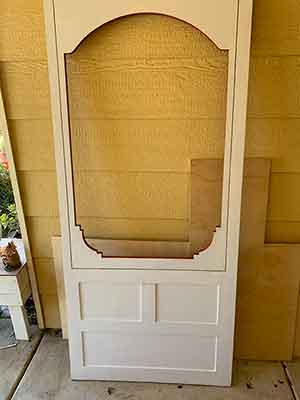
One of the best home improvements we ever made was also one of the simplest when we bought and installed our front screen door years ago. It had been looking a bit shabby recently from dirt and cat claw marks on the screen, so we used the occasion of the screen's replacement to spruce it up with a fresh coat of white paint on the interior. Photo by Glenn.
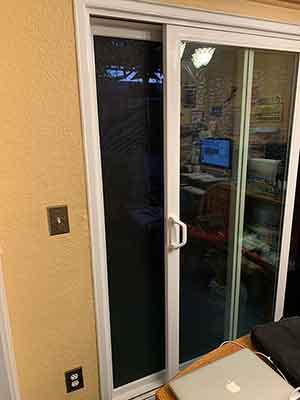
Speaking of screen doors, here's the one we've been awaiting these past eight months. Home Depot finally came through with the screens for our dining room and bedroom doors, just in time for the hot summer months ahead. Photo by Glenn.
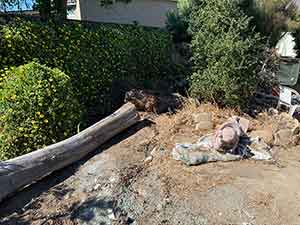
Roni wants to turn this weed infested section of the backyard into an oasis for greenery. We've got our work cut out for us to first get rid of the old ash tree. Photo by Glenn.
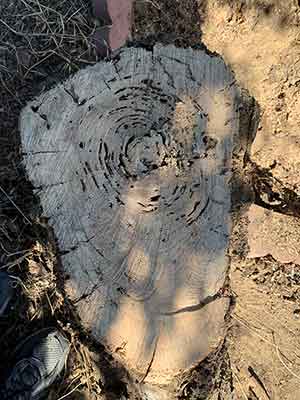
Here's the stump from the ash, which Glenn removed with a small chainsaw. You can see where the termites have been at work these past few years tunneling near the center of the trunk. Photo by Glenn.
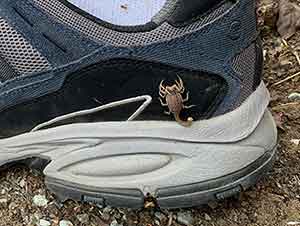
Glenn managed to pick up an unwelcome passenger while working in the yard. These scorpions thrive in our desert-like environment. They may look harmless enough, but they pack a painful sting if you're unlucky enough to come into contact with one. Photo by Glenn.
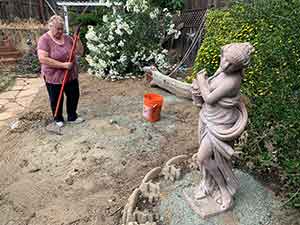
Spring is standing tall in her circle garden once more after we hoisted her back into place during the yard cleanup. She suffered minor damage when the ash tree collapsed. Roni is in the process of raking up some of the leftover gravel from our driveway project. Photo by Glenn.
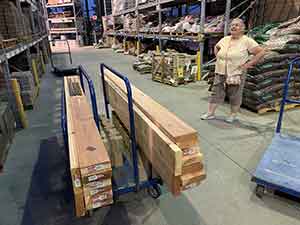
It's time to go shopping. We're at Lowe's in Brentwood, picking up lumber, bricks and other supplies to build our raised planter beds. Photo by Glenn.
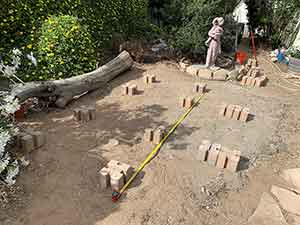
The first step in the planter box construction is to lay out the concrete corner blocks. We've got a rough idea of where they should be placed, but we'll fine tune things once the wood is cut. Photo by Glenn.
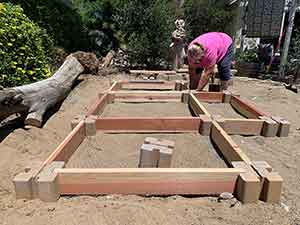
The bottom row of boards is installed for the planter. Photo by Glenn.
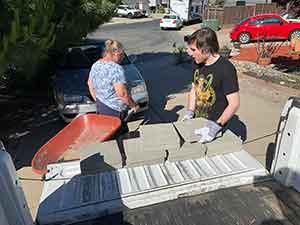
Ben helps us transfer 50 stepping stones from the truck to the backyard. He actually preferred taking them by hand to having to use the wheelbarrow. Photo by Glenn.
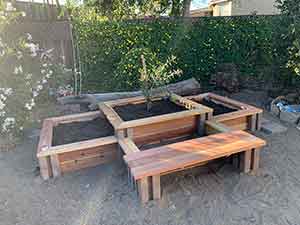
Here is the new raised planter box, mostly finished except for a few more plants and attaching the top rails to the sides. Roni has already planted an olive tree at the center. The front bench looks inviting. Photo by Glenn.
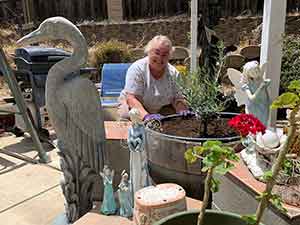
We actually purchased two olive trees. This is the other one, which we planted in the wiskey barrel on our patio to replace the crepe myrtle tree that succumbed to lack of water. Photo by Glenn.
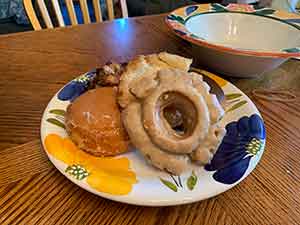
It's Father's Day. How do you know when you have the greatest son in the world? He buys you doughnuts, of course. Photo by Glenn.
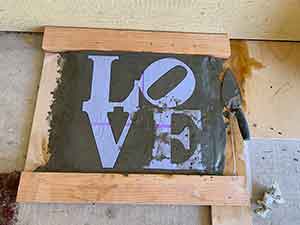
For our first concrete art project we chose to make a replica of the famous LOVE sculpture. Cutting concrete is a bit like cutting cookie dough, and pretty easy to do while it's still wet. Photo by Glenn.
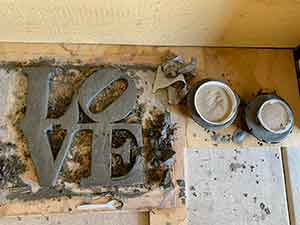
The concrete carving is drying and we have removed most of the excess cement from around the letter shapes. Photo by Glenn.
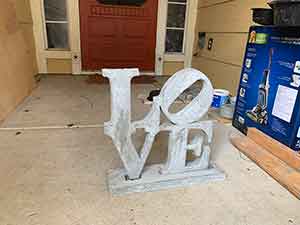
A couple of days have passed and the LOVE sculpture is dry enough to paint. Here we have placed it on its base before mortaring the two pieces together. Photo by Glenn.
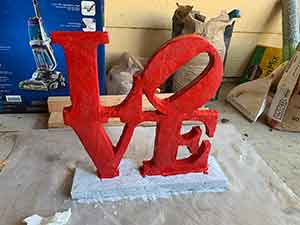
Are you feeling the LOVE yet? We've given it its coat of red paint and will soon paint the base black. Photo by Glenn.
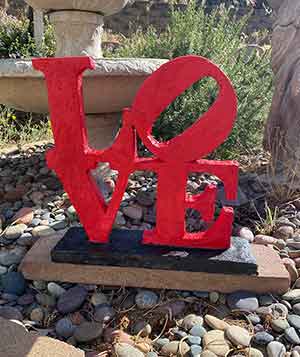
Here it is, all finished and installed in Summer's Garden. Those bright red letters really liven up our drab yard. Photo by Glenn.
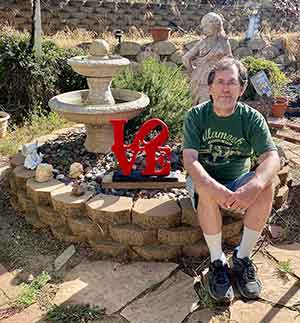
Sculture and sculptor appear side by side. Glenn can't take credit for the original work, which was designed by Robert Indiana. But imitation is the highest form of flattery, as the saying goes. Photo by Glenn.
In our case, those six weeks stretched into the new year and beyond as our patience waned and we grew concerned we might never see our screens. Periodic calls to the customer service department received vague updates, and eventually they stopped being returned entirely. And then one day we heard that the screens had in fact shipped from the factory and were on their way to us. When? Well, Home Depot said they’d call us when the installer was ready to bring them out.
We are generally patient people and understanding of a global pandemic’s power to disrupt the world’s economy, but we were getting ready to tell the customer service rep we’d install the screens ourselves if they’d let us bring them home from the warehouse, when lo and behold we got the call that we were on the schedule for a June 23 delivery. Could it really be?
Indeed it could. The installer guy showed up in our driveway a little past 8 a.m. that morning and escorted the screen doors through our living room and out to the back patio. He monkeyed around with them for a good 20 minutes before determining that they were mostly functional and he was ready to be on his way.
Well, mostly functional. The screen on the dining room door was a bit temperamental no matter how many adjustments he made, and ultimately we were told it was a function of the metal screen door frame siding across the vinyl track of the sliding door that caused the issue. We should hit it with a bit of silicone spray to make things operate more smoothly. Of course we bought that line because we had no way to test it ourselves. We’d have to procure some silicone spray.
After installer dude left, Roni remembered that she had some silicone mold release agent among her resin casting supplies. So we vacuumed the sand and dirt out of the track of the door and gave the track a few shots of the silicone spray. We did notice some improvement, but sadly not enough to make us ooh and aah at the door’s breezy operation.
What we’ve come to determine in just a few short days of screen door ownership is that we either got a lemon or the installation process was faulty. But given all the hoops we went through just to get the doors at our house, we didn’t want to battle with the customer service reps again. Nor are we brave enough to attempt to adjust the screen’s wheels for fear we might screw things up worse than they are.
So for now we are welcoming the cool breeze at the end of our hot summer days and we are doing our best to finesse the screen door when we open it.
* * * * *
A
ND A HOT SUMMER it appears to be, what with inflation spiraling higher and major political unrest brewing in the form of abortion and guns rights debates as we ramp up for November midterm elections. Add to that California’s annual incineration via wildfires and drought, a lingering pandemic that ebbs and flows, gas prices that won’t take a vacation so that average people who need one can’t afford to, and it’s starting to look like 2020 all over again.
Maybe what we need is a little more love in the world. Well, we did our part to contribute to a loving environment in June with a couple of fun, artistic endeavors that contributed to the beautification of our backyard.
Glenn has lately become interested in working with concrete after many hours spent watching folks on YouTube pour it, shape it and sculpt it into various useful objects from pots to statuary. So in June he decided to try his hand at a concrete art project, choosing as his first subject Robert Indiana’s iconic LOVE sculpture commissioned by the Philadelphia Museum of Modern Art in 1965 and erected in statue form in 1976.
We don’t have a lot of room in our yard for something the size of the installation in Philly, so we elected to go with a considerably smaller, 16-inch rendition. First, we headed to Lowe’s and bought a 47-pound bag of portland cement and a 60-pound bag of fine sand along with a trowel and several other instruments of concrete construction. Next, Glenn converted the LOVE image into outlines on the computer and printed out a paper template, much as he has done for the many wood cutouts he has made.
Unlike wood, which produces loads of sawdust, concrete tends to be very messy and less forgiving. We chose to work on the front porch because it provided a cool location and a flat, firm surface to work on. We protected the porch using thin sheet plastic like the kind used in painting prep work. But even that proved inadequate once we added water to the dry mix and started spreading liquid concrete everywhere.
Because we were making artwork as opposed to pouring, say, a patio, we wanted smaller aggregate in the concrete, hence the sand rather than gravel. Our mix was two parts sand to one part cement and one part water, which makes for a very runny mix. A bit too runny, as things turned out, because all that moisture took a long time to dry and made it difficult to carve the concrete as needed. Using a pair of 2x4 boards as guides, we poured out the concrete in a rough square on the porch and screeded it to about 1 inch thick. We let it firm up for a few minutes before putting down our paper template, realizing too late that printing paper quickly turns to sludge when exposed to water. We had planned to carve the sculpture and then remove the template so we could add reinforcing wire to it while still wet, but that proved impossible without tearing the template, so we gave up on that step after having limited success adding the reinforcement to the letter “E”
Carving the concrete was pretty easy, once it had firmed up a bit after two hours. We used a pocket knife to trim off the excess. Not wanting to waste anything, we recycled the scraps by using them to make a couple of small pots and to form the base for the sculpture.
After letting the design dry for a couple of days, we peeled it off the plastic and attached it to the base we’d created using a bit of wet cement as mortar. We wanted our sculpture to be free-standing, so the base gives it a lower center of gravity. All together it weighs about 15 pounds. Unfortunately during the assembly process we managed to break the top of the “E”, but thanks to the reinforcing wire it all held together and we were able to fix the break by brushing a bit of wet cement to the back.
Once the base had dried, we used watered-down white latex paint to give everything a base coat, then painted the LOVE in its iconic red and the base in black. We had wanted to put it in the front yard, but because of the breakage problem we’d already had and concerns that it might be damaged or stolen by neighborhood miscreants, we decided instead to put it in the backyard, placing it in the circle of Summer’s Garden where it really stands out and gets our attention every time we sit down at the dining room table and look out the back door.
* * * * *
O
UR OTHER BACKYARD project arose from Roni’s ongoing efforts to rid the yard of weeds, since every year it seems we are reinventing the wheel by attempting to rake and hoe the sand we cleared of debris just a few months earlier. As we’ve gotten older, there is less of a desire for all things yard work related, so the best way to combat the weeds is to not let them grow in the first place. Our answer to this annual question is: more rock.
Aside from the eastern yard behind our bedroom that we rarely ever look at, the largest spot that concerns us is the gap between Winter’s and Spring’s gardens on the western side that we can see from the dining room. That last point being the reason we wanted something pretty to look at, like the LOVE sculpture we’d just created. Roni had been leaning toward covering the area in decorative rock, but then we decided it would make better use of the property to build a raised planter box instead.
Roni had come up with the idea, but she wanted Glenn’s help to construct it. So she asked him what would be easiest — a raised planter constructed from retaining bricks, or one build from wood. We ended up compromising, creating the raised bed from both materials.
At the home improvement stores we found a cool concrete product that makes construction of a wood planter much easier. They sell 8x8-inch preformed blocks with notches carved into the sides wide enough to hold a 2x6-inch board. The blocks can be stacked up to three high and are held in place with rebar. Like the connection corners in an erector set or package of Lincoln Logs, the blocks serve as hubs to create boxes of any dimension based on the length of wood one uses.
In our case, we decided to build a four-box unit roughly 10 feet long by 6 feet deep, slightly modified from a basic set of plans the manufacturer supplied online. They conveniently told us how many boards we’d need and what lengths to use. After weighing the benefits of pressure treated lumber vs. the beauty of redwood, we decided to go with the more expensive redwood planks. Roni sat down to make up our shopping list.
Our eyes bugged out when she estimated the cost for our project at over $1,000. What? This was supposed to be the cheaper, less weighty alternative to using concrete retaining blocks alone. So Glenn ran the numbers a second time and discovered she had overestimated the amount of wood needed, thanks to some vague cutting instructions on the plan. That trimmed our bill by about half — still expensive, but closer to what we expected.
* * * * *
W
E PROBABLY SHOULD buy stock in Lowe’s, because they got a fair amount of our business for this project. It was there that we bought the 28 corner blocks and 19 8-foot 2x6s we needed, along with the 12 sections of rebar. The cart was so heavy that it nearly took the both of us to push it through the store and out to the truck.
Later, when we got the planter assembled, we would return to the home improvement stores to pick up 50 concrete stepping stones and 10 bags of topsoil mix. Fortunately we had Ben to help us unload those, although it helped to have use of the wheelbarrow to lug it all to the construction site.
The assembly project went fairly smooth — and quickly, thanks to Roni’s insistence that we get it finished while the weather remained relatively cool and while our interest in it was still high. Roni did most of the work clearing the site of weeds and debris that included gravel and paver sand left over from our driveway project five years ago. Glenn used his small chainsaw to remove the stump from our toppled evergreen ash tree, and Ben helped us move the trunk out of the way; we still might use it as a planter or bench if we ever figure out what to do with it.
The massive tap roots the tree had grown looked like they might remain in the ground for years, but termites and natural decay had been hard at work, and so we found the spongy wood broke apart quite easily once we were able to rake it up.
The site was mostly level when we sketched out the footing of our planters. We had to make some adjustments when we added in rolls of chicken wire for the purpose of keeping the gophers and ground squirrels from tunneling beneath the planter area. Once satisfied with the positioning of the corner rocks, we stacked them to their final height then hammered in the rebar. Glenn methodically cut the boards to length over a couple of weekends, thrilled to discover that the 19 boards he’d estimated and purchased were almost exactly enough to create all the pieces with a couple of feet to spare.
Last but not least, we decided to incorporate a wood bench into the project. The designs hadn’t called for one, but we thought that such an inviting spot needed a place to sit and appreciate it, so the bench got tacked onto the front planter box adjacent to the flagstone path that runs from our patio to Winter’s Garden.
It hasn’t taken Roni long to decide what she wants to do with the new planting area. We went to Home Depot and bought some roses and perennial flowers, as well as a few small vegetable plants for a garden. In the largest box at the center she planted an olive tree, one of a couple she bought earlier this month.
There are still some finishing details we need to do, such as screwing down the cap boards of the planter boxes, but the bulk of the work is complete. Next will probably be adding some art pieces to complete the scene.
* * * * *
T
HE CRASHING STOCK market continues to take no prisoners. Just when you think you’ve seen the worst, the bear continues to find new ways to savage unwitting investors, and especially those with an investment horizon beyond about 15 minutes.
The last two weeks of the month brought new devastation to our accounts as the Federal Reserve board tacked on three-quarters of a percent to base interest rates in its latest desperate attempt to curb inflation. Despite any hope for a market bottom and disbelief that some already pulverized equities continue to suffer daily drubbings, there appears no sign that the pain will be over this summer amid spiraling energy costs.
Difficult as it has been, we turn a blind eye to our dwindling account balance and continue to buy things we believe in for the long term. We added 100 shares of semiconductor manufacturer AMD and 22 shares of Canadian mining company Barrick Gold (GOLD) to our taxable account, as well as 300 shares of ChargePoint (CHPT). We are hedging a lot of this with options trades designed to increase in value if the market continues to fall — a prediction that hasn’t disappointed yet this year. We’re short on 200 shares of Apple (AAPL) on the belief (fear?) that its price will continue to drop as fall approaches and the likelihood of a recession grows more certain.
In Glenn’s IRA we picked up 100 shares of Archer Aviation (ACHR), a Bay Area-based startup working to develop a fleet of renewable energy-powered aircraft capable of vertical takeoffs and landings. It’s a very speculative play, but one of a few we are trying to build into our long-term investments as we look for growth beyond the more stodgy dividend payers. Most won’t be profitable until the end of this decade, if at all. Not the companies that are in favor in the current economy, but certainly priced to buy before an inevitable return to growth investments… sometime.
* * * * *
O
UR ONGOING FINANCIAL collapse was surpassed in June only by another type of crash, this one of the technological variety. If you are reading this newsletter now, it is nothing short of a minor miracle given the past several days have been spent in computer purgatory while Glenn has tried to resurrect his iMac from a catastrophic system failure.
These kinds of mega meltdowns don’t happen too often with Apple products, which is part of the reason people love them despite their premium price tags. But when things really go wrong, they can truly ruin your day… or week.
It was Wednesday, June 22, when Glenn woke up unusually early and thought he might get a jump on his day’s work for the Local News Matters website. He had no sooner settled in to tackle the task than Roni approached him needing design help for a rush project she needed for one of her clients. The huge graphics files resided on Glenn’s computer, so soon he had pulled them up and together we were churning out concept files for the client.
A couple of hours and a dozen design iterations into the project, Glenn went to save his work and the computer locked up. Time for a reboot. Except when the computer came back on line… it didn’t. No system file. Programs that should have opened didn’t, including the iTunes store. Was it a hiccup? No. Another reboot revealed the awful truth that the startup disk was corrupted and a repair wasn’t possible. Hooray.
That led to a mostly wasted day of backing up files and reinstalling system software. Because the computer is five years old and had already gone through a couple of minor system updates, its software was deemed too new to recover with the built-in recovery software Apple provided, so Glenn wound up making the leap to OS Monterey, Apple’s latest and supposedly greatest operating system. He was able to use the new software to update the old system, allowing him to keep all his preferences in the process. A real time saver despite all the hassle of having to recover the crashed disk.
But if things seem too simple they usually are, and so the following day when the computer started performing slowly under the new OS and Glenn gave up in exasperation for a what was supposed to be a quick reboot, the computer responded with the message that it had encountered an error and couldn’t boot. The startup drive was unrecognizable and unrepairable for good.
So short of cracking open the case of the iMac to install a new internal drive — no easy chore with an all-in-one computer — the only workaround was to buy an external drive and recreate the startup disk there. Count another day lost, but the pain didn’t end there.
* * * * *
T
HE EXTERNAL DRIVE workaround was good enough to get the computer running again, but performance took a serious hit thanks to it being an older machine now trying to run the latest operating system over an indirect connection. And because he had to rely on a clean install of the software, all Glenn’s preferences had vanished forever — passwords, website bookmarks, serial numbers for installed programs and utilities.
Worst of all was that the version of Adobe Suites CS6 we had been using and relying on for years now no longer worked with the new system. And because Adobe in its quest for profits had long ago switched to a subscription-based model called Creative Cloud, we would now have to purchase a monthly license just to use the programs we both rely on to perform our jobs. Adobe isn’t stupid, but we sure felt like we were when we plunked down $600 for an annual subscription to the entire suite of software just so we can use Photoshop, Illustrator, Acrobat and Dreamweaver.
To be fair, Adobe produces some good software that is the industry standard for creatives. We’ve often looked for reasonable free substitutes and have come away mostly dissatisfied. But that is not to say the suite isn’t bloated with code and extensions that hog a ton of memory and cause it to run slowly on older machines.
So far we are just getting by. Preparing this month’s newsletter proved to be an arduous task from start to finish, and that’s simply not what should happen with software designed to make your work easier. Perhaps with another month under our belts things will be better. For now, Glenn is relieved if he can get through a day of work without another system crash or other major incident leading to lost productivity.
And on that note, we’d better wrap up this month and get it posted while we still can!
