
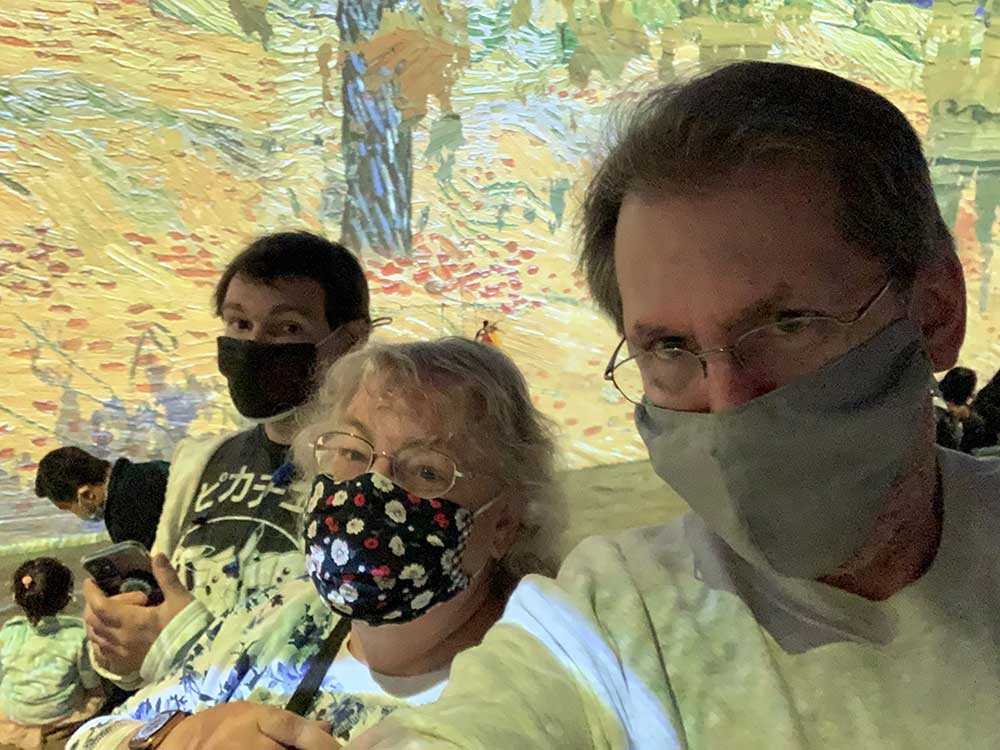
Surrounded by a digital swirl of pastels, we pose for a selfie during our May 16 visit to the "Immersive Van Gogh" exhibit in San Francisco. The show — one of several currently sweeping the nation — puts a high-tech twist on art appreciation. We give you our thoughts in this month's newsletter. Photo by Glenn
May 30, 2021: In an age when selfies and social media are everything, it is a sad truth that we sometimes find out more about the events we personally experience in hindsight than while we are actually living through them. Such turned out to be the case this month when we made a rare visit to San Francisco to take in the “Immersive Van Gogh” exhibit at the former Fillmore West concert hall.

It's Ben's birthday, and we're celebrating with a trip to the dump! Actually, he's spending some time with friends back at the house, so we're taking advantage of the opportunity to do some housework before the real party begins later. Photo by Glenn.
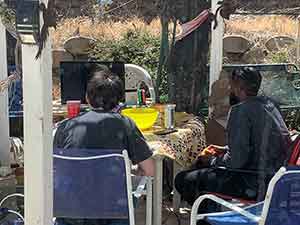
Ben and his coworker Nick play videogames on our back patio. It is one of the few times he has had guests over since the COVID-19 pandemic began in March last year. But hey, it's his birthday and we've all been vaccinated, so time to shed those masks and have some fun. Photo by Glenn.

A closer inspection of Ben's ice cream cake reveals that he is, in fact, 27 years old. Photo by Roni.
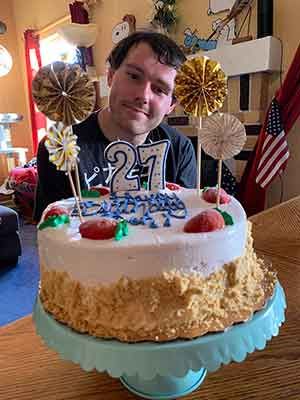
How about a smile from our birthday boy? Well, it's probably the most of a smile we ever get out of him. Photo by Roni.
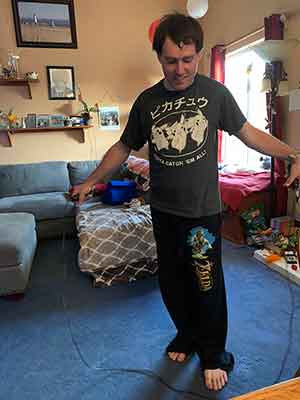
Ben has been interested in fitness recently, so we got him a workout set as one of his birthday gifts. It comes with weights, exercise mat, jumprope and some other essential gear. We also got him his own scale so that now he won't have to use ours. Photo by Glenn.
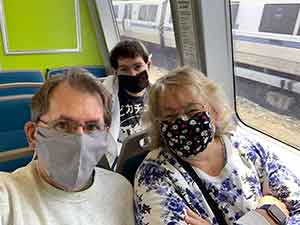
It's Sunday morning, May 16, and we're settled onto BART for a ride into San Francisco to see the "Immersive Van Gough" exhibit. Not many people on the train these days, thanks to the pandemic; the system is running at roughly 15 percent of its pre-pandemic ridership. Photo by Glenn.
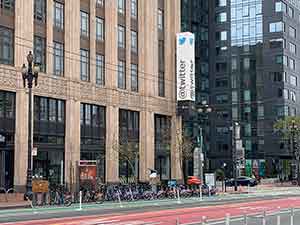
The exhibit hall is just a few blocks from the Civic Center BART station. We pass the headquarters of social media company Twitter during our stroll along Market Street. Jack Dorsey was nowhere to be found. Photo by Glenn.
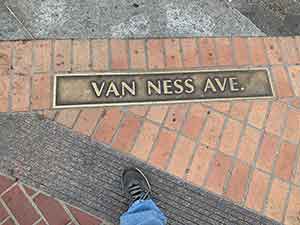
As the sign says, we're waiting for the light to change at the corner of Market Street and Van Ness Avenue. The exhibit hall is at the opposite corner, about the direction Glenn's foot is pointed. Photo by Glenn.
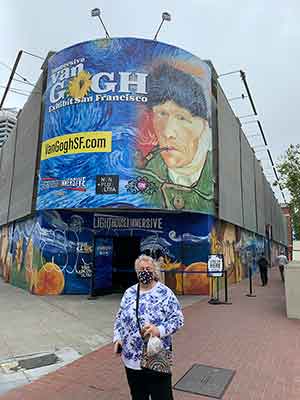
We're outside the SVN West (formerly known as The Fillmore), just about to head inside to see the Van Gogh exhibit. It's difficult to see here, but a few of the neighborhood graffiti taggers have provided their own art for visitors to see. At least it's free. Photo by Glenn.
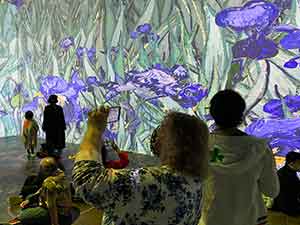
Images from Van Gogh's "Irises" series are playing on the walls when we enter the auditorium. We're too fascinated to think about finding a seat just yet. Photo by Glenn.
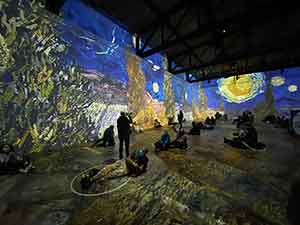
Exhibit attendees sit in their social circles to watch Van Gogh's art pass by. Digital projectors focus the ever-changing scenery perfectly on every surface, including walls and floors. Photo by Roni.
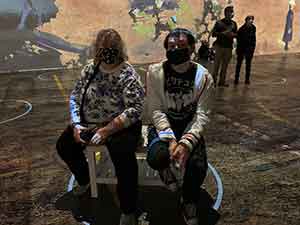
A few of the circles included chairs or benches to sit on. We were lucky enough to find one. Photo by Glenn.
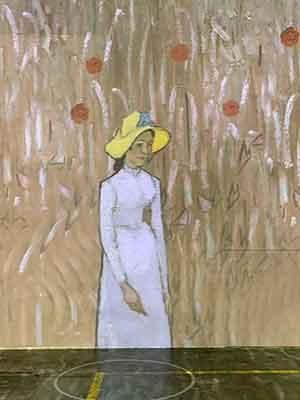
The creators of the Immersive Van Gogh exhibit took great liberties with the original artworks to create something new. This is "Girl in White," transposed from its left-facing orientation as Van Gogh painted her. Here she is walking across the scene. This image, in various sizes and orientations, was repeated on every wall in the theater. Photo by Glenn.
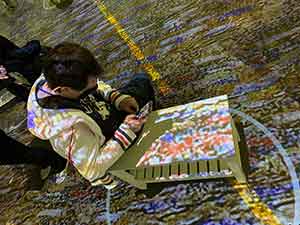
There were mesmerizing moments at the Van Gogh exhibit, including this one where a kaleidoscope of color was splashed about the room like rain. Ben attempts to photograph the digital projection on our bench. Photo by Glenn.
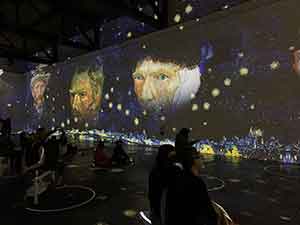
We're near the end of the show. Various self portraits of the artist appear to float god-like in the heavens It's sort of a creepy way to conclude the presentation. Photo by Glenn.
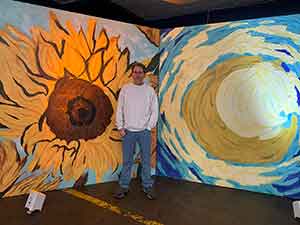
Outside the Immersive Van Gogh gift shop you have the opportunity to immerse yourself in a Van Gogh painting. Photo by Glenn.
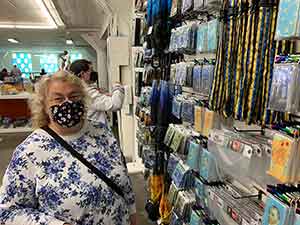
Roni and Ben look for souvenirs in the Immersive Van Gogh gift shop. There were lots of magnets, keychains, and even a few smartphone cases for sale. Photo by Glenn.
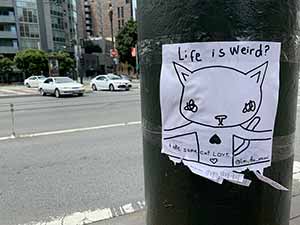
In San Francisco, when things get too weird there is always something weirder to take your mind off of it — like this poster offering tear-off nuggests of inspiration for passersby. Photo by Glenn.
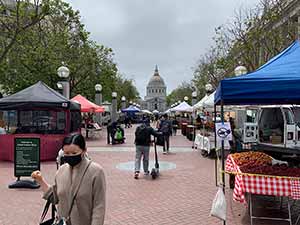
We've wandered into United Nations Plaza where the Heart of the City Farmers Market is in progress. That's the dome of San Francisco City Hall in the distance. Photo by Glenn.
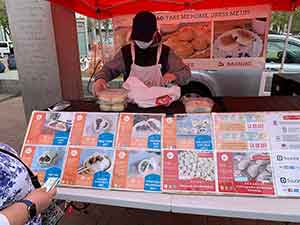
A street vendor bags our purchase of bao buns, which looked like a good choice for dinner. These were easy to transport home on BART. Photo by Glenn.
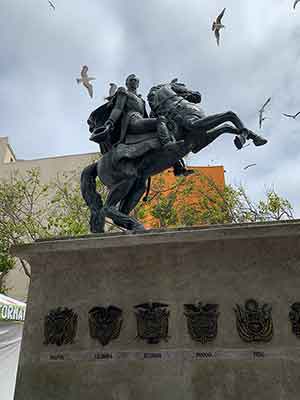
A statue of Simon Bolivar appears to be rallying the seagulls to victory. In an era when it seems like just about every public tribute to great figures of the past is under assault, this is one statue that has managed to escape the vandals. Photo by Glenn.

It's Mother's Day, and we throw in this photo for no reason other than it's a peaceful Sunday morning two days after our street was rocked by yet another late-night karaoke party. Peace is a cause for happiness these days. Photo by Glenn.
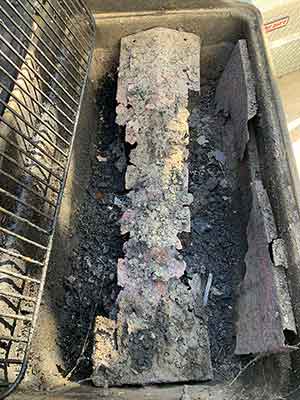
Being Mother's Day, we thought it would be a good time for a backyard barbecue. It might be time to replace some worn parts, however... Photo by Glenn.

Drumsticks are cheap and easy to prepare on the grill. This is the first barbecue we've had in more than a year and a half. Photo by Glenn.
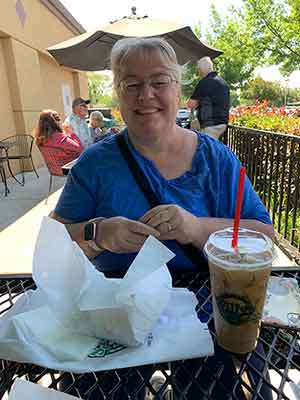
California is mere weeks from lifting its stay-at-home mandate, but people are already starting to return to their outdoor activities. We're at Willy's Bagels in Brentwood on the morning of Saturday, May 22, where Roni gets her first taste of open-air dining, sans mask. Photo by Glenn.
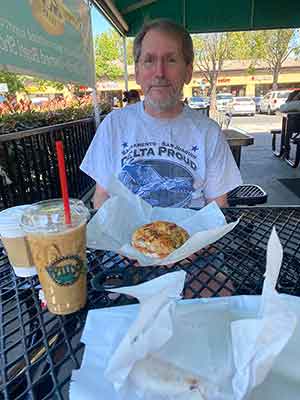
Glenn displays his bagel and two drinks — the hot mocha he chose, and the caramel macchiato he inherited from Roni after she discovered they mistakenly gave her a coffee drink instead of the chai tea she ordered. Roni doesn't do coffee! Photo by Roni.
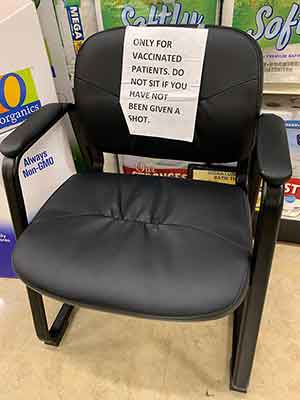
We're going to look back on this period in our nation's history with great puzzlement as to some of the things that were or weren't done in the name of the pandemic. This chair for "vaccinated patients" is located inside the Brentwood Safeway store outside the pharmacy. Ignore for a moment the fact that it is in the middle of a busy store that has been open throughout the pandemic, where people handle thousands of grocery items each day whether or not they have been vaccinated. If you are going to catch COVID, it probably won't be from this chair. Photo by Glenn.

Here is what you don't want to see when you are trying to make an online purchase. The U.S. Mint couldn't keep up with demand on the first day of pre orders for its commemorative Morgan dollars, and this was all we got to see when we attempted unsuccessfully to buy one. Photo by Glenn.
Roni was very excited about this show, particularly after learning about it a few months ago when it was making the rounds of Europe. A new twist on static art exhibits where visitors make their way through a museum gallery staring at framed canvases hung on the wall, Immersive Van Gogh promised attendees an interactive multimedia experience with the artist’s most recognized works digitally projected on every surface of the room, moving and changing before their eyes while musical accompaniment helped set the mood. Given that Vincent Van Gogh was one of the most recognizable figures of the Post-Impressionism period, it might be said that the immersive exhibit was its creator’s impression of impressionist art. And therein, perhaps, was the root of the problem with Immersive Van Gogh.
You see, what we didn’t know when we booked our tickets to the San Francisco show last fall — more than half a year in advance, as we pushed our reservation to the very last available weekend of its initial run in hopes that the COVID-19 pandemic would be history by then — is that Immersive Van Gogh is actually one of at least five such events currently touring the United States, each of which tours under a different name. And just as those names are all somewhat similar yet different, so too are the ways individual elements are assembled and presented between shows.
To paraphrase a Wikipedia entry on the subject: “Events held in the United States include ‘Imagine Van Gogh: The Immersive Exhibition,’ the ‘Immersive Van Gogh Exhibit,’ ‘Van Gogh: The Immersive Experience,’ ‘Van Gogh Alive,’ and ‘Beyond Van Gogh.’” Confused yet? Ticket prices range anywhere from $25 to $75 per person, and many people have complained that the similar naming has caused them to accidentally purchase tickets to the wrong event.
Count us among that group.
Roni bought tickets (at $55 each) for the three of us to attend the May 16 showing at the former Fillmore, and knowing nothing of the multiple iterations of the attraction, we blissfully went on our way to deal with the other concerns of 2020, including how to muddle through the holidays while wearing masks and remaining six feet apart.
* * * * *
F
OR US, THE biggest issue with Immersive Van Gogh it seemed we would confront was how to get to the city. To drive or not to drive is always the question when touring San Francisco, and despite the many conveniences provided by leaving the car in the driveway and hopping aboard public transportation, Ben was having none of it. He remembered his last trip on BART — a weekday afternoon commute with standing room only from Hayward to Concord — and was adamantly opposed to the idea. But much has changed since the start of the pandemic, and those once-crammed BART trains are currently running at 15 percent capacity.
Roni favored the idea of having the car with us in case we wanted to explore San Francisco after seeing the exhibit. But being that she was our designated driver and we weren’t all that sure where we would find parking near the show, not to mention what traffic in the city might be like, she eventually came around to the idea that BART was the better option. And so with a bit of arm-twisting and grumbling on Ben’s part, we found ourselves at the Antioch eBART station a little before 11 a.m. on a warm Sunday morning. We knew it might be chilly in the city, so we wore our sweatshirts despite concerns we might have to carry them around later if the temperature picked up.
BART was quiet, as expected. An advantage to catching it from the end of the line is that you have your pick of the seats, so at least we were all seated in the same part of the car for our ride across the Bay. We reached the Civic Center Station on Market Street a bit after noon, which left us plenty of time to stroll the four blocks to the exhibit hall and grab some snacks from the All Star Cafe at the corner of Van Ness Avenue. No one wanted to see Van Gogh on an empty stomach.
Our appointment time for the show was just before 1 p.m. The tickets said we should plan to arrive half an hour early, but seeing as there was no line stretching around the block, it looked like we’d have no problem getting inside. In fact, once we’d polished off our doughnuts and cinnamon rolls, we decided to see if they’d let us in the door early, and they did. An attendant scanned our tickets and we proceeded up a set of stairs with some clever word play displayed at the top of each landing — “Gogh this way”... “Keep Goghing” — And because we all had to… well, “Gogh,” after our long BART ride, we made a quick stop at the all-gender restrooms on the top floor as an exhibit worker gave a quick rundown of what we would see behind the black curtains and down the long hall to our left.
Reassembled and filled with anticipation for this highly touted exhibit, we entered the dark corridor expecting to get our first glimpse of interpretive panels or some interactive feature that would introduce us to the great master. Instead, we were led to another set of curtains that opened into the main exhibit hall, and we were instantly surrounded by the shimmering blues, greens and golds of Van Gogh’s “Irises” paintings. On the floor, separated by illuminated circles spaced six feet apart, were dozens of masked people — some standing and others seated on benches or bare wood — taking it all in. An observation platform towered inconveniently in the center of it all, obscuring what otherwise was a 360-degree panorama projected onto all four walls of the hall, floor to ceiling.
“This is it? OK, I guess this is it.” That was the extent of the conversation as we searched around the hall and realized the only doorway was the one we had just come through, and it led only to the exit. So no interpretive displays or anything else to look forward to, just a 32-minute video program played on an endless loop as guests stood around to, apparently, take it all in. We found an empty circle and took our place in the exhibit hall, smartphones in hand, to document our immersive experience, such that it was.
* * * * *
W
E'D ARRIVED IN the middle of the program, but a docent assured us that we’d be able to stay as long as we liked to see the complete presentation from start to finish. And it was quite the show — the effort that must have gone into reworking Van Gogh’s art and combining the digital images seamlessly into something new and beautiful was impressive. Flowers, trees and dazzling fireworks sprung to life on the walls, while larger-than-life images of grizzled fishermen and fair maidens seemed to walk from one corner of the room to the next. A painting of a sun-drenched field at harvest time morphed into an eye-level journey through a real-life image of tall stalks of wheat. Scenes from “Starry Night” twirled in the sky, their reflections shimmering in the calm waters beneath a stone footbridge.
We did our best to photograph things with our iPhones, but the pictures would never do it justice, so we spent most of the show sitting back and observing the ever-changing scene and watching others in the exhibit hall do the same. In fact, people watching was one of the best parts about “Immersive Van Gogh.” Some sat unmoving in their social circles while others hopped from point to point around the hall. A few hugged the walls as if trying to become part of the scene. We tried to work up the courage to approach the attendant about heading up the stairs to the observation deck, but the platform was usually busy and looking down on the room didn’t seem like the ideal vantage point to enjoy the show, so we spent the entire time at ground level.
There were no limits on personal photos or moving about the room, so people did pretty much whatever they wanted. The one rule the docents enforced was a ban on flash photography, and when Roni at one point accidentally forgot her flash was set to auto, the attendant quickly descended on us with a warning. It was a minor slap on the wrist, however.
Ben’s attention span waned before ours, so by the time the show had looped back to the point where we’d arrived, he was ready to go. He was notably disappointed that the show had turned out to be less about learning the history of Van Gogh and his art than about creating eye candy for the digital generation. No original paintings and not even a lithograph, just the movie. Glenn called the experience “Van Gogh lite remixed mashup.
Roni was less harsh in her assessment, and once the credits rolled a second time and we had sat through the entire presentation from start to finish, she was eager to head to the gift shop. We shopped an underwhelming collection of overpriced pins, magnets and postcards, then headed out onto Van Ness Avenue in search of what we hoped would be lunch.
But this was San Francisco’s financial district on a Sunday amid a pandemic that had radically altered the city’s dining scene, so finding a place that was open and serving something we wanted to eat proved difficult. And on top of that, we weren’t in the nicest part of town; Market Street was awash in homeless people lounging in doorways and panhandling along the sidewalk. Since we had no car and had to walk that way to get back to BART, there were few dining options available.
We soon wound up at United Nations Plaza, which in better times might have enticed tourists like us with its sculptures and inspirational messages carved on columns and embedded in the concrete walkways. Today, however, the plaza looks worn and destitute, its public spaces fenced off and overrun by homeless people. The Heart of the City Farmers Market was starting to close up for the weekend, but a few vendors were still doing brisk business selling fresh produce and other items. We stopped at a booth where a man was peddling frozen Korean bao buns, and after he tempted us with a buy-two deal, we purchased a couple of four-packs to take home with us for dinner.
But that didn’t fill our stomachs right then, and we didn’t want to face an hour long BART ride without a bite to eat, so when we saw a food truck at the edge of the plaza selling Mexican street tacos, we bought some. Still, there was no place to sit except for some concrete benches on the plaza filled with street people, so we tried to eat our fare while walking slowly back toward BART — not easy to do when you are wearing a mask, carrying bags or being pestered by random people for whatever it is you are eating, as Ben was. Not to mention that the odor of human excrement does little to whet one’s appetite. We eventually decided to put our unfinished meals in our souvenir bag to have when we got home.
* * * * *
W
HILE OUR DAY in the city hadn’t quite lived up to expectations, we nonetheless appreciated the fact we had been able to make the trip at all, seldom as it has been during the pandemic that we have ventured anywhere. The Immersive Van Gogh exhibit had been a letdown, sure, but we chalked it up to luck of the draw — sometimes things don’t turn out to be as engaging as they first appear from commercials. Buyer beware.
And then we turned on YouTube.
Not wanting to spoil the experience of our visit, we had refrained from watching others’ video accounts of the event in advance. Now we were eager to compare notes. And this was when we came to the discovery that there were other traveling Van Gogh exhibits that were not accidentally designed to resemble one another. Some people had even filed complaints with the Better Business Bureau after purchasing tickets to one show thinking it was another.
We watched a review of the “Beyond Van Gogh” exhibit in Miami, Florida, and came away feeling both anger and jealousy. Angry that we’d paid more for the show we’d attended, jealous because theirs was filled with the interpretive panels and multiple rooms ours hadn’t offered. And their gift shop was much larger, featuring things such as T-shirts and coffee mugs that we surely would have bought rather than $20 keychains and $5 postcards.
In another video review of the San Francisco show we’d just been to, we learned that customers received a free commemorative poster when they walked in the door. Wow. We’d seen those posters too, but no one was handing them out on our visit.
All in all, “Immersive Van Gogh” or whatever it is called was worth checking out once. The visuals are stunning, and the show represents a new style of performance art that is likely to become more common in our tech-obsessed culture. But the deliberate deception on the part of the promoters can’t be overlooked, and so we’d caution others to research what they are getting before buying tickets. Oh yes, the San Francisco show has been extended through Sept. 6.
* * * * *
I
T HAS BEEN a wild couple of months for our investments, as the economy continues to recover from the pandemic and the financial markets grapple with fears of runaway inflation that may or may not materialize. This has led to a dramatic rotation out of growth stocks and into once-shunned value names that were decimated by the COVID-induced shutdowns more than a year ago. Since much of our investment strategy now relies on options, which behave quite differently than the shares of underlying stock they control, we have enjoyed some significant wins and a few crushing defeats.
March and April were both very good months for selling put options, which were largely responsible for generating $6,000 and $5,200 respectively. There was a reason for that, as we learned in May when the markets sold off, as most experts warned they eventually would have to. The good news is that we expected this and had lightened up on our trades. The bad news was that positions we had already entered fell so dramatically it may be weeks or months before we can escape them profitably. Consequently, May’s $3,700 — our worst month yet in 2021 — looks pretty tame by comparison as we tally our cash flow from trading activity.
When it comes to selling put options, the last thing you want to do generally is buy shares, although if done strategically it can allow you to own the stock at a discount since you receive a cash premium up front when you enter the contract, which reduces your cost basis. The key word is “strategically,” which we’d like to believe happens with every option we sell, although in reality we sometimes get tempted to make trades we shouldn’t because the premiums are so juicy. And when that strategy backfires, it can bite hard.
Our largest position this year by far was on Apple (AAPL), a long-term bet that the stock would rise above $140 a share on the back of great earnings and the promise of new iPhones, computers and electric vehicle development during the course of the year. But when the markets began to slide, so too did Apple along with any hope of it hitting 140.00 for now. We awoke the morning of May 19 to discover we owned 100 more AAPL shares and our cash reserves were lower by $14,000. If this sounds familiar to what happened in March, then you will remember that this trade was the result of that one, which also ended with assignment.
Given this was the second time in two months we’d had the misfortune of having to purchase Apple stock unexpectedly, we decided it must be karma and opted to keep the shares. To date, the stock is still showing weakness and we’re about $1,500 in the hole, but we expect it will recover eventually and so are content to hold it. But Apple now represents more than 8 percent of our entire portfolio, so as much as we love the company’s products we are nonetheless dangerously overweight their stock.
Just two days after our AAPL purchase, an option we’d had for two months on electric vehicle maker Lordstown Motors (RIDE) expired in the money, just below our 10.00 strike price. A very small position, we decided to own the 100 shares instead of buying back the put at a small profit. Because we received $120 when we originally entered the trade, it was like buying the stock for $880. So now we own shares in an EV company with no products (yet) and no revenue. But at least we can sell covered call options against it. Exciting times.
We at last threw in the towel on our remaining shares of “meme stock” AMC when it rose to ridiculous new heights on May 27, selling at 26.05. It has traded higher since then and could “go to the moon” as the WallStreetBets community likes to say. But our appetite for risk is much lower than those young’uns and we don’t have “diamond hands” when it comes to holding onto overinflated equities, so we were happy to exit with only a modest overall loss on the position we started less than two years ago. People are crazy gamblers in the market right now. Good luck to them.
* * * * *
O
UR LITTLE BOY Ben turned 27 this month, so while he will always be our baby he is getting further away from those days of diapers, late-night feedings and Thomas the Tank Engine cartoons. But not from the virtual and gaming worlds that so dominate the interests of his generation, and so it was on his birthday that he was happy to have a couple of friends over to engage in exactly that.
With COVID still a concern while people are in the process of being vaccinated, we all decided it would be best to have his small gathering outdoors. He set up a table on the back patio and brought out his PS5 with a monitor so he and his guests could play their games under the shade of the BAP pergola. And because Ben did all the prep work for his party, we got a clean patio out of the deal, so we were happy to let them have their fun.
While Ben partied, we used the time to make a trip to the dump that we had been putting off for weeks. Roni had been diligently filling up the back of the truck with yard debris, so we made the run over to the Pittsburg Transfer Station and got rid of loads of rotting wood, tree trimmings, a couple of olds toilets and the original cushions from the sofa we refurbished in the den.
We celebrated Ben’s birthday as a family later that day with sushi rolls and Chinese takeout for dinner, followed by an ice cream cake from Cold Stone Creamery.
Our neighbors at the Loud House next door have been doing some celebrating of their own lately, and it seems the neighborhood has finally had enough of the midnight parties, blasting music and bad karaoke that have brought dozens of people and vehicles to our once quiet cul-de-sac.
After we all suffered through one such party Friday, May 7, that stretched into the wee hours of the morning, they were assembling to repeat the process just one week later. We had all bunkered down beneath our headphones in anticipation of more misery when Ben noted some unexpected party attendees out on the court — two Oakley Police Department vehicles. And it wasn’t even 8 p.m.
We don’t know who called the police or what was said to the hosts, but things got considerably quieter after that. The amplified music was turned way down and the party broke up at a more reasonable hour. It has been more than two weeks since and things have been peaceful. This being Memorial Day weekend and the unofficial start to summer, we are holding our collective breath that the atmosphere remains calm. Fingers crossed.
* * * * *
T
HE LAWS OF supply and demand have been affecting everything lately, although we hope that some of the product shortages we’ve experienced recently will subside as the world’s economy gradually rights itself, post pandemic. We’ve been dealing with sticker shock at our local grocery stores, and even when products are available they are sometimes inferior in quality to what we are used to. Lumber prices are through the roof, which is because housing demand is high and supplies from overseas can’t reach us fast enough. Cellphones, automobiles and other sought-after consumer products have been impacted by lack of computer chips. The one thing that hasn’t been in short supply lately? Toilet paper.
Yes, the thing that couldn’t be found on any store shelf anywhere at the start of the pandemic has come out of hibernation. We were shocked to find a mountain of 30-roll packs at Costco this week, so of course we had to buy one just because we could. That and paper towels, which had also been tough to find. We could have picked up bulk supplies of hand sanitizer too, but we rarely used it before COVID, so why start now?
Among the commodities that remain difficult to find are precious metals. The price of silver is near an all-time high, and consequently that has made it difficult to purchase even when it is available. Case in point is the U.S. Mint’s recent release of the 100-year anniversary commemorative Morgan dollars, the first of which went on pre-order sale May 27. Glenn doesn’t collect coins like he once did, but the new Morgans got his attention and so he attempted to purchase one the moment they went on sale at 9 a.m. that day, knowing the likelihood of success was small because of the limited production and high interest.
His hopes grew when he successfully placed one of the coins in his online cart and was able to proceed deep into the checkout process, being allowed to create his account and even supply his credit card information, which the website happily accepted. Or at least it appeared to accept it until, seconds later, a message popped up that the page he was looking for was “no longer available.” He went through the order process a second time and was informed that the server was down. No confirmation message, no sale, no coin.
Glenn was not alone, of course, as thousands of equally disappointed numismatists took to social media to recount their failures with the mint’s website. Acknowledging the overloaded server fiasco, the U.S. Mint sent letters of apology to customers (potential customers, that is) a few days later and said they planned to delay the product launch dates of other coins in the series until the server issues could be addressed. Too little too late, as far as we are concerned.
Will Glenn attempt to purchase the next commemorative Morgan dollar when it is released? Of course. But it’s probably going to require more luck than skill to pull off this one, so he’s not holding his breath.
