Rio's fight for life
August 25, 2011
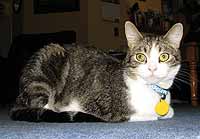
We made our first visit to the vet in late June, when we noticed that our cat Rio was having problems in the litter box. He had long had soft stools, and even when he was at the pound before we brought him home, his caretakers had made note on his medical chart that he had been treated for a bout of diarrhea. They had dewormed him, and there was no mention of anything after that. We assumed that the poor kitty had a sensitive stomach, as for months we’d been feeding him canned food and noticed the litter box was particularly messy after he used it.
But what got us — and him — to the Antioch Veterinary Hospital was when we began finding bloody discharge around the house and heard him straining to do what should have come easily at the box. He also seemed more listless than normal, less interested in playing with our other cat Katy than he used to. The vet said he looked generally healthy aside from some weight loss, so she pumped him with subcutaneous fluids, prescribed a 10-day course of pills, and ran a test for cancer and feline leukemia, which came back negative. She sent us home $200 lighter and we waited for a few days for the meds to take effect.
Rio, being a cat, of course was wise to our attempts to get the pill down his throat each day. We followed the advice of other veterinarians and cat owners online who talked about having one person pry open his jaws while the other used a “pill popper” to insert the pill into his mouth and pop it to the back of his throat where he would swallow it reflexively. Yeah, right. Rio’s jaws clamped shut with all the yield of a vice grip, and on the one occasion when we did get the pill in his mouth, he quickly spit it back out.
Roni solved the problem with a product called Greenies that we found at PetSmart. They are little chewable pockets that conceal the pill so the cat thinks he is eating a treat rather than the medicine. Rio was skeptical of these at first, but when Katy greedily scarfed them down (minus the pill) he was reassured that the Greenies were fit for consumption and went along willingly with the program.
By the end of the 10 days the diarrhea had ceased and we thought we were on the road to recovery. But then the listlessness returned along with a new refusal to eat, and we could see that he was losing more weight. Although we didn’t have a way to check his temperature, we could feel that he was burning up. And soon he developed a small sneeze. So on July 29 we returned to the vet for a follow-up diagnosis.
Yes, Rio was running a bit of a fever. In fact, he’d had it when we brought him in the previous month as well. He seemed interested in food when he actually did choose to eat, so the vet didn’t suspect it was something as simple as a cold. That and the continued weight loss — he’d dropped another pound since our earlier visit — led her to conclude it might be something more sinister: Feline Infectious Peritonitis, or FIP. We had never heard of this, but apparently it is fairly common in our county and, unfortunately, fatal.
We anted up another $300 for blood tests and fluids and a 2-week course of antibiotics that would hopefully knock out whatever he was fighting in the event it wasn’t FIP, while we waited for the test results. The vet called us the next morning with the dreaded news: Rio had FIP and might not live another two months.
Two months? But he was such a young, healthy cat before we treated him for the diarrhea. How could he have contracted the fatal illness when we’ve kept him indoors and kept his shots current since bringing him home July 1 of last year? As we learned, FIP is spawned from the corona virus, which virtually all cats are exposed to, and can lie dormant for months or years before the cat starts to exhibit symptoms. For most, their immune systems kick in and the cat never gets sick, but can remain a carrier of the disease. It was possible that Katy and Rio were both exposed to FIP while they were in the shelter, but Katy for whatever reason didn’t catch it. The biggest problem with the vet’s diagnosis was that we didn’t test specifically for FIP (another $190) and the test itself isn’t foolproof, so she was reluctant to prescribe it. She was relying solely on her experience of 11 years in private practice, and she had seen many FIP cases before.
Still, we clung to a sliver of hope that her diagnosis had been wrong this time. Roni started a regimen of hourly feedings and encouraging Rio to drink, determined not to let his weight sink further and to help him regain his strength. We hoped that a new round of subcutaneous fluids would help him break his fever so he would regain his appetite. Meanwhile, we looked for other possible causes of his illness. And after doing some research, we suggested to the vet that he might be suffering from Valley Fever. It was definitely a shot in the dark, given that it is rare to begin with, but remembering back to when Glenn had it and seeing how Rio had similar symptoms, why couldn’t that be a possibility?
Apparently the vet agreed, although it would take another test ($120) to confirm that diagnosis, along with chest x-rays. Then there would be months of antifungal medicine to administer. If we were right. The vet said we could test it out by using the leftover fluconzole Glenn had from his treatment, giving Rio 200mg a day, half a tablet in the morning and half at night. If we saw any improvement then there was a chance we were on the right track.
Unfortunately, we didn’t see much improvement. Rio continued to grow weaker and the sneezing fits that gripped him every time he ate were becoming more severe. So it was back to the vet on Aug. 12, this time to see if there was anything else that could be done. He hadn’t responded to the antibiotics and had lost another pound; it was to the point where we could feel his spine and the vet could see the bones in his hip joints, which meant that he was losing muscle mass, which wasn’t good. His fever was lower, but still present. We could put him on a steroid to boost his appetite and make him more comfortable, but unless we ruled out Valley Fever as the cause (that $120 test we hadn’t done) she couldn’t prescribe it to him because the steroid with Valley Fever could hasten his demise, as it lowers the immune system.
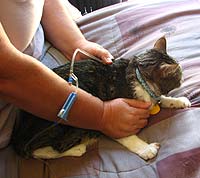
We decided to do another course of subcutaneous fluids, only this time we would administer the injections ourselves once every couple of days. The vet showed us how to hook up the needle to an IV bag and told us how much fluid to give, then sent us home with a 1,000ml bag of lactated ringer’s solution and enough needles for five doses ($98).
If we thought giving Rio a pill was tough, how would he take to having a needle inserted between his shoulder blades by rank amateurs? Apparently better than we thought. With Roni holding Rio down so he wouldn’t dart off the bed, Glenn carefully found the loose skin of Rio’s upper back and slid the needle in. We got about half of the dose administered before Rio suddenly bolted off the bed, taking the needle and IV line with him. We figured that was good enough for one day and let him slink back behind the bed to rest. He probably would have darted under the bed, except that we precluded that by disassembling our bed frame and putting the mattress directly on the floor, because he was spending all his time under there once he grew ill and it was hard to reach him when we needed to give him his pill.
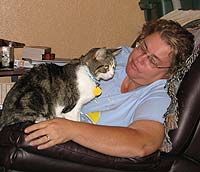
Subsequent injections went more smoothly, and after a week we were done with the bag. Best of all, the fever was down a bit, he was eating more heartily, and we noticed he was back to his old self somewhat, venturing out into the living room more to be with the rest of the family. He might not have gained much weight, but he was certainly eating well again, to the point that he was more aggressively battling Katy for first dibs at the food bowl. He even started purring again, something we hadn’t heard much of for the previous couple months.
Whether this means he has turned a corner for the better is hard to say. We aren’t trying to fool ourselves into thinking he is on his way to being cured of whatever he has, and in all likelihood he will continue to have health issues for as long as we are blessed to have him in our family. A “poor doer,” the vet often says, meaning that he isn’t thriving the way a healthy 16-month-old cat should. It may just be a matter of time, but for now we are waiting and watching and thankful for every minute we have with him.
The news of Rio’s illness put a damper on what already has been an unusual summer. It was very much on our minds as we journeyed to Courtland on July 31 for our annual visit to the Delta Pear Fair, although we did our best not to let it interfere with the festivities.
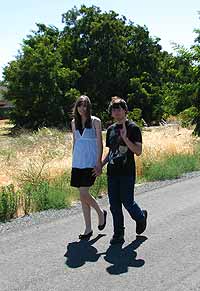
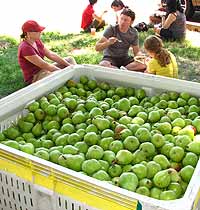
Ben brought along his girlfriend Lea, and the two of them spent much of the afternoon hanging out together near the car show. We were fortunate to have cool weather, as the Delta can get very hot in mid summer, and there was no shortage of pear goodies when we arrived by 10 a.m., unlike some past years where many of the confections were sold out before noon. Nonetheless, we made sure to make our first stop the pear pie booth, where we picked up our dessert for the night. While Glenn juggled the pink pie box, Roni stopped off at the booth next door and bought a sample of pear strudel. Mmmmmmmm. Add to that a package of pear cookies, a tin of pear bread from Lions Club booth, and the huge pear ice cream cones we got on the way back to the car, and there was plenty of pear goodness to satisfy our appetites for another year.
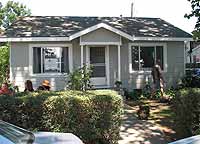
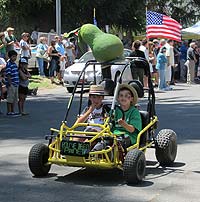
With the kids doing their own thing, we grabbed lunch from the Lockeford Sausage Co. booth and enjoyed our sausage sandwiches under the shade of the main stage tent while listening to kids take part in the duck calling contest. Then it was time to line up along the sidewalk for the 1 p.m. parade, which every year seems to set a new record for brevity. Our viewing spot on Primasing Avenue was right in front of a house that was for sale, so for the heck of it we went in to check it out. The place was a two bedroom, one bath going for $135,000. It was built in 1936, but the sellers were updating paint and floors. Still a little steep for our taste, although the idea of having a front row seat for the Pear Fair every July certainly would be a selling point. Might make a great vacation home under different circumstances.
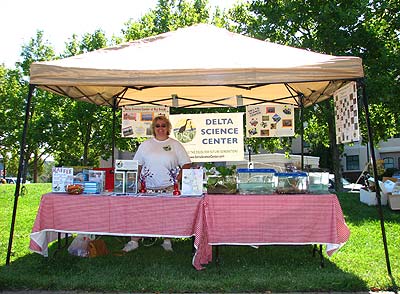
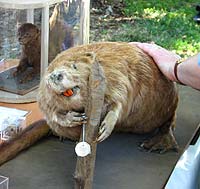
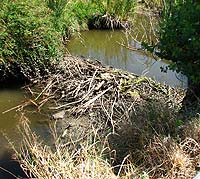
The following week, Aug. 6, found us back on the festival circuit, only this time the cause celebre was fauna rather than flora. Roni’s involvement in the Delta Science Center brought us to the Martinez Beaver Festival, which marked its fourth year of raising awareness about the beaver family that gained national attention when it built a dam in Alhambra Creek that threatened to flood the downtown. The local effort to protect the beavers and their home inspired the creation of Worth A Dam, a nonprofit educational group that puts on the festival each year.
Unlike most food fairs, the Beaver Festival is a celebration of the environment and “green” causes. There were around 30 booths set up in a small park west of the new Martinez Amtrak station representing everything from the National Parks Service and the Lindsay Wildlife Museum to the Sierra Club and a group promoting safe habitat for burrowing owls. The DSC took part because the science center is trying to reach an audience in Martinez, a place where it hasn’t had much exposure before now.
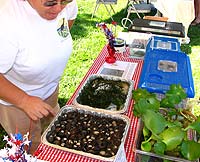
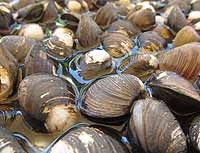
We arrived a little before 9 a.m. to set up our booth along the park pathway. The night before we had piled the canopy and tables, etc., into the back of Roni’s car so they would be ready to go. It was a simple matter of picking up a box of doughnuts for breakfast and grabbing a few fish from the local bait shop… Uh, did you say bait? Yep. The DSC had a couple small tanks of perch at the July Oakley Cityhood Celebration that proved a hit with the kids, so Roni decided to recreate the display for the Beaver Festival. She got some water weeds from the Delta, and to supplement the display she added some minnows, clams and sucker fish from the bait shop, all of which were donated.
We hauled the fish and plants to the show in a couple of orange 5-gallon Home Depot buckets, then transferred them to the smaller clear plastic tanks and hooked up air lines to each of them. We had so many clams that we had to spread some out in an aluminum pan on the table, and received all the predictable comments about needing only to add butter sauce. The clams were, well, happy as clams to be sitting in their pan of water, and every so often would emit little jets of water like kids in a watermelon seed spitting contest.
The festival ran from 10 a.m. to 4 p.m. and was well attended for such a small show. We took turns manning the booth so that each of us could explore the other booths for a few minutes and listen to some of the old-time music that was being performed by acoustic musicians on a small stage near the Alhambra Creek footbridge. Walking out on that bridge afforded a good look at the beaver dam that was the focus of attention in the news media several years ago.
Our visit to the show was fun and educational, and there were many positive comments from people getting to know the DSC and its programs for the first time. We would certainly go back to the Martinez Beaver Festival, but hopefully we can do it as spectators next time rather than participants — there is so much to see and only a limited amount of time to do it all.
Next stop for the DSC is the Oakley Almond Festival on Sept. 10-11. Maybe we’ll see you there.
Despite our unusually cool summer this year, August remains the best time for blackberries, and just about anywhere you go along the Delta right now, you will be sure to find canes loaded with fresh, black fruit. We have always enjoyed nibbling at the berries on our many walks along the Big Break Regional Trail near home, but until this summer we had never before gone out of our way to pick them in large enough quantities to do anything productive with them.
That changed Aug. 13 when Ben and Glenn decided to make it a father-son outing to gather berries off the trail in hopes of making a pie. They brought along a cooler bag with three 8-ounce plastic containers with lids. They walked along the trail to a point where it crosses a slough, along which grow acres of willow trees, water weeds and berry brambles. Someone had conveniently carved a 4-foot-wide path into the heart of this overgrowth, so it was a simple matter for Glenn and Ben to stroll along the path and pluck all the berries they could grab.
There are two varieties of blackberries: the thornless kind often found for sale at nurseries, and the wild ones that grow like barbed wire along the Delta, with razor sharp thorns that resemble cat claws. It was into these that Ben and Glenn had to reach to harvest the best berries. Glenn had brought along work gloves to protect his hands, but he soon found that the material easily snagged on the thorns and that he still got pricked through the leather. One thing the gloves did do was prevent his hands from being covered in berry juice.
Ben, meanwhile, discovered that the best berries — the ripest and plumpest ones — were to be found higher up rather than at eye level. Once he had exhausted the low-hanging fruit, he walked a bit farther up the trail until he found a dense thicket of berries that could only be accessed by climbing up one of the willow trees. He did so, and for several minutes he enjoyed quickly filling his two containers. He returned one of them to the storage bag and then went back to resume picking. As he was finishing up, he took a wrong step and slipped on the tree limb, landing flat on his back on the limb atop a thicket of berry canes, dropping the berry container to the ground in the process.
Ben was okay, fortunately, but it took some fancy maneuvering and a little assistance from Dad to get out of the berry brambles and to retrieve the fruit that had dropped to the ground in a dense thicket. The good news was that they were able to retrieve most of the lost berries and salvage Ben’s hard work.
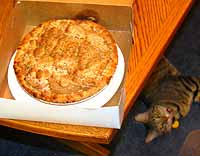
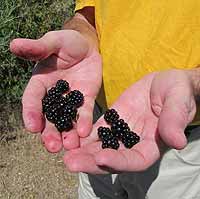
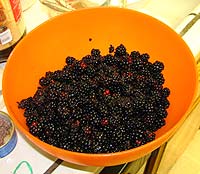
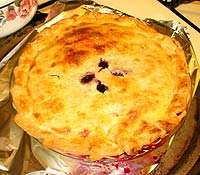
In the end, they had picked close to 24 ounces of fresh blackberries, enough to make a pie and have a few left over for freezing. Roni picked up a frozen pie crust at the store, Glenn washed the berries, then we added some sugar and tapioca pearls to the filling and baked it up. It was a very tasty pie, with just the right amount of tartness to make everyone happy. Apart from the seeds, which got stuck in our teeth at every bite, it was a perfect summer treat.